
$62M Fund Launch by Escape Velocity Targets DePIN Infrastructure Development
The funding announcement highlights venture capital's cautious re-engagement with infrastructure-focused cryptocurrency investments amid DePIN's challenges in progressing past initial token distribution phases.

Venture capital firm Escape Velocity, which specializes in cryptocurrency investments, has successfully secured approximately $62 million in capital earmarked for investments in decentralized physical infrastructure network (DePIN) initiatives, demonstrating ongoing venture capital appetite for this segment even as the broader cryptocurrency and technology funding landscape experiences a downturn.
According to an initial report published by Fortune on Thursday, this capital raise represents Escape Velocity's second investment fund specifically designed to support entrepreneurs working within DePIN and additional crypto-native industries. The fund reached its final close in December and secured backing from notable investors such as Marc Andreessen, who co-founded Andreessen Horowitz, along with Micky Malka, the founder behind Ribbit Capital.
Additionally, Cendana Capital, which operates as a venture fund-of-funds focused on investing in emerging fund managers, contributed $15 million to this investment vehicle.

According to Mahesh Ramakrishnan, who serves as co-founder of Escape Velocity, the DePIN industry continues to be significantly underdeveloped when measured against its full capabilities, a situation primarily attributable to how many recent initiatives have been structured.
A lot of what you've seen in the last three years are DePIN projects that have launched tokens before they have anything. They're launching tokens on the basis of hype and on the basis of an idea.
Mahesh Ramakrishnan, Escape Velocity co-founder, told Fortune
The disparity between promotional excitement and practical real-world applications continues to be substantial, though numerous advocates within the industry maintain the perspective that this sector is still in its nascent phases. Jeffrey Hu, who leads investment research at HashKey Capital, shared with Cointelegraph during the previous year that his organization maintains an "especially bullish" outlook regarding DePIN technologies due to their capacity to connect the physical and digital realms.
DePIN has become an overlooked sector, research shows
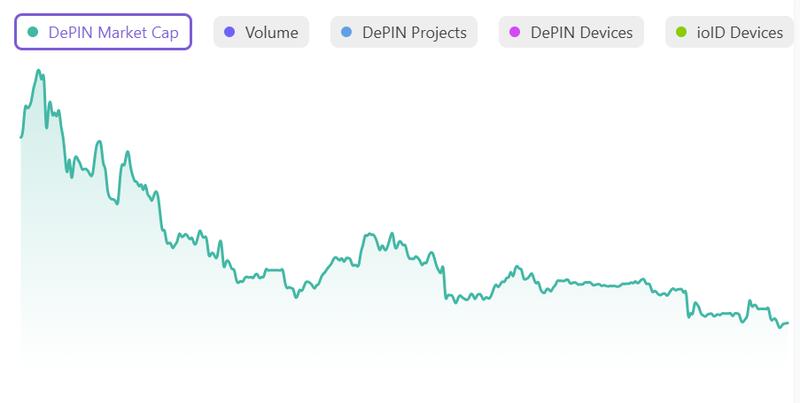
Even with widespread challenges facing the industry, a focused subset of DePIN initiatives continues to demonstrate evidence of meaningful progress. Based on the most recent "State of DePIN" report produced collaboratively by Escape Velocity and Messari, the aggregate market capitalization across the sector currently sits at approximately $10 billion, while networks within this space are projected to generate around $72 million in onchain revenue throughout 2025.
Messari described DePIN as a comparatively modest yet robust category, highlighting that networks actively producing revenue have maintained operations despite experiencing significant declines in token valuations throughout the sector.
A substantial number of tokens associated with DePIN projects currently trade between 94% and 99% below their historical peak values, illustrating the substantial disconnect between market valuations achieved during the prior market cycle and present-day adoption metrics. Nevertheless, the report indicates that a particular group of projects connected to functioning physical infrastructure has demonstrated greater sustainability than price movements alone might suggest.
Additional research findings indicate that DePIN initiatives are experiencing increased adoption momentum in regions characterized by more transparent regulatory environments and more pressing infrastructure requirements, particularly including the United Arab Emirates and Singapore. Industry analysts observe that these geographical markets frequently offer more expedited routes for implementation and strategic partnerships, supporting the perspective that DePIN technology adoption could potentially materialize beyond conventional Silicon Valley–oriented startup environments.