Zcash Orchard Privacy Technology Coming to Dash Evolution Sidechain
Dash blockchain reveals plans to incorporate Zcash's advanced privacy-focused technology into its Evolution sidechain network, with implementation targeted for March.

On Thursday, Dash—a layer-1 blockchain protocol featuring privacy-preserving capabilities—revealed plans to incorporate Zcash's "Orchard" shielded pool technology into the Dash Evolution chain. This secondary layer operates atop the L1 network and provides smart contract capabilities to the ecosystem.
According to a statement provided to Cointelegraph, the feature will become operational after cybersecurity audits are finalized, with the official rollout anticipated to occur in March.
In its initial phase, the integration will facilitate simple peer-to-peer transfers of Zcash (ZEC) on the Evolution chain. Future updates will expand Orchard's privacy-enhancing capabilities to include tokenized real-world assets (RWAs), the statement indicated.
DASH (DASH), the blockchain network's native digital asset, experienced a dramatic price increase of more than 125% throughout January. The token momentarily touched a local peak near $96 on the Binance cryptocurrency exchange before pulling back to its present trading range.
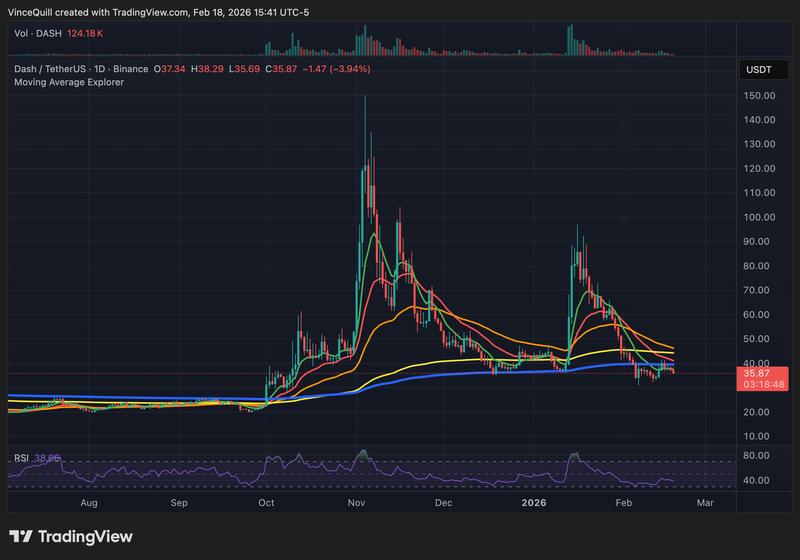
Privacy-focused blockchain protocols and their associated tokens experienced substantial growth throughout 2025 and into early 2026. Supporters of these technologies have positioned them as a necessary countermeasure against expanding financial monitoring efforts by governmental bodies and corporate entities.
Privacy gaps hindering cryptocurrency payment adoption, despite technology facing criticism
Changpeng Zhao (CZ), co-founder of the Binance cryptocurrency exchange, believes that "Lack of Privacy may be the missing link for crypto payments adoption."
According to CZ, corporate entities will remain reluctant to embrace blockchain technology until privacy-preserving mechanisms can adequately protect payment information, which frequently contains confidential details regarding employee salaries and compensation structures.
Avidan Abitbol, who previously served as a business development specialist for the Kaspa cryptocurrency project, explained to Cointelegraph that transaction records have the potential to expose critical intelligence about strategic partnerships and other proprietary business information to rival companies.
However, Agata Ferreira, an assistant professor at the Warsaw University of Technology, maintains that genuine financial privacy requires an integrated approach combining regulatory frameworks, cultural acceptance, and technological implementation, rather than merely concealing onchain metadata.
Detractors of privacy token technology, including author and Bitcoin (BTC) proponent Saifedean Ammous, contend that user anonymity remains vulnerable to compromise. They argue that ownership of privacy tokens can be traced through detailed forensic examination and law enforcement investigative techniques.

In January 2026, the Dubai Financial Services Authority (DFSA), which serves as the financial regulatory body for the emirate, issued a prohibition on privacy tokens, encompassing both ZEC and XMR (XMR), the native token of the Monero privacy protocol.
While the prohibition does not restrict citizens from maintaining ownership of these tokens, it does forbid licensed cryptocurrency exchanges from offering these assets to new customers, underscoring the ongoing conflict between government regulators and privacy-enhancing technologies.