Software and payment sector stocks plunge following Citrini's alarming AI forecast
A report from Citrini Research suggests AI agents may boost corporate profit margins while simultaneously displacing workers, resulting in a significant reduction in consumer expenditure.

On Monday, a report released by Citrini Research received partial blame for triggering significant sell-offs in software and payments stocks, as the document presented extreme projections showing how AI could fundamentally disrupt economic systems, including eliminating substantial portions of the labor force, dramatically reducing consumer expenditure, and posing risks to the United States' $13 trillion mortgage industry.
Prior to Monday, Citrini remained relatively obscure, but its "Global Intelligence Crisis" publication quickly gained traction, accumulating more than 22 million views exclusively on X, and explored the possibility that AI agents might elevate corporate profitability to such heights that human employees would become progressively obsolete, potentially triggering an economic downturn.
The publication presents an alarming projection for June 2028, depicting a scenario where the Standard & Poor's 500 experiences a 38% decline from its peak value, unemployment surpasses 10%, private credit systems begin collapsing, and prime mortgages start deteriorating — all occurring in a context where AI technology not only met but surpassed all anticipated benchmarks.

According to Citrini, a new phrase "Ghost GDP" might gain prominence, characterized as economic output that appears in national statistics but fails to flow through the "real economy."
"A single GPU cluster in North Dakota is generating output previously attributed to 10,000 Manhattan office workers," Citrini theorized in a potential June 2028 scenario.
The outcome: widespread layoffs affecting white-collar workers, substantially diminished consumer expenditure, and an economic recession, according to Citrini's assessment.
Macroeconomic instability stemming from AI developments and additional challenges, including tariffs implemented by US President Donald Trump, has negatively impacted the cryptocurrency marketplace throughout recent months, with Bitcoin (BTC) experiencing a nearly 50% decline from its $126,080 record peak achieved in early October, even as traditional safe-haven assets like gold maintain their upward trajectory.
AI, credit card stocks tank
On Monday, IBM, a computing and AI corporation, experienced its most significant single-session decline in a quarter-century, plummeting 13.1% to reach $223.35, while Microsoft, Oracle and Accenture registered decreases of 3.21%, 4.57% and 6.58%, respectively, according to Google Finance information.
Payment processing companies Visa, Mastercard and American Express also experienced declines of 4.5%, 5.77% and 7.2% following Citrini's prediction that private credit systems and software-backed lending would encounter widespread default cascades.
Market participants' concerns intensified following statements from prominent risk theory expert Nassim Taleb, who indicated that AI technology could potentially bankrupt certain software enterprises, while Anthropic announced that its Claude Code platform possesses the capability to update and modernize legacy software coded in the COBOL programming language, which currently processes substantial transaction volumes for numerous governmental bodies, financial institutions and aviation companies.
The revelations from Anthropic seemed to have a direct impact on IBM's market valuation, given that COBOL applications predominantly operate on IBM's infrastructure and systems.
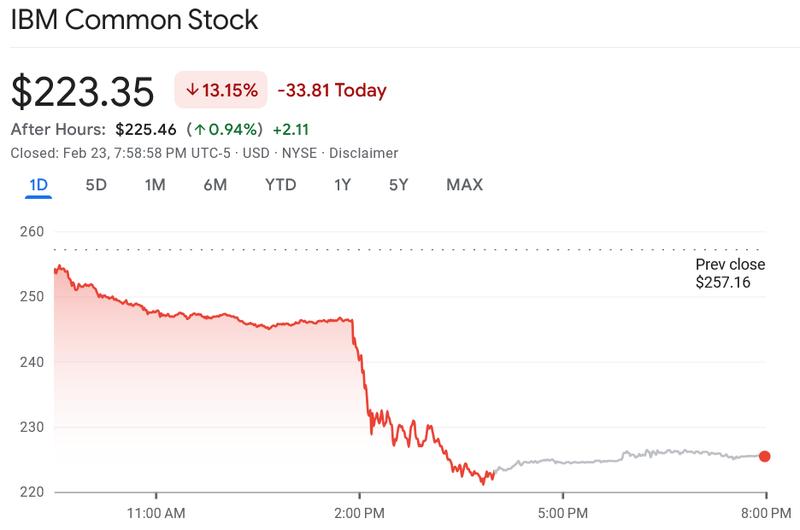
According to Citrini's analysis, the proliferation of agentic AI technologies such as Anthropic's Claude Code or OpenAI's Codex will catalyze this sweeping economic transformation, diminishing demand for human workers and compelling corporations to redirect cost savings toward increasingly sophisticated AI systems, effectively establishing a self-reinforcing cycle that hastens workforce displacement and the deterioration of consumer spending patterns.
Tech entrepreneurs say AI agents aren't worth the costs yet
Nevertheless, three multimillionaire technology investors offered recent commentary suggesting that the substantial expenses associated with implementing AI agents currently fail to warrant replacing numerous human employees, who can execute comparable tasks with equal effectiveness at lower costs.
Technology investor Jason Calacanis revealed he is currently expending $300 daily to maintain operations of a single AI agent even though it functions at merely 10% to 20% of its maximum capacity, while Chamath Palihapitiya, CEO of Social Capital, acknowledged experiencing identical challenges and stated that his AI agents would need to demonstrate productivity levels at least double that of human employees to economically justify their deployment costs.
Billionaire investor Mark Cuban characterized the economic-constraint perspective on AI agents presented by Calacanis and Palihapitiya as the most intelligent counterpoint he had encountered regarding the notion of AI technology replacing human workers.