Northern Trust launches blockchain-based share class for Treasury fund amid growing tokenization trend
The Chicago-based investment manager introduces a distributed ledger-powered option for its money market fund while blockchain-based US Treasury holdings approach the $11 billion threshold.

Northern Trust Asset Management has introduced a blockchain-enabled share class for its NIF Treasury Instruments Portfolio, representing the firm's inaugural move into the digital asset space, the company announced.
The offering leverages distributed ledger technology to create and maintain a digital representation of shareholder ownership records, even as the fund's core portfolio remains focused on investments in short-duration US Treasury securities.
The shares will debut on BNY's LiquidityDirect platform, which runs on Goldman Sachs' Digital Asset Platform, Monday's announcement revealed. The portfolio itself remains traditional in nature, neither utilizing blockchain infrastructure nor holding cryptocurrency investments. Rather, designated intermediaries will be responsible for maintaining blockchain-based ownership ledgers on behalf of their client base.
The underlying NIF Treasury Instruments Portfolio maintains a diversified allocation to short-maturity US Treasury securities and aims to preserve a constant $1.00 net asset value per share, although the fund lacks FDIC insurance protection and carries the risk of principal loss.
As the investment management division of Northern Trust Corporation, Northern Trust Asset Management oversees approximately $1.4 trillion in total assets under management as reported on Dec. 31, which includes roughly $355 billion dedicated to liquidity management strategies, company data shows.
The introduction of this new share class represents Northern Trust Asset Management's first foray into digital asset offerings, according to company statements.
Blockchain-enabled money market funds leverage distributed ledger infrastructure to digitally represent conventional money market investment vehicles, providing market participants with onchain exposure to short-duration, income-generating instruments including US Treasury securities.
Tokenized Treasurys funds expand
Money market funds utilizing tokenization have emerged as among the most meaningful use cases for blockchain infrastructure within the conventional financial services industry. Through the implementation of blockchain-based shareholder registries, these investment vehicles seek to enhance the efficiency of both settlement processes and ownership transfers.
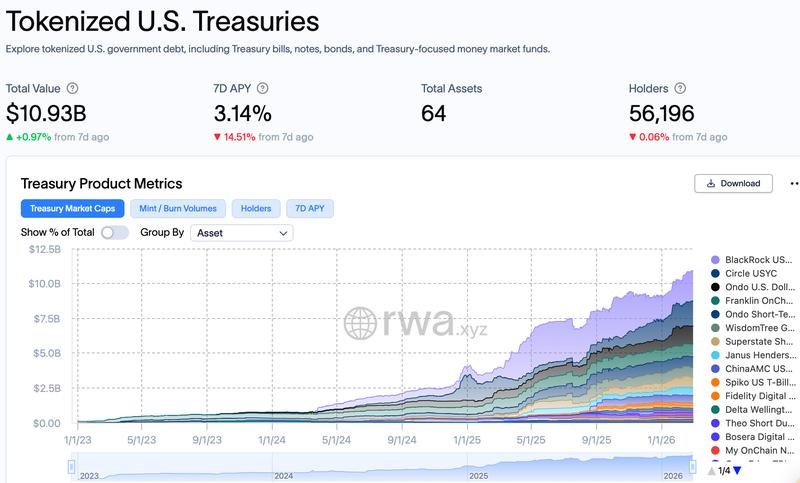
Data compiled by RWA.xyz indicates that approximately $11 billion worth of US Treasury obligations are presently tracked on public blockchain networks, establishing this asset class as the predominant category within tokenized real-world asset holdings.
Major global investment management firms command substantial market share in this emerging space. BlackRock's USD Institutional Digital Liquidity Fund maintains approximately $2.2 billion in blockchain-based Treasury exposure, with Franklin Templeton's OnChain US Government Money Fund ranking second at slightly more than $920 million.
Additional market participants have pushed the boundaries of these structures even further. WisdomTree unveiled continuous trading capabilities and immediate settlement functionality for its WisdomTree Treasury Money Market Digital Fund (WTGXX) on Feb. 24, allowing uninterrupted secondary market trading of a registered tokenized mutual fund structured under the Investment Company Act of 1940.
With the sector's continued growth trajectory, central banking authorities are scrutinizing potential systemic concerns. The Bank for International Settlements issued a cautionary assessment in November, noting that tokenized money market vehicles might create operational challenges and liquidity fragilities should investor redemptions intensify or available onchain liquidity become constrained.