IMF Report Highlights Tokenization's Efficiency Gains Alongside New Financial Risks
According to the International Monetary Fund, tokenization offers potential benefits for cross-border transactions and expanding financial access in developing markets, while raising issues related to market volatility and potential threats to "monetary sovereignty erosion."

According to the International Monetary Fund, the adoption of tokenization technology could eliminate inefficiencies and increase transparency throughout the financial system, though the agency cautioned that this same technology may generate complications that impact overall financial stability.
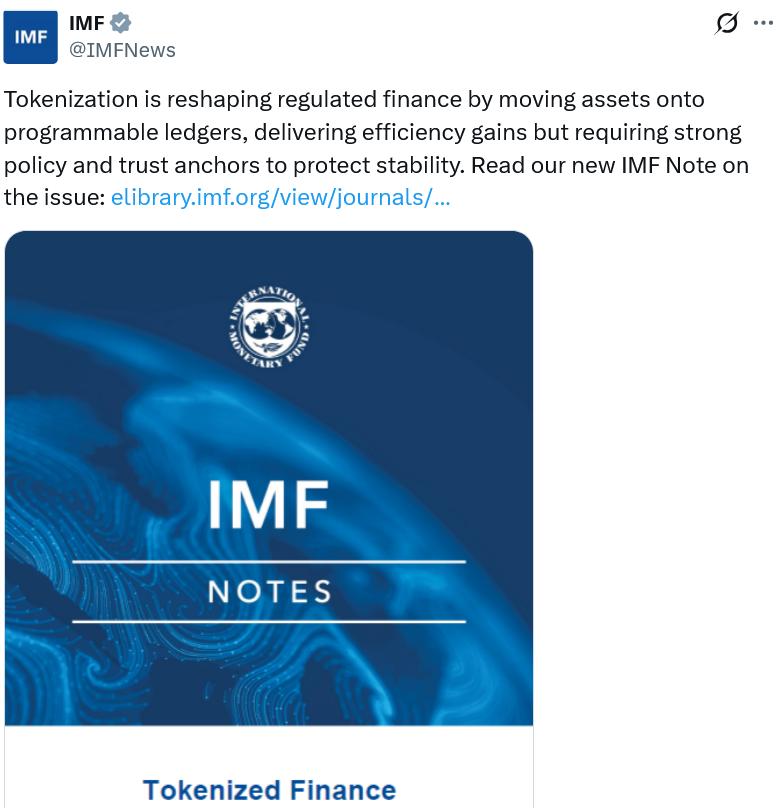
In a 23-page Thursday report, the IMF stated that "the net effect of tokenization on financial stability is uncertain," noting that while "atomic settlement and enhanced transparency reduce some traditional risks, but speed and automation introduce new ones."
Current data from RWA.xyz indicates that over $27.6 billion in real-world assets, excluding stablecoins, has been tokenized onchain. In 2022, Boston Consulting Group projected that the tokenization market might grow to $16 trillion by 2030, whereas McKinsey & Co offered a more modest forecast of $2 trillion for the same period in 2024.
While the IMF recognized that tokenization broadens the methods by which securities and various financial instruments are issued, exchanged, settled and administered, the organization noted that it transfers risks away from traditional banking systems toward shared ledgers and smart contract code.
"Stress events in tokenized markets are likely to unfold faster than in traditional systems, leaving less time for discretionary intervention."
The institution further indicated that tokenization presents opportunities for developing economies, including accelerated cross-border payments and broader financial inclusion, though it simultaneously "raises the risk of volatile capital flows, rapid currency substitution, and erosion of monetary sovereignty."
Wall Street advocates for tokenization
Major Wall Street figures, including BlackRock CEO Larry Fink, have championed blockchain tokenization, with proponents aiming to tokenize a wide range of assets from stocks and bonds to money market funds and real estate.
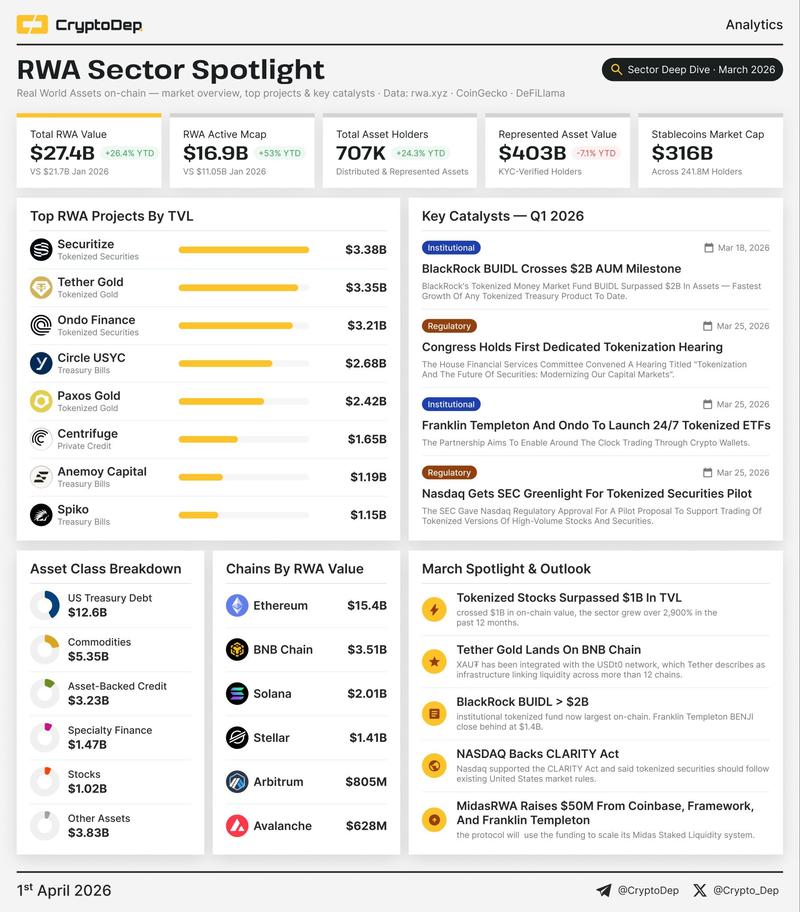
According to CryptoDep, citing April 1 data, Securitize — the tokenization platform powering the BlackRock USD Institutional Digital Liquidity Fund — holds the top position among RWA projects by total value locked at $3.38 billion.
Following closely are Tether Gold and Ondo Finance with $3.35 billion and $3.21 billion, respectively.
Intercontinental Exchange, the parent company of the New York Stock Exchange, is also moving forward with initiatives in this space, revealing in January plans to introduce a tokenization platform enabling round-the-clock trading and instantaneous settlement of stocks and exchange-traded funds through a blockchain-based post-trade system.
Nevertheless, the IMF highlighted that legal complications represent another significant barrier, explaining that tokenized markets could remain "fragmented and peripheral" without clear legal frameworks governing ownership records and settlement finality.
The cryptocurrency sector has been working on solutions to tackle this issue, including the Ethereum ecosystem's ERC-3643 permissioned token standard, which guarantees that only specific investors can access tokenized products.
On March 20, Coinbase Asset Management introduced tokenized shares for the Coinbase Bitcoin Yield Fund on Ethereum layer 2 Base, collaborating with financial services firm Apex Group, which applied the ERC-3643 standard to verify that token holder identity and eligibility met compliance requirements.