Ex-Mt. Gox Chief Proposes Controversial Bitcoin Hard Fork to Retrieve 80,000 Stolen BTC
Mark Karpelès, who previously led Mt. Gox, has put forward a Bitcoin hard fork proposal aimed at retrieving 80,000 BTC lost in a 2011 security breach, igniting controversy over Bitcoin's core principle of immutability.

Mark Karpelès, who once served as the chief executive of the defunct Mt. Gox exchange, is seeking backing from the cryptocurrency community for an initiative designed to retrieve over $5.2 billion in Bitcoin that was stolen from his platform more than ten years ago.
Last Friday, Karpelès put forth a proposal through GitHub that would introduce a new consensus rule enabling the 79,956 Bitcoin stolen from Mt. Gox (which remain in a single wallet address) to be transferred to a designated recovery address without requiring access to the original private key.
"These particular coins have remained stationary for more than 15 years. They represent some of the most widely recognized and publicly monitored UTXOs in the entire history of Bitcoin," Karpelès stated in his proposal.
According to Karpelès, considering that Mt. Gox trustee Nobuaki Kobayashi is already managing the distribution process to creditors, should the coins become recoverable, the current legal and operational infrastructure is in place to ensure they reach their legitimate owners.
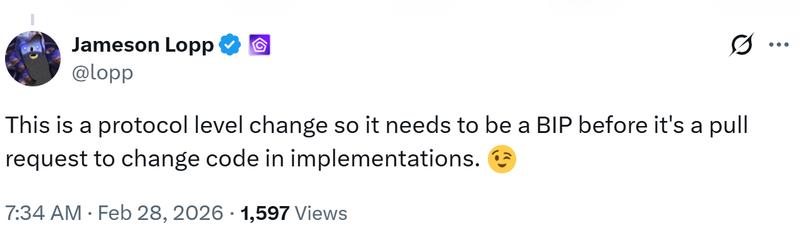
"I want to be completely transparent: this proposal constitutes a hard fork. It would validate a transaction that is currently invalid. Every node in the network would require an upgrade prior to the activation height. I'm not attempting to hide this fact or present it as something different," Karpelès emphasized.
Nonetheless, Karpelès clarified that his proposal wasn't designed to circumvent the established Bitcoin development procedures; rather, it was meant to initiate meaningful dialogue within the Bitcoin community.
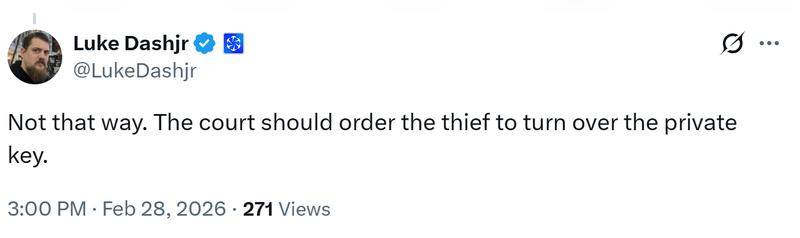
"The trustee overseeing MtGox has refused to pursue recovery through on-chain methods, pointing to the lack of certainty regarding whether such a consensus modification would ever gain adoption," Karpelès explained.
"This situation creates a circular problem: the trustee refuses to take action without guaranteed certainty, while the community cannot properly assess the concept without having a specific proposal to review. This patch resolves that impasse by offering something tangible for discussion."
Bitcoin immutability at risk, say critics
The proposal put forward by Karpelès encountered significant resistance on Bitcointalk, an online discussion forum, with the majority of commenters contending that it would establish a dangerous precedent for Bitcoin, a decentralized digital currency designed to be irreversible and unchangeable.
"Every time a hacking incident [happens], someone will call for another new consensus rule to recover stolen funds. This will destroy the bitcoin concept in full," commented "coupable," a forum participant who has been active since 2015.
"Bitcoin should be independent from what Law Enforcement decides in any [jurisdictions]," another community member identified as "PrivacyG" stated.
Karpelès conceded that this would represent the most compelling argument in opposition to his proposal, though he countered that this particular situation is sufficiently unique, given that there exists both law enforcement documentation and broad community agreement that the wallet address in question holds Bitcoin that was stolen from Mt. Gox.
Several individuals claiming to be victims of the Mt. Gox bankruptcy expressed support for the proposal.
"If those coins ever move by whatever mechanism, then I am going to want my share of them back," a user named Samson wrote.
"I'm a creditor and have been paid what little was left of my Bitcoin from the bankruptcy - I got about 15% back… I would support obtaining a court order to claim these coins."
A brief recap of Mt Gox's collapse
Mt. Gox was at one point the largest Bitcoin exchange in existence, functioning from 2010 through 2014 and processing 70% of all Bitcoin transactions across the globe.
However, its worldwide prominence made it an attractive target for cybercriminals, who exploited vulnerabilities in Mt. Gox's security infrastructure in 2011 to steal thousands of Bitcoin, while additional operational failures resulted in thousands more Bitcoin being "lost."
On Feb. 24, 2014, a purportedly leaked internal document alleged that the company had become insolvent following the loss of 744,408 Bitcoin in a theft that had gone undetected for an extended period.
The exchange sought bankruptcy protection in Tokyo on Feb. 28, 2014, disclosing that it faced approximately $65 million in liabilities after losing 750,000 Bitcoin belonging to its customers and 100,000 of its own holdings, which were valued at nearly half a billion dollars at that time.