Ethereum's Vitalik Buterin advocates for AI integration in DAO decision-making systems
The Ethereum co-founder has put forward the idea that large language models and other AI technologies could enhance the effectiveness of decentralized autonomous organization governance structures.

Vitalik Buterin, who co-founded Ethereum, believes that the integration of artificial intelligence technology has the potential to develop more effective decentralized governance frameworks and empower participants to make decisions with greater knowledge and understanding.
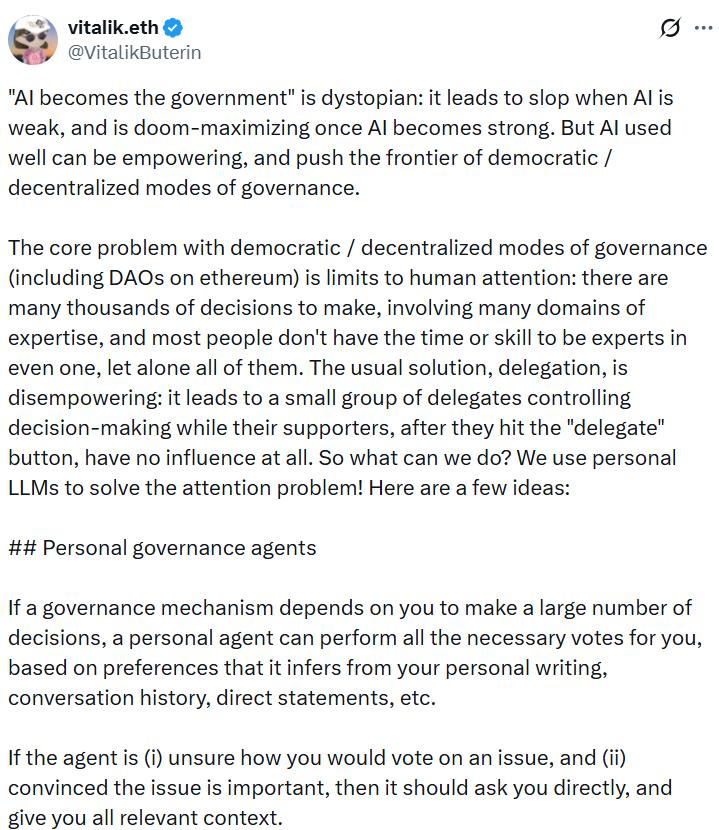
In a post shared on X this past Sunday, Buterin explained that among the primary challenges facing democratic and decentralized governance structures, such as DAOs, is the inherent "limits to human attention," stemming from the numerous decisions that often demand diverse areas of expertise or significant time commitments, resources that most individuals simply don't possess.
"The usual solution, delegation, is disempowering it leads to a small group of delegates controlling decision-making while their supporters, after they hit the delegate button, have no influence at all," he said.
According to estimates, participation rates among members of DAOs typically hover somewhere between 15% and 25%. Such low engagement levels can create problems including the concentration of authority among few participants and suboptimal decision-making processes. In the most severe situations, this can open the door to governance attacks, scenarios where malicious actors accumulate sufficient token holdings to approve harmful proposals while remaining undetected by other community members.
AI-powered assistants that vote for you
Buterin's proposal centers on the use of personal assistant large language models (LLMs) as a potential remedy for the "attention problem" by supplying users with all the pertinent information necessary to make informed voting decisions.
"If a governance mechanism depends on you to make a large number of decisions, a personal agent can perform all the necessary votes for you, based on preferences that it infers from your personal writing, conversation history, direct statements," he said.
"If the agent is unsure how you would vote on an issue, and convinced the issue is important, then it should ask you directly, and give you all relevant context," Buterin added.
According to Lane Rettig, who serves as a researcher at the Near Foundation with a focus on AI and governance, he informed Cointelegraph in the previous year that the non-profit organization had been developing a comparable concept: AI-driven digital twins designed to cast votes on behalf of DAO participants as a way to tackle the problem of low voter turnout.
Privacy an important aspect to preserve
Buterin pointed out that another obstacle emerges in highly decentralized governance systems when critical decisions hinge on private or confidential information, particularly in situations involving negotiations, internal conflicts, or allocation of funds.
"Typically, orgs solve this by appointing individuals who have great power to take on those tasks," he said.
Buterin went on to suggest that an alternative approach could involve users submitting their "personal LLM into a black box, the LLM sees private info, it makes a judgment based on that, and it outputs only that judgment. You don't see the private info, and no one else sees the contents of your personal LLM."
"All of these approaches involve each participant making use of much more information about themselves, and potentially submitting much larger-sized inputs. Hence, it becomes all the more important to protect privacy," Buterin said.