ETH Price Faces Sub-$1.5K Drop Risk as Vitalik Accelerates Token Sales
With more than 7,000 ETH remaining in Ethereum's co-founder's wallet for potential liquidation, this supply pressure threatens to drive prices even lower in upcoming sessions.

Ether (ETH), the native cryptocurrency of the Ethereum network, appears poised to challenge and possibly breach the critical $1,500 support threshold in upcoming trading sessions.
Key takeaways:
- The world's second-largest cryptocurrency has moved into the breakdown stage of its ongoing bearish continuation formation.
- Price action in ETH could fall beneath $1,500 before early March concludes, driven by selling pressure from its founder.
Bear pennant breakdown points to $1,475 target for ETH
During Monday's trading session, ETH experienced a decline exceeding 5.60%, settling around the $1,850 level as markets responded to broader risk-off conditions fueled by concerns over potential tariff implementations.
Through this price movement, the leading alternative cryptocurrency penetrated below its prevailing bear pennant formation's lower boundary, while increased trading volumes suggested strong trader commitment supporting the breakdown.
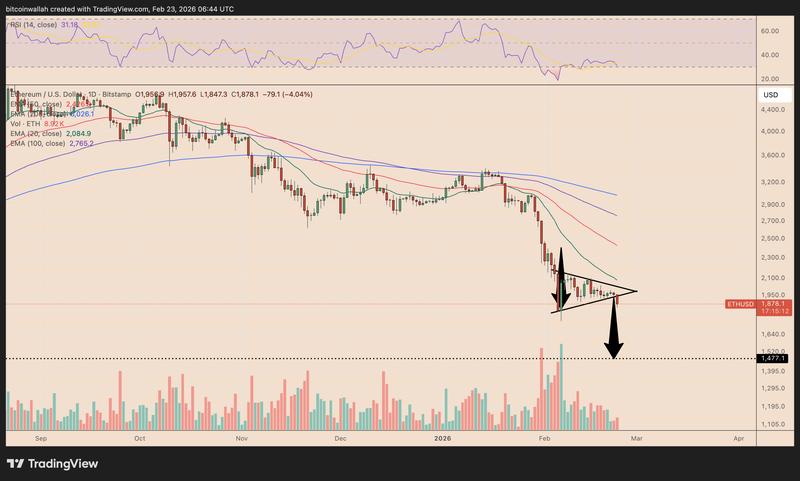
When bear pennant patterns complete their breakdown phase, prices typically decline by a distance equivalent to the preceding downward trend's measured height.
Using this technical methodology on ETH's current chart configuration suggests a potential downside objective of $1,475, positioned near the psychologically significant $1,500 level, with this target potentially materializing before February ends or during early March.
For the bullish case to gain traction, buyers must successfully recapture the pennant formation's lower boundary as a support level, then continue their advance beyond the 20-day exponential moving average (20-day EMA, represented by the green line) currently positioned at $2,085, which would negate the prevailing bearish scenario.
Additional ETH liquidations from Vitalik Buterin appear imminent
Scheduled token sales from Ethereum's co-creator Vitalik Buterin have provided no assistance to bullish traders attempting to establish positive momentum throughout February.
On Jan. 30, Buterin announced his intention to extract and liquidate 16,384 ETH through his Kanro entity, with proceeds designated for supporting ecosystem development, open-source software projects and various long-term strategic initiatives amid an "mild austerity" period at the Ethereum Foundation.
Beginning in early February, blockchain monitoring service Arkham Intelligence has documented roughly 9,000 ETH sold through multiple transactions, with the liquidation rate accelerating once more during the previous 48-hour period following a 3,500 ETH withdrawal from the Aave protocol.
According to onchain analytics platform Lookonchain, Vitalik Buterin "is selling ETH faster again," as noted in their Monday report.
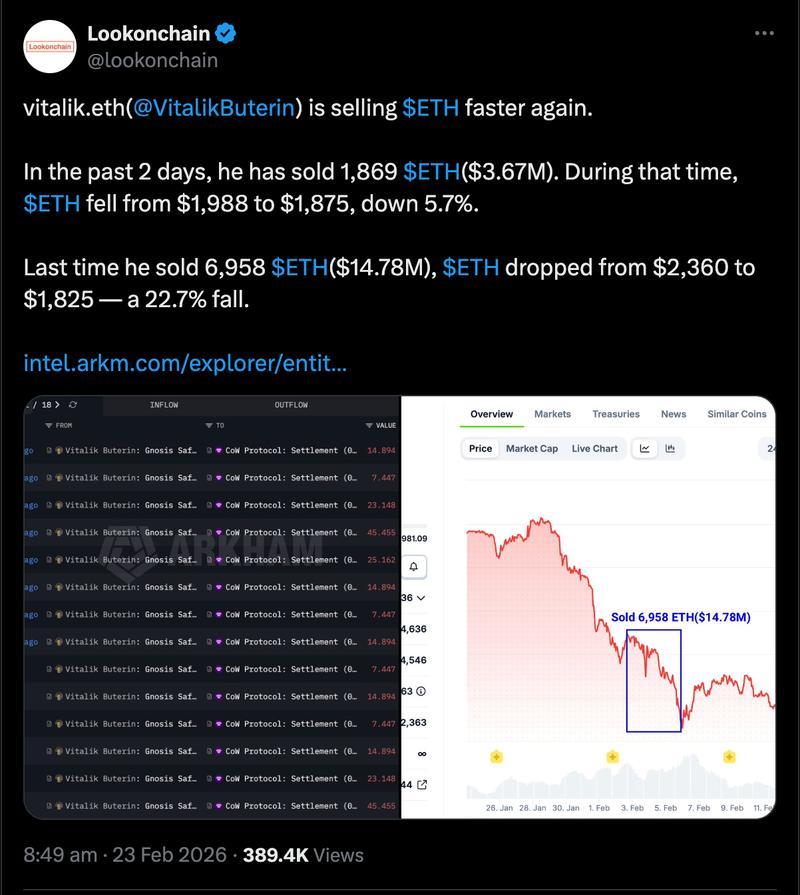
Throughout February, Ethereum's valuation has experienced an 18.55% decline, coinciding temporally with Buterin's systematic token distribution. This selling pressure may intensify should he proceed to liquidate the approximate 7,350 ETH currently remaining.
Historical patterns demonstrate how supply movements connected to founders, including treasury transactions from the Ethereum Foundation, tend to magnify negative market sentiment among market participants.
As an example, when 35,000 ETH (valued at approximately $125 million during that period) were transferred during May 2021, this movement came before a 50% price collapse in ETH occurring over the following weeks.
Subsequently, the foundation executed another transfer of 20,000 ETH ($95 million in value) to the Kraken exchange on Nov. 11, 2021, an action that retrospectively aligned with Ether reaching its peak price near $4,700 before beginning its subsequent downward trajectory.
These historical precedents further strengthen the probability that ETH will achieve its pennant formation target beneath $1,500 during the approaching trading days.
This article does not contain investment advice or recommendations. Every investment and trading move involves risk, and readers should conduct their own research when making a decision.