ECB Leadership Transition and Digital Euro Project Face Uncertainty as Lagarde Considers Departure
Reports suggest Christine Lagarde, President of the European Central Bank, may depart before her term concludes, coinciding with a pivotal period for the European Union's digital euro initiative.

Christine Lagarde, who currently serves as President of the European Central Bank (ECB), may be contemplating a departure prior to the conclusion of her eight-year tenure, which is scheduled to end in October 2027, according to a Financial Times report that cited an individual "familiar with her thinking."
The report, published Wednesday by the FT, indicates that Lagarde—who assumed her position in November 2019—is evaluating the possibility of an earlier exit timed before France's presidential election in April 2027, which would allow outgoing French President Emmanuel Macron and German Chancellor Friedrich Merz the opportunity to reach consensus on her replacement.
However, a spokesperson for the ECB contested the report's accuracy when responding to Cointelegraph, stating: "President Lagarde is totally focused on her mission and has not taken any decision regarding the end of her term."
ECB navigates digital euro and MiCA-era stablecoins
Should she decide to leave early, her departure would occur during a particularly critical juncture for the ECB's digital strategy and initiatives.
Throughout Lagarde's tenure, the ECB has advanced preliminary development work for a digital euro while consistently emphasizing the importance of controlling risks associated with privately issued digital currencies, including stablecoins, under the framework of the newly implemented European Union Markets in Crypto Assets Regulation (MiCA) regime.
Officials at the ECB have issued warnings that the rapid expansion of stablecoins could present threats to financial stability and create challenges for monetary policy implementation across the euro area, despite the protective measures built into MiCA, and have advocated for establishing a robust marketplace for properly regulated stablecoins denominated in euros that are capable of competing effectively with dollar-based tokens.
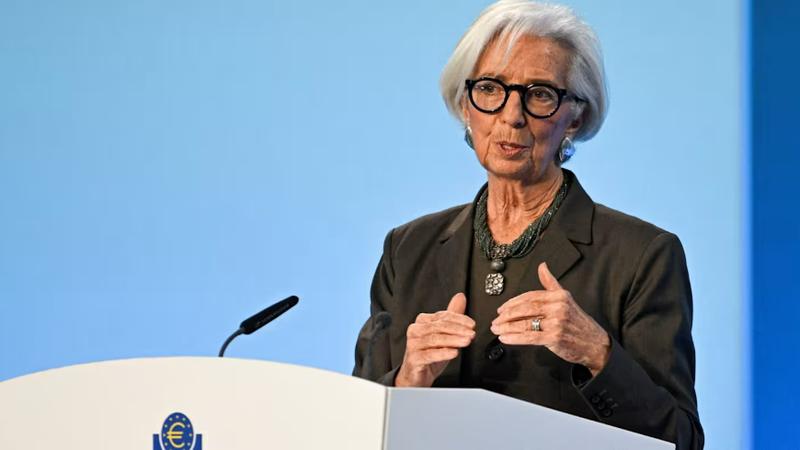
Lagarde has personally been an outspoken skeptic of Bitcoin (BTC) and alternative crypto assets, characterizing them as "highly speculative," and stating during a 2022 television interview that cryptocurrency is "worth nothing" and lacks any underlying assets, reiterating this position even when BTC approached all-time highs in November 2025.
Consequently, a leadership transition at the ECB could influence the institution's public messaging regarding, and the priority level assigned to, matters including the digital euro initiative, stablecoin supervision and crypto-related payment systems, notwithstanding the fact that the broader regulatory framework is established at the EU level.
Shortlist to replace Lagarde shares cautious line on crypto
In a December poll of economists conducted by the FT, Spain's previous central bank governor Pablo Hernández de Cos and his former Dutch counterpart Klaas Knot emerged as frontrunners to succeed Lagarde, while Isabel Schnabel, who serves on the ECB executive board, and Joachim Nagel, president of the Bundesbank, were also identified as viable candidates.
Each of these four individuals has adopted reserved positions regarding cryptocurrency. During previous public addresses, Hernández de Cos has characterized crypto assets and stablecoins as presenting financial stability concerns that necessitate stringent regulation and supervisory oversight, whereas Knot has advocated for establishing a comprehensive global regulatory framework addressing crypto and stablecoins.
Nagel has connected the digital euro initiative to the preservation of European monetary and financial sovereignty, and has referred to Bitcoin as a "digital tulip" that is "anything but transparent," issuing warnings against considering Bitcoin suitable as a reserve asset.
Schnabel has previously characterized Bitcoin as a "speculative asset without any recognizable fundamental value."
Digital euro timeline hinges on EU lawmakers
The digital euro initiative remains dependent on approval from EU lawmakers, although the ECB has progressed into a technical preparation phase and is establishing partnerships to guarantee that the digital euro will be universally accessible to everyone.
Following the establishment of the legal framework, which could potentially occur in 2026, a pilot phase might commence as soon as 2027, with the Eurosystem targeting a timeline that would position them to conduct an initial issuance approximately around 2029.