Cryptocurrency Investment Opportunities Contracting, According to NYDIG Analysis
According to NYDIG's Greg Cipolaro, investor appeal is limited to just a few crypto applications, suggesting the industry should reconsider its expansive 'web3' vision.

As the cryptocurrency industry continues to evolve and reach maturity, the range of crypto applications capable of drawing in investors is beginning to contract, though this trend might actually benefit the sector by highlighting its sustainable long-term champions, according to analysis from NYDIG.
In a Friday note, Greg Cipolaro, who leads research at NYDIG, indicated that crypto's "investable universe" is consolidating around applications or services that primarily "extend traditional finance products onto blockchain infrastructure."
Among the specific examples he cited were Bitcoin (BTC), tokenized assets, stablecoins, certain decentralized finance infrastructure, and a select number of "general-purpose" blockchains like Ethereum, while noting that outside these particular use cases, "the probability of large-scale blockchain applications appears lower than previously assumed."
While some cryptocurrency industry leaders had previously championed blockchain technology as a potential alternative to virtually every existing service offering, numerous previously-hyped use cases in crypto, including gaming, social networking, and the metaverse, have failed to deliver results when compared with their centralized counterparts.
According to Cipolaro's analysis, this outcome stems from the fact that centralized systems "will always be faster, cheaper, and operationally more efficient for the vast majority of enterprise and consumer applications."
Economically viable apps will be slimmer than expected
According to Cipolaro's assessment, the "space for economically viable blockchain applications is narrower than early narratives hoped," with his argument centered on the premise that only those use cases where blockchain's advantages exceed its drawbacks will ultimately endure.
The core attributes of open blockchains, trustlessness, permissionlessness, and censorship resistance, are uniquely suited to money and money-like (financial) applications. Most real-world applications do not require global, permissionless state machines with immutable ledgers.
The current state of the market reflects this reality, Cipolaro noted, pointing to Bitcoin's increasing dominance while altcoins have attracted minimal investment capital owing to a "limited emergence of durable new narratives."
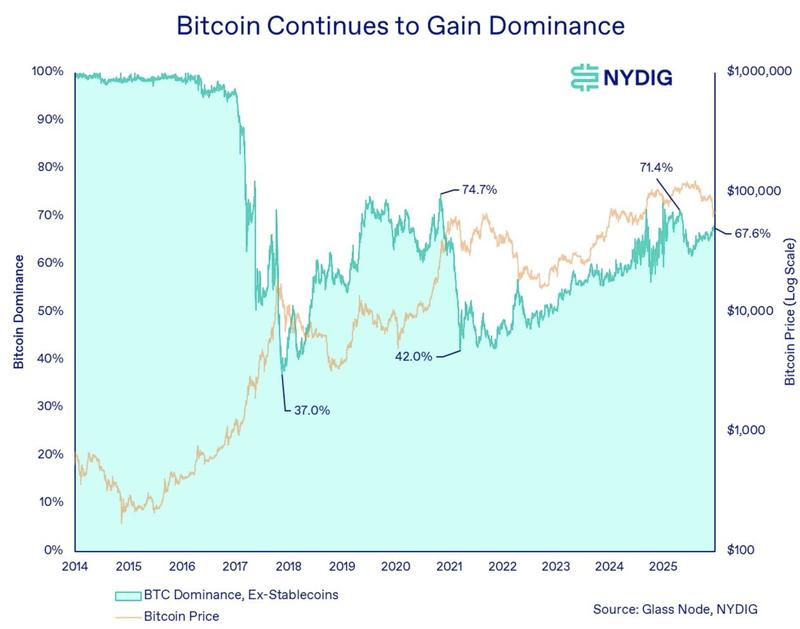
The failure of many non-financial verticals to gain traction suggests a consolidation of capital toward a smaller set of use cases. Rather than an explosion of applications, we are observing capital concentrate in a few core categories.
This narrowing trajectory in viable use cases has the potential to "improve durability and clarity around long-term winners," particularly for Bitcoin and certain projects connected to financial infrastructure, according to Cipolaro's analysis.
On the flip side, this trend might also diminish the "speculative breadth" available within the cryptocurrency market and limit the capital that has historically flowed into alternative assets, he further noted.
A more sober market, anchored in monetary and financial utility rather than broad 'web3' ambition, may ultimately strengthen core assets, but it also implies that crypto's total addressable scope could be materially smaller than once projected.