Critical XRP Ledger vulnerability stopped just before mainnet deployment
A combination of artificial intelligence technology and human expertise discovered a severe security flaw in the XRP Ledger that could have facilitated the theft of user funds prior to being neutralized through urgent corrective measures.

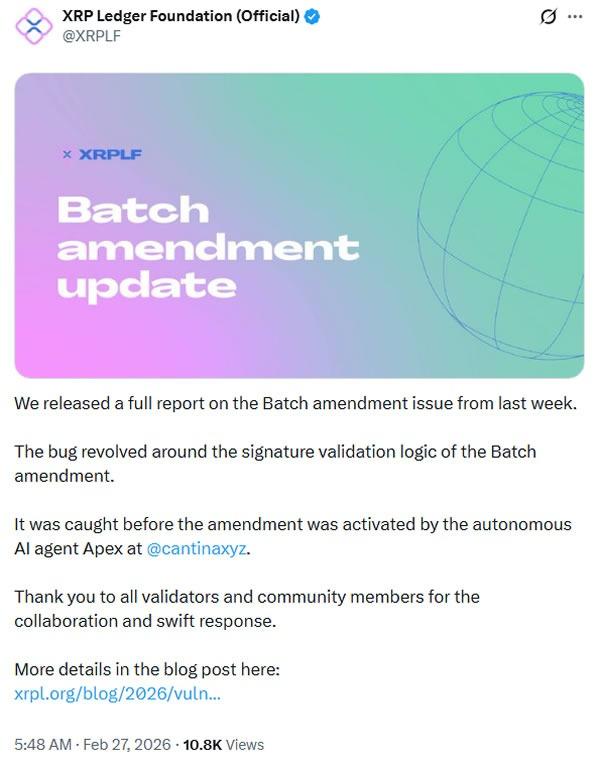
The XRP Ledger Foundation has officially announced the successful patching of a severe security vulnerability discovered within a pending amendment to Ripple's XRP Ledger, successfully preventing what could have become a significant security breach.
According to the XRP Ledger Foundation's announcement on Thursday, Pranamya Keshkamat, who serves as a security engineer at the cybersecurity company Cantina, alongside Cantina's AI-powered security bot, uncovered a "critical logic flaw" within Ripple's blockchain platform, the XRP Ledger, on February 19.
The security weakness present in the batch amendment's signature validation code would have provided malicious actors with the capability to carry out transactions originating from targeted user accounts, potentially leading to the complete draining of their funds, all without requiring access to the victim's private keys.
"The amendment was in its voting phase and had not been activated on mainnet; no funds were at risk," stated the XRPLF.
Exploitation may have destabilized the ecosystem
Beyond just the possibility of fund theft and unauthorized alterations to the ledger state, the security flaw had the potential to "destabilized the ecosystem," according to the XRPLF's statement.
"A successful large-scale exploit could have caused substantial loss of confidence in XRPL, with potentially significant disruption for the broader ecosystem."
Hari Mulackal, serving as CEO of both Cantina and Spearbit, stated that "our autonomous bug hunter, Apex, found this critical bug."
"Had this been exploited, it would have been the largest security hack by dollar value in the world, with nearly $80 billion at direct risk," he added, possibly referring to XRP market capitalization.
Emergence of AI cybersecurity scanners
Cantina AI's autonomous artificial intelligence security platform detected the vulnerability through "static analysis of the rippled codebase," subsequently submitting a disclosure report that enabled the Ripple engineering teams to confirm its existence and initiate the code patching process.
The XRPLF indicated that validators received guidance to vote against the amendment in question, while an emergency software release (rippled 3.1.1) was made available on Feb. 23 with the purpose of preventing the amendment's activation.
Artificial intelligence technology is seeing growing adoption in the cybersecurity field for the purpose of detecting code vulnerabilities that might escape detection by human reviewers.
On Feb. 20, Anthropic launched Claude Code Security, its artificial intelligence-powered cybersecurity vulnerability scanning tool, which the company asserts "can reason like a skilled security researcher," resulting in a decline in publicly traded IT security company stock prices.