Coinbase Executive Faces Lords Scrutiny Over Stablecoin Risks and Regulatory Concerns
British legislators questioned whether stablecoins pose deposit flight and financial stability threats, as Coinbase and Innovate Finance cautioned that overly stringent regulations could push innovation to other jurisdictions.

On Wednesday, the United Kingdom's House of Lords subjected Coinbase's senior international policy official to intensive questioning regarding the potential for stablecoins to siphon deposits from traditional banks and introduce fresh vulnerabilities to Britain's financial infrastructure, examining issues ranging from bank runs reminiscent of Silicon Valley Bank to money laundering and Know Your Customer (KYC) compliance protocols.
Throughout the Lords' examination into stablecoins, Tom Duff Gordon, who serves as Coinbase's vice president for international policy, maintained that properly reserved and regulated stablecoins were "safer than uninsured bank deposits" due to their one-to-one backing by cash reserves and premium government securities, with the ability to be redeemed at face value.
According to his testimony, stablecoins possess the potential to significantly lower payment expenses, accelerate international money transfers, and support emerging artificial intelligence powered "agentic" payment systems.
Duff Gordon rejected claims that Coinbase was attempting to circumvent KYC requirements and cautioned that excessively restrictive proposals from the Bank of England and Financial Conduct Authority (FCA) regarding capital requirements, holding restrictions and rewards risk could suffocate competition. Such an approach, he contended, would position the UK behind both the United States' Guiding and Establishing National Innovation for US Stablecoins (GENIUS) Act framework and Europe's Markets in Crypto Assets Regulation (MiCA) structure in the worldwide competition to capture stablecoin innovation.
Lords probe deposit drain and crime concerns
Members of the Lords continuously pressed Duff Gordon regarding who ultimately shoulders redemption risk during periods of crisis, whether existing frameworks simply transfer risk from traditional banks to non-banking issuers, and whether permitting rewards on stablecoins might provoke a "deposit drain" from Britain's banking institutions.
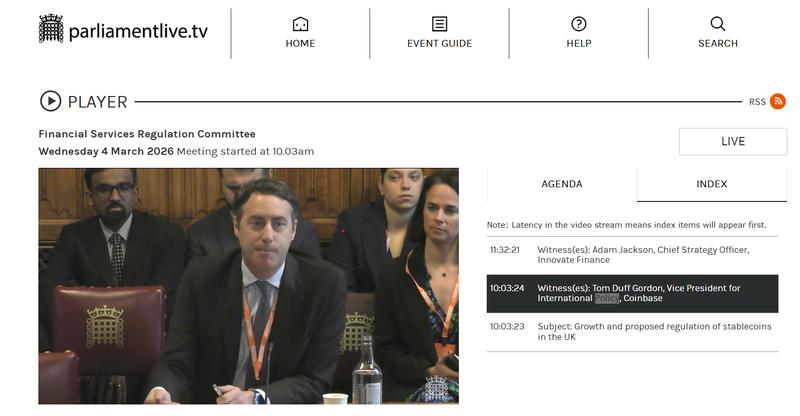
Duff Gordon responded by asserting that anxieties surrounding disintermediation and credit creation were "wildly exaggerated," noting that stablecoins have already been adopted by significant corporate entities and card networks to reduce payment expenses.
Members of the committee additionally voiced apprehensions about stablecoins' involvement in criminal activity, which led Duff Gordon to highlight Coinbase's implementation of KYC, Anti-Money Laundering (AML), and sanctions screening procedures for customers, while contending that blockchain transparency combined with exchange-level oversight mechanisms could facilitate, rather than complicate, the monitoring of illegal transactions when compared to conventional cash systems.
UK could fall behind in stablecoin race
Adam Jackson, who holds the position of chief strategy officer at Innovate Finance, an independent industry body for the UK financial technology sector, contended that Britain was in danger of creating a framework that was "more prescriptive and less competitive" than the European Union's MiCA regulations. "We risk being second movers but second movers who are less competitive than the first movers," he cautioned.
The session represented a stark departure from the committee's preceding hearing, during which skeptics including Financial Times commentator Chris Giles and US law professor Arthur E. Wilmarth Jr voiced their skepticism regarding whether stablecoins would emerge as a widely adopted form of currency in the UK and supported a more stringent Bank of England regulatory stance.
Wilmarth Jr took his criticism further by characterizing the US's GENIUS Act as a "disastrous mistake" for permitting non-banking entities into "the money business."