British Gambling Watchdog Considers Cryptocurrency Payment Integration for Online Gaming
Britain's Gambling Commission is examining possibilities for enabling cryptocurrency transactions at online gaming platforms as part of the FCA's upcoming digital asset licensing system, scheduled for implementation in 2027.

Britain's Gambling Commission is investigating potential pathways for integrating digital currencies as payment methods at authorized online gaming establishments, as the nation moves toward implementing comprehensive regulatory oversight of cryptocurrency operations under the Financial Conduct Authority's (FCA) supervision.
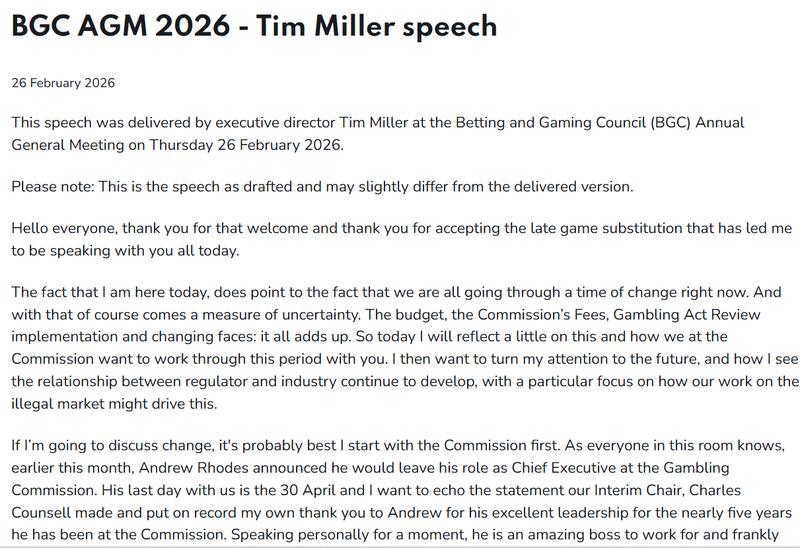
On Thursday, Tim Miller, who serves as the commission's executive director for research and policy, indicated that the regulatory body aims to investigate "the potential path forward" for permitting "cryptoasset to be used as a consumer payment option for licensed and regulated gambling in Great Britain." These statements were delivered during Miller's address at the Betting and Gaming Council's annual general meeting held in London, as documented in his official published remarks.
Entities engaged in regulated cryptocurrency operations will need to obtain proper authorization from the FCA in accordance with the Financial Services and Markets Act 2000 (FSMA) once the new regulatory framework becomes operational, Miller explained.
"And that, as well as the growing appetite we see from punters, means we do now want to start looking at what the potential path forward would be to create a way for cryptoasset to be used as a consumer payment option for licensed and regulated gambling in Great Britain."
Regulatory body requests industry representatives to outline potential approaches
According to Miller, he has asked the Industry Forum, which serves as an advisory body comprised of gambling industry stakeholders, to investigate optimal approaches for integrating digital currency payment options, though no specific timeframe has been established for completion.
Miller indicated that enabling cryptocurrency transaction methods could serve as a protective measure for British consumers against unauthorized gambling platforms.
"Our illegal markets research also gives us evidence that crypto is one of the two biggest searches that lead British gamblers to illegal sites," Miller stated, further noting that this initiative could represent a significant consumer protection advancement.
Nevertheless, Miller emphasized that permitting digital currency payments should not be interpreted as regulatory approval for crypto-based casinos themselves, since such operations would face considerable challenges in meeting customer suitability verification requirements mandated by UK lawmakers.
Financial regulator establishes 2027 target date for new digital asset framework rollout
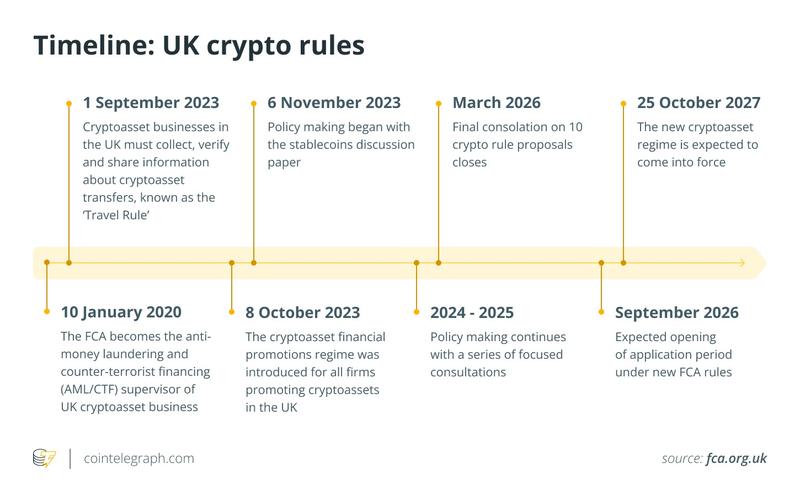
These statements arrive on the heels of recent regulatory announcements from the FCA, which has published its final consultation document outlining 10 proposals addressing cryptocurrency market operations. The financial watchdog anticipates completing this consultation phase in March, with comprehensive implementation planned for October 2027.
Earlier in January, the FCA established a definitive schedule for its forthcoming crypto authorization system, mandating that companies obtain complete authorization prior to the regime's official launch on Oct. 25, 2027, as previously reported by Cointelegraph.
"We expect the application period will open in September 2026," the FCA stated in documentation released on Jan. 8.
Crypto asset service providers (CASPs) that fail to submit applications within this designated timeframe will be subject to transitional provisions, which permit continuation of currently offered products while imposing limitations on launching new services.