Bitcoin Weathers Geopolitical Storm: Five Key Insights for the Week Ahead
Despite sidestepping an Iran-related selloff at March's opening, Bitcoin traders anticipated BTC price levels might collapse under persistent bearish pressures.

As March 2026 begins its first week, Bitcoin (BTC) finds itself in a holding pattern while unprecedented geopolitical turmoil unfolds across global markets.
- Despite a fresh conflict erupting in the Middle East, Bitcoin manages to escape significant volatility, though trader sentiment remains far from optimistic.
- Extended BTC price trend analysis points toward a new $45,000 downside objective.
- The week's macroeconomic spotlight centers on Iran-related tensions as experts reject notions of "World War Three."
- Escalating inflation concerns might motivate the US to conclude the Iran military operation swiftly.
- After an extended period of withdrawals, Bitcoin institutional capital flows are showing early signs of a significant reversal.
Bitcoin withstands Iran conflict emergence — temporarily
Bitcoin's price movement resisted the temptation to plunge despite the Iran military action unfolding during weekend hours characterized by thin market liquidity.
According to TradingView data, a dip approaching $63,000 represented the peak of the initial market response before prices staged a persistent recovery.
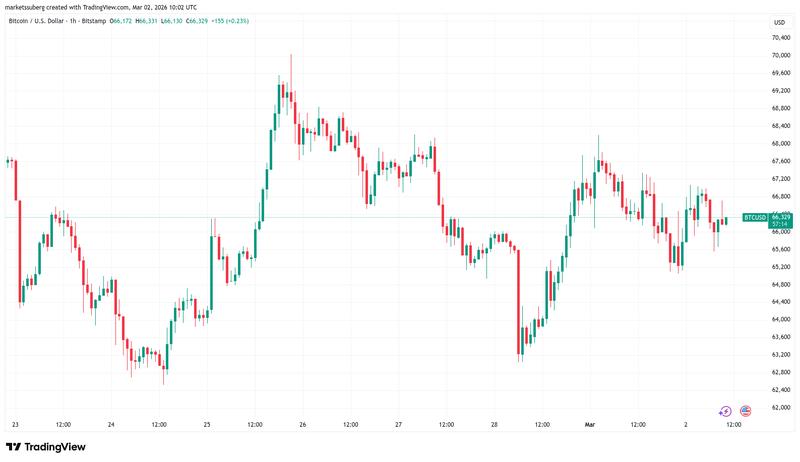
Presently, market participants perceive ongoing developments as leaning toward cryptocurrency market equilibrium.
"If it's a bloodbath (unlikely imo), then I'll long Bitcoin around $61k-$60k ahead of de-escalation talk news," trader CrypNuevo posted in an X thread.
According to CrypNuevo's analysis, de-escalation would emerge as a crucial catalyst for financial markets in the near term, asserting that alternative scenarios would prove detrimental to the US administration.
"The truth is that this war is not convenient for Donald Trump in a midterm election year, here's why: A long conflict would keep the Strait of Hormuz closed for a long time leading oil prices to increase, and consequently, US CPI inflation would spike. And that won't happen," he wrote.
Meanwhile, trader Crypto Tony identified $62,000 as a viable entry point for establishing a BTC long position.
Additional traders cautioned about recurring bearish patterns featuring triangle formation structures within the context of a continuing downward trend.
"$BTC has been following the same pattern again and again," trader BitBull summarized.
"I think there'll be a pump above $74K to trap late buyers before the next big dump."
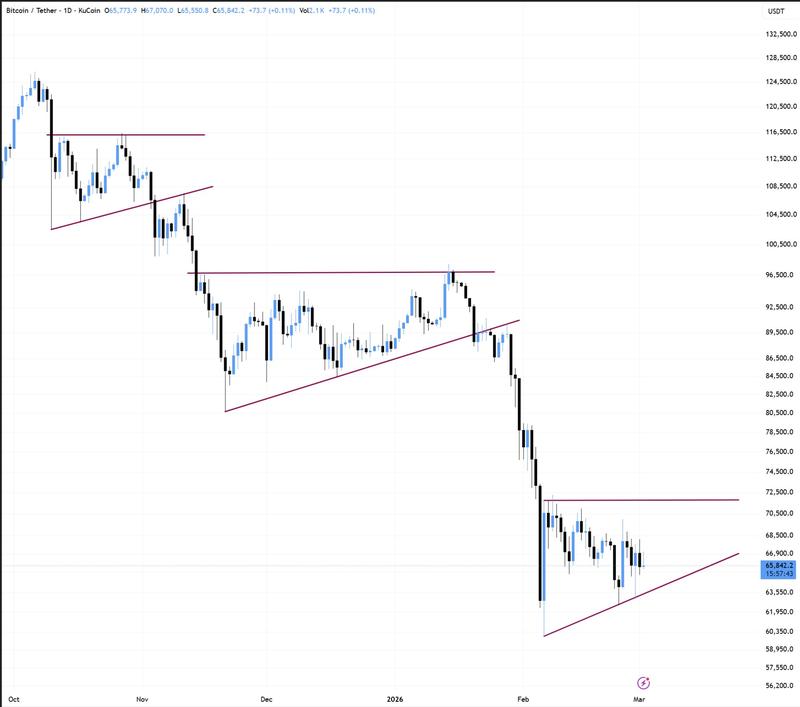
BTC price forecasts incorporate $45,000 bearish level
Pessimistic Bitcoin price projections continue to dominate across extended timeframes.
The absence of bullish momentum, with buyers failing to reclaim even proximate support zones, is generating progressively darker market outlooks for 2026.
Independent analyst Filbfilb has refocused attention on a particular trend line suggesting an additional 50% decline in BTC prices.
"In every instance since inception, a weekly close below the yellow band has resulted in a c.40-50% correction," Filbfilb shared with X followers alongside historical price performance charts.
"Levels c. $40-45k for the bands at the moment. A bounce off around $50k is not impossible, but ultimately, the price has met the lower band."
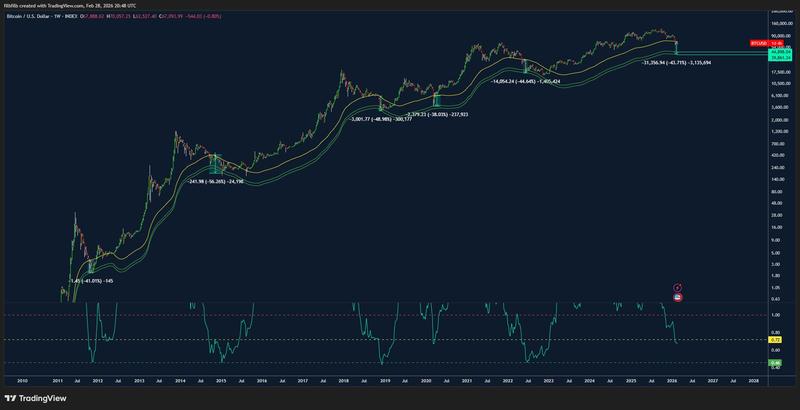
Through follow-up conversations, a potential recovery threshold surfaced for the weekly closing price, though this remained unattainable on Monday, positioned at $72,000.
As previously reported by Cointelegraph, the $45,000 range has already gained traction as a favored target for establishing a long-term BTC price bottom.
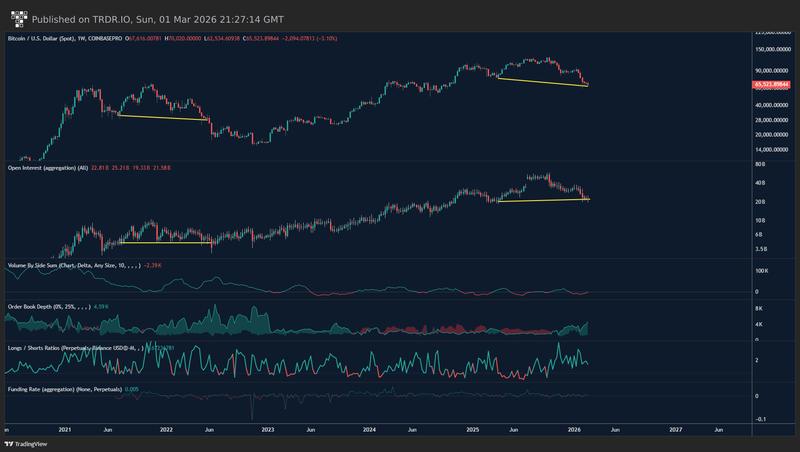
Via his Telegram trading channel, Filbfilb noted that open interest patterns are also replicating Bitcoin's previous bear market behavior. With open interest climbing while prices simultaneously decline, this indicates growing short position activity.
Iran situation assessment: "This is NOT World War Three"
With minimal US inflation statistics scheduled for release this week, focus will remain concentrated on Middle Eastern developments and broader geopolitical uncertainty.
Iranian developments triggered a 7% surge in WTI crude oil prices Monday morning, while Asian equity markets experienced downward pressure amid globally escalating tensions.
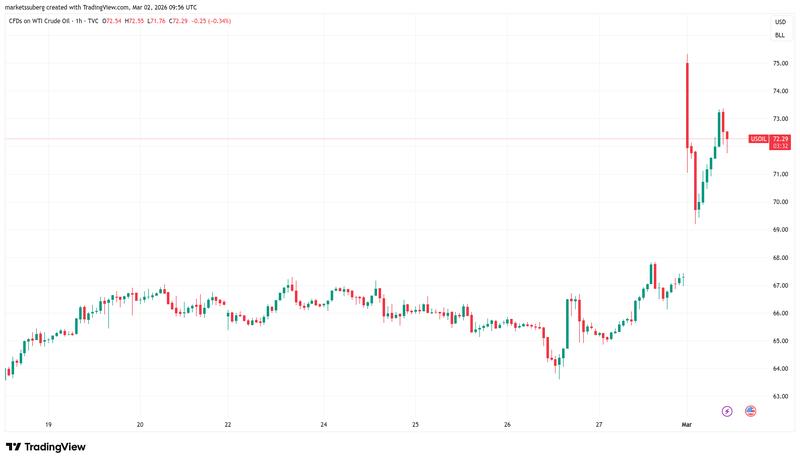
Market volatility intensified as participants attempted to assess the ramifications of an Iranian military offensive that US President Donald Trump indicated might extend for a month.
"Combat operations continue at this time in full force and they will continue until all our objectives are achieved. We have very strong objectives," Trump said in a televised address on Sunday.
Throughout the weekend, cryptocurrency markets contained volatility, and as traditional finance markets reopened, Bitcoin maintained $65,000 as its support foundation.
"Approximately $300m in long liquidations were triggered as the news broke, a notable but contained figure, particularly relative to the more disorderly deleveraging events observed in early February," trading company QCP Capital wrote in its latest "Asia Color" market update.
"The comparatively modest scale of forced selling suggests that positioning had already been materially lightened in recent weeks."
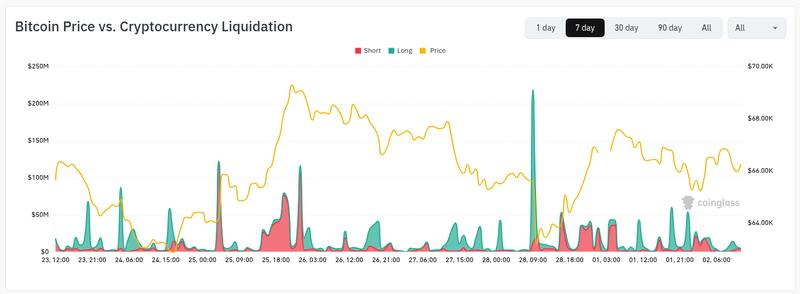
QCP observed that the preceding Iranian disruption in June 2025 produced only temporary BTC price deviations before the then-prevailing upward trend resumed.
"While the scale of this attack is far greater than last year's, price action could be hinting at early signs of history repeating itself," it added.
Market intelligence resource The Kobeissi Letter reached comparable conclusions regarding overall market responses. According to their analysis, oil price movements were not signaling widespread panic.
"This is NOT World War 3. Ignore the noise," it told X followers.
Oil market turbulence brings US inflation into sharp focus
As Cointelegraph previously documented, apprehensions have emerged regarding the Iran conflict's extended impact on United States inflation metrics.
Due to potential disruptions to petroleum shipping lanes, particularly the possible blockage of the Strait of Hormuz, Consumer Price Index (CPI) measurements have become especially scrutinized. The February CPI report is scheduled for publication on March 11, with more than a month remaining before the weekend's events begin reflecting in official statistics.
"A full closure of the Strait of Hormuz would send oil prices above $100 per barrel, according [to] our analysis, which would imply a spike in US CPI inflation to ~5%," Kobeissi wrote in an X post on the topic.
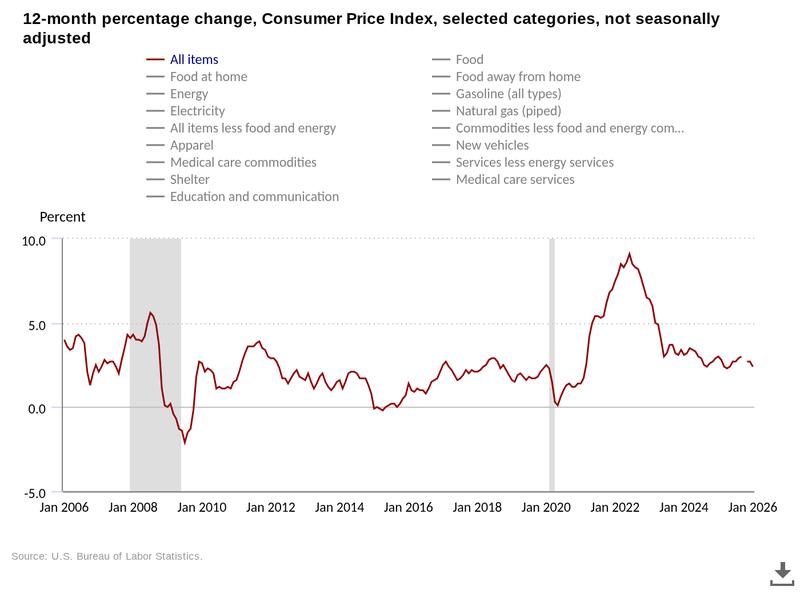
Recent United States inflation figures have exceeded market forecasts, with several readings missing by substantial margins, creating heightened market sensitivity to unexpected catalytic events.
"Changes in energy prices can drive fluctuations in headline inflation, with a study by the Federal Reserve estimating that every $10 increase in the price of oil adds 0.20% headline inflation."
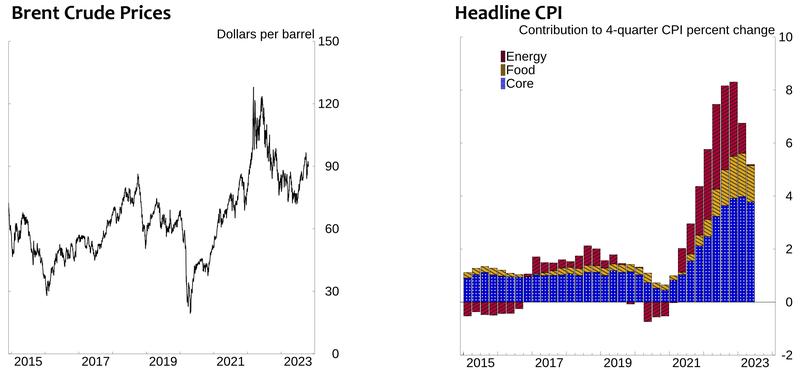
Mosaic drew parallels between the present circumstances and the onset of the Russia-Ukraine war in 2022, cautioning that geopolitical factors were not the sole forces driving oil prices upward.
"Energy prices were a major contributor to an inflation wave that peaked in 2022 at the highest level in over 40 years," it continued.
"While the conflict in the Middle East will be a major catalyst for movement in energy prices, a prolonged period of underinvestment in various energy and industrial commodities was already setting the stage for a rally."
Nevertheless, Kobeissi contended that Trump's declared policy objective to "eliminate inflation" and reduce gasoline costs would drive efforts to minimize any secondary consequences.
"A prolonged war with Iran would work in the opposite direction of these key initiatives, particularly in the short-term during a crucial midterm election year. We think Trump aims for a short and swift operation and markets prevail once again as the dust settles," it concluded.
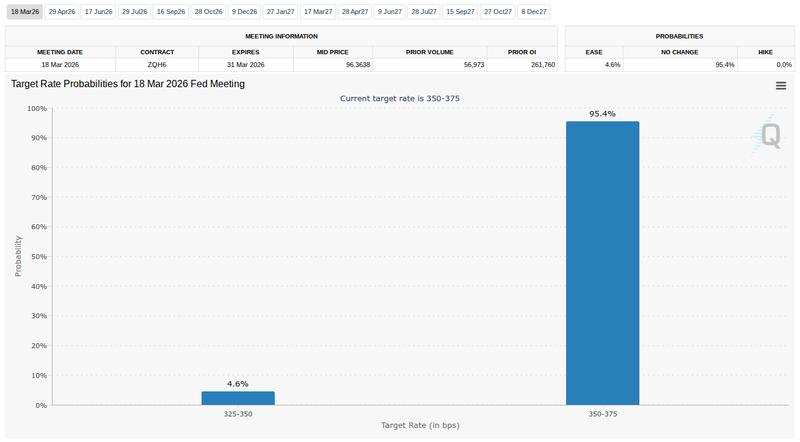
Elevated inflation diminishes the probability of Federal Reserve interest-rate reductions and, consequently, reduces expectations for liquidity injections into cryptocurrency and risk-oriented assets. According to the most recent information from CME Group's FedWatch Tool, there exists only a 4.4% probability of a rate cut at the Federal Reserve's March policy meeting.
Institutional Bitcoin ETF activity turns positive
Despite underwhelming BTC price performance and widespread acknowledgment of an emerging bear market, institutional investment flows are generating excitement at onchain analytics platform CryptoQuant.
During the previous week, United States spot Bitcoin exchange-traded funds (ETFs) recorded three straight days of net positive inflows exceeding $1 billion in aggregate. Friday witnessed only a minor net withdrawal of $27.5 million, according to statistics from UK-based investment firm Farside Investors.
"Lately, the crypto markets has been showing some very specific on-chain signals that suggest a major shift in how Bitcoin is moving between different types of investors," CryptoQuant contributor Amr Taha commented in a "Quicktake" blog post on Monday.
According to Taha's assessment, the recent surge in inflows constituted the first "meaningful" accumulation phase since October of the previous year, coinciding approximately with Bitcoin's $126,200 record high.
"This marks the first noticeable accumulation wave after months of stagnation or decline," he added.
"Historically, rising ETF demand tends to be constructive for price, while declining demand often aligns with price weakness."
Previously, Cointelegraph covered projections that institutional Bitcoin investor conviction would only intensify over time, with an emerging class of purchasers demonstrating less inclination to liquidate positions based on near-term price fluctuations.
"Every cycle, the weak hands get filtered out. And every cycle, what replaces them is longer-duration capital," EMJ Capital founder Eric Jackson explained.
"2017: retail sold at $20K. 2021: funds sold at $69K. 2025: ETF allocators are selling at $63K."
Jackson characterized the recent departure of ETF investors as the "purification" of the long-term Bitcoin bull case.