Binance's Push for Arbitration in US Crypto Lawsuit Rejected by New York Court
Court decision maintains investor claims from before 2019 in public proceedings, denying Binance's attempt to relocate the case to Singapore arbitration.

A federal judge in the United States has determined that Binance is prohibited from compelling a cohort of American customers to resolve their claims through arbitration regarding financial losses on cryptocurrency tokens purchased via its international platform prior to Feb. 20, 2019, ensuring the substantial class action lawsuit remains in public court proceedings.
Thursday's ruling by District Judge Andrew Carter Jr., presiding in the Southern District of New York, determined that these particular claims were not subject to the arbitration clause introduced by Binance.com in 2019 due to inadequate notification when the platform unilaterally modified its terms of service from the 2017 edition, which did not include arbitration requirements or waivers for class action participation.
In the judge's assessment, Binance depended on a broad clause permitting terms-of-service modifications and the publication of revised 2019 terms on the platform's website, yet no documentation existed demonstrating that the cryptocurrency exchange delivered personalized notifications or officially "proclaimed" the newly introduced arbitration requirement to its user base.
Judge Carter determined that Binance's declarations about functioning in a "new world" with decentralized operations failed to alter the fundamental contract law principles applicable to agreements conducted over the internet.
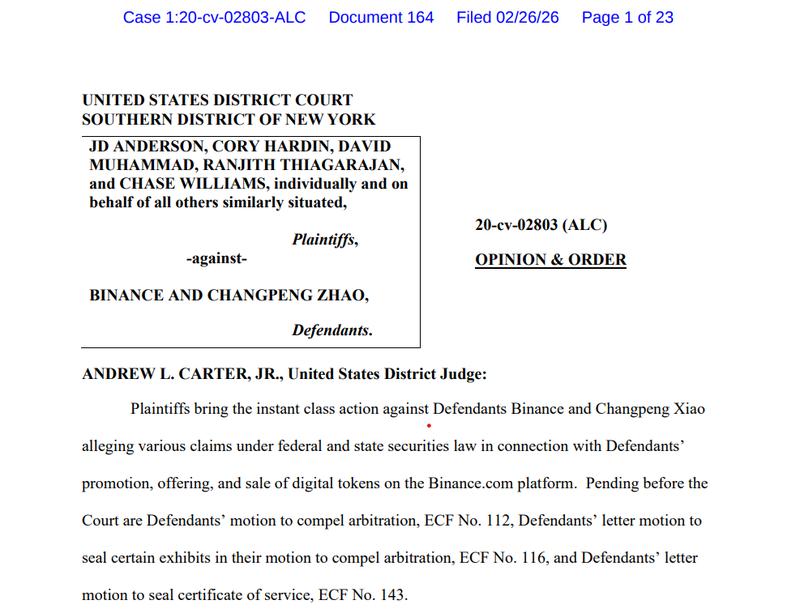
His determination established that the arbitration provision introduced in 2019 could not be enforced retrospectively on claims that originated prior to its Feb. 20 implementation date, given that the contractual agreement never explicitly indicated it would encompass conduct from earlier periods.
Judge Carter additionally ruled that an alleged waiver of US class action rights incorporated within a section title of the 2019 terms could not be enforced in federal court proceedings due to the contract's failure to explicitly outline the provisions of such a waiver and required narrow interpretation against Binance in its capacity as the document's author.
Binance says post‑2019 claims already dismissed
The litigation, Williams v. Binance, represents a proposed class action initiated by five American investors residing in California, Nevada and Texas who allege that Binance along with founder Changpeng Zhao (CZ) unlawfully distributed unregistered securities through Binance.com while failing to obtain registration as a broker‑dealer.
This litigation had been previously dismissed during 2022 prior to the Second Circuit's decision to restore the investors' allegations in 2024, returning the matter to Judge Carter's courtroom.
Through a statement provided to Cointelegraph, a representative from Binance indicated that "in response to our motion on this issue plaintiffs voluntarily and correctly dismissed all claims that accrued on or after Feb. 20, 2019." The spokesperson further stated that Binance intends to "vigorously defend the limited claims that remain in this meritless case."
The outstanding claims will now advance through a federal United States court instead of undergoing private arbitration proceedings in Singapore, with judges, as opposed to arbitrators, evaluating whether cryptocurrency platforms possess the authority to depend on unilaterally modified online terms of service to restrict investor litigation.