Bank of Canada report reveals Aave transferred risk burden to borrowers to prevent bad debt
Research from Bank of Canada staff revealed that Aave V3 successfully prevented bad debt throughout 2024, though the system transferred liquidation losses to borrowers.

Research published by Bank of Canada staff members discovered that Aave V3 maintained a record of zero non-performing loans throughout 2024, with its Ethereum lending market leveraging overcollateralization mechanisms and automated liquidation processes to shield lenders from financial losses.
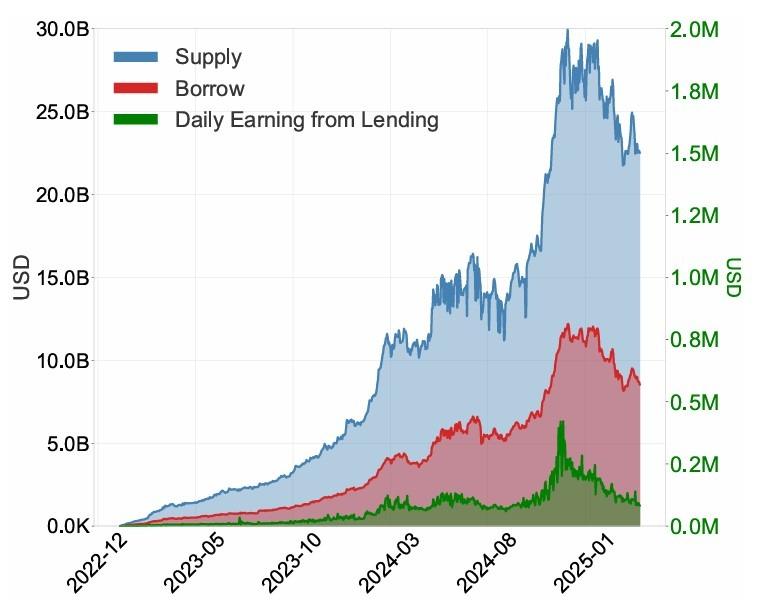
The study analyzed transaction-level data spanning from Jan. 27, 2023, through May 6, 2025, revealing that lending positions underwent liquidation before the value of collateral dropped beneath the outstanding debt obligations, successfully limiting losses to lenders throughout the entire sample period.
However, the research highlighted a significant tradeoff inherent in this approach. The system successfully shielded lenders from losses that couldn't be recovered, yet simultaneously transferred the risk burden onto borrowers while limiting capital efficiency when compared to conventional lending frameworks.
The paper explained that Aave V3's architecture depends on automated risk management controls instead of conventional underwriting procedures, mandating that borrowers deposit collateral exceeding their borrowed amounts and triggering position liquidations whenever risk threshold limits are violated.
Recursive leverage fueled borrowing demand
The research paper revealed that lending activity on Aave V3 wasn't exclusively driven by users pursuing liquidity access. The analysis determined that recursive leverage strategies represented more than 20% of aggregate borrowed volume and comprised 8.2% of all borrowing transactions throughout the examined timeframe.
The recursive leverage strategy entails borrowing repeatedly against posted collateral, redeploying those borrowed assets as fresh collateral and initiating another borrowing cycle to multiply market exposure.
The research indicated that this dynamic increased borrower vulnerability during market downturns. The paper documented that liquidation events on Aave V3 typically occurred in concentrated clusters, with four specific assets representing 90% of the total value that was liquidated.
These assets include Wrapped Ether (WETH), Wrapped Staked Ether (wstETH), Wrapped Bitcoin (WBTC) and Wrapped eETH (weETH).
The research estimated that losses incurred by borrowers during significant liquidation episodes could reach substantial levels. The analysis showed that liquidation fees generally fell within a range of 5% to 10% of the liquidated value, while opportunities for gains missed due to subsequent price recoveries elevated the combined losses to approximately 10% to 30% in certain instances.
The staff research document indicated that although the architectural design of Aave V3 successfully prevented unrecovered bad debt throughout the sample period, this achievement came by subjecting borrowers to sudden losses whenever collateral valuations experienced sharp declines.
Cointelegraph reached out to Aave for comment but did not receive a response before publication.