Amendment to Senate Housing Legislation Seeks CBDC Ban Through End of Decade
Language from earlier standalone legislative efforts to prevent a Federal Reserve digital dollar has resurfaced in an amendment tucked into Senate housing legislation.

A newly proposed amendment to the Federal Reserve Act would prohibit the United States central bank from launching a central bank digital currency (CBDC) through the end of this decade.
The legislative language was discovered near the conclusion of the 300-page "21st Century ROAD to Housing Act" (HR 6644) that the Senate Committee on Banking, Housing, and Urban Affairs made public on Monday.
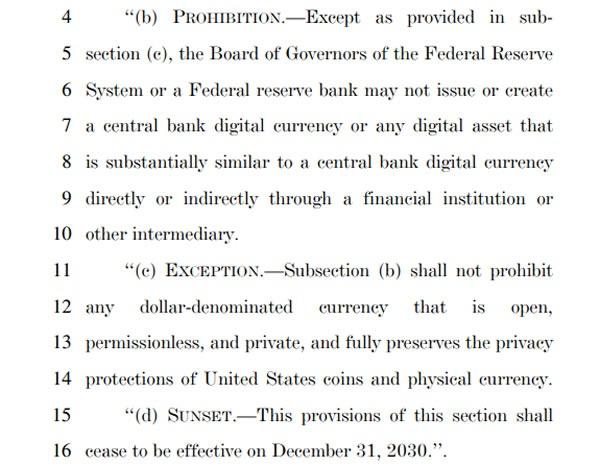
According to section ten of the draft legislation, neither the board of governors of the Federal Reserve System nor any Federal Reserve bank "may not issue or create a central bank digital currency or any digital asset that is substantially similar to a central bank digital currency directly or indirectly through a financial institution or other intermediary."
Additionally, the legislation carves out an exception for stablecoins, specifying that the Fed "shall not prohibit any dollar-denominated currency that is open, permissionless, and private," and fully preserves the privacy protections of the physical currency.
A sunset clause included in the proposed ban would terminate its effectiveness on December 31, 2030, meaning fresh legislation would be required to extend the prohibition beyond that date.
In a swift response, the White House released a statement expressing its support for the Act and its measures to block a CBDC, noting such a digital currency could "pose significant threats to personal privacy and liberty."
On Monday, the Senate moved it forward decisively through a procedural cloture vote (84-6), which serves to limit debate and advance the measure, paving the way for consideration on the full Senate floor.
Prior legislative efforts to ban CBDCs have failed
The language found in this housing bill represents a revival of text from earlier unsuccessful efforts to block a US CBDC and does not constitute the first such legislation.
Senator Mike Lee introduced the "No CBDC Act" (S 464) as a standalone bill in February 2025, with the goal of preventing both the Fed and Treasury from launching a CBDC; the measure, however, failed to advance in Congress.
Additional legislation aimed at preventing the Fed from launching a CBDC was brought forward in June 2025 by Congressman Tom Emmer through the "Anti-CBDC Surveillance State Act" (HR 1919).
While the bill successfully passed a House vote on July 17, it has not yet received full approval from the Senate.
CBDC testing underway in China, Russia, and India
According to the Atlantic Council's CBDC tracker, just three countries have formally launched a CBDC: Nigeria, Jamaica, and The Bahamas.
An additional 49 nations are currently in active CBDC testing phases, including China, Russia, India, and Brazil, while 20 nations are in the development stage of a CBDC, and 36 remain in the research phase.
Germany's central bank president Joachim Nagel promoted the advantages of CBDCs for the European Union in February, which is currently conducting pilot programs.