Severe US winter weather causes Bitcoin mining hashrate to plummet to seven-month minimum
According to estimates from Bitcoin mining data platform Hashrate Index, the United States accounts for the world's largest share of mining power, representing close to 38% of total global hashrate.

The Bitcoin network's total hashrate plummeted to its lowest point in seven months during the weekend as an intense winter storm swept across the United States, delivering heavy snow and ice accumulation that forced mining operations to scale back their activities in support of electrical grid stability.
According to a Monday report from AccuWeather, an American weather forecasting service, the powerful winter storm impacted approximately three dozen states throughout the weekend, resulting in extensive snow and ice coverage along with power disruptions that left one million utility customers without electricity.
Information gathered from CoinWarz, a mining data analytics tool, reveals that the hashrate for the Bitcoin (BTC) network started declining on Friday, reaching a low of 663 exahashes per second (EH/s) by Sunday — representing a hashrate decrease of more than 40% over a two-day period.
Nevertheless, the hashrate has started its upward recovery and stood at approximately 854 EH/s by Monday.
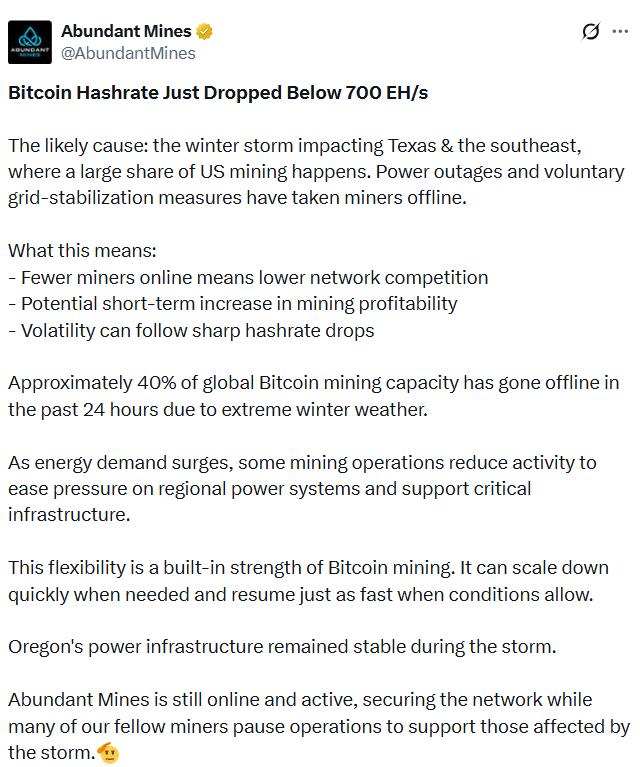
"Roughly 40% of worldwide Bitcoin mining infrastructure has been taken offline over the last 24 hours as a result of severe winter weather conditions," stated Abundant Mines, an Oregon-based Bitcoin mining company.
"When energy consumption spikes, certain mining facilities decrease their operations to relieve strain on local electrical systems and maintain support for essential infrastructure. This adaptability represents an inherent advantage of Bitcoin mining. Operations can reduce quickly when circumstances require it and restart equally fast once normal conditions return."
The United States represents the dominant contributor to global Bitcoin mining capacity, with Hashrate Index, a Bitcoin mining data platform, estimating that the nation accounts for nearly 38% of worldwide hashrate.
Additionally, a 2024 analysis conducted by the federal Energy Information Administration discovered that more than 137 cryptocurrency mining operations were located throughout the US.
Miners helped to stabilize the grid
Bitcoin mining operations contribute to power grid stabilization through load balancing capabilities by adjusting their electricity consumption upward or downward rapidly. Mining facilities can establish operations adjacent to wind or solar energy installations and increase consumption to absorb excess power generation while shutting down operations when grid capacity becomes constrained.
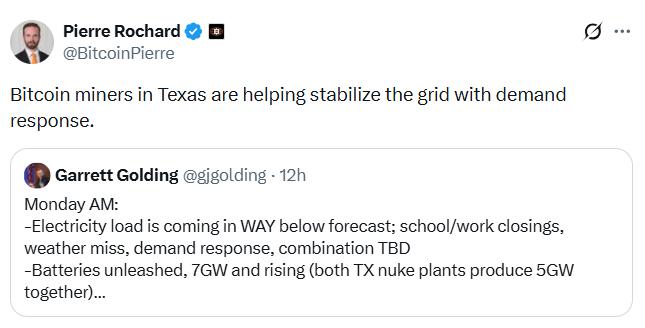
Members of the Bitcoin community, including Daniel Batten, a researcher focused on Bitcoin environmental, social and governance matters, noted in a Monday post on X that Bitcoin mining operations and demand response mechanisms collaborated in Texas to maintain grid stability during the severe weather event.
Winter storm affecting Bitcoin production
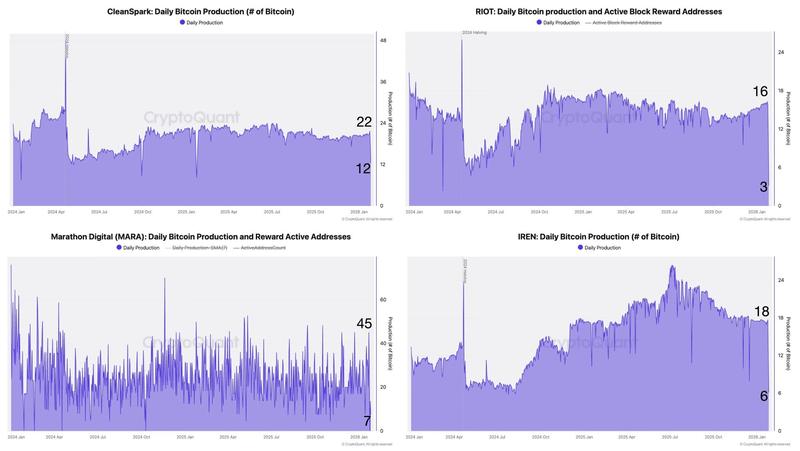
The severe weather event also reduced daily Bitcoin production rates for several of the largest mining companies operating in the United States, as reported by Julio Moreno of CryptoQuant, referencing information from the analytics platform.
Major US mining operations, including Marathon Digital Holdings, experienced a decline from mining 45 Bitcoin on the previous day down to just seven, while IREN's production decreased from 18 to six.