
Bitcoin Treasury Leaders Demand Changes to Basel III's 1,250% Crypto Risk Classification
Leaders in the cryptocurrency sector are pushing for significant changes to capital requirement regulations and the risk classification system for digital assets outlined in Basel III banking standards.

Executives managing cryptocurrency treasuries are urging the Basel Committee on Banking Supervision (BCBS), a global banking oversight organization, to reconsider the 1,250% risk weighting assigned to Bitcoin and additional digital currencies within the Basel III regulatory structure.
The requirement of 1,250% capital means financial institutions are obligated to support each Bitcoin (BTC) position on their books with approved collateral at a full 1:1 ratio, rendering BTC holdings significantly more expensive compared to alternative asset categories.
By contrast, liquid cash, tangible gold holdings and sovereign debt instruments are assigned a 0% risk weighting within the Basel III regulatory structure.
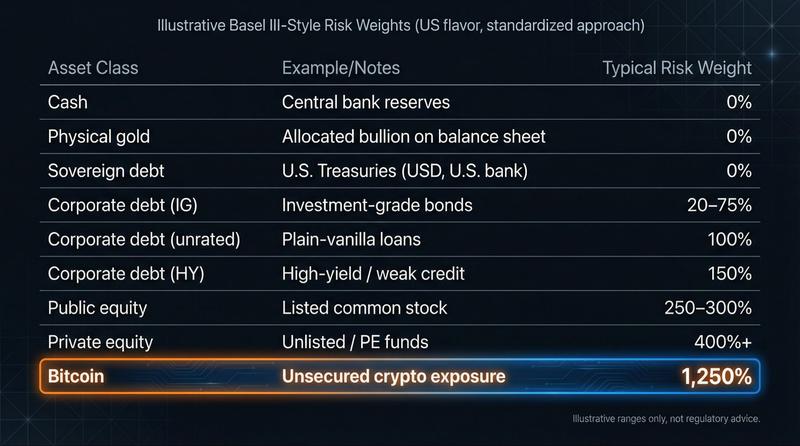
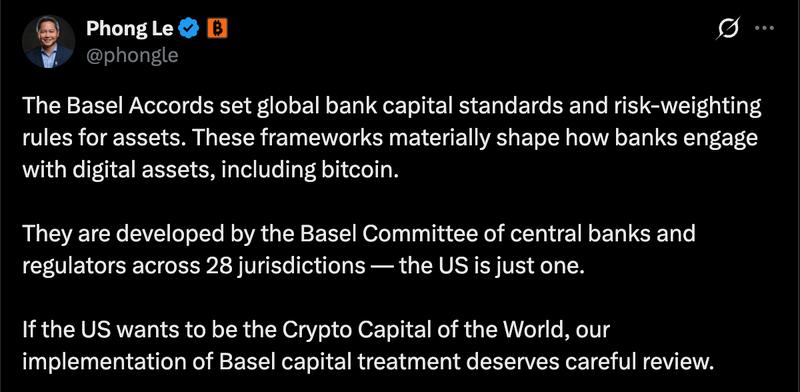
"If the US wants to be the 'crypto capital' of the world, the banking regulations need to change. Risk is mispriced," Jeff Walton, chief risk officer at Bitcoin treasury company Strive, wrote on X.
The regulations governing capital under Basel III create disincentives for financial institutions seeking to maintain BTC and cryptocurrency holdings due to the comparatively elevated collateral expenses associated with digital asset positions, which diminish a bank's return on equity, an essential indicator of banking profitability, as explained by Chris Perkins, president of investment company CoinFund.
Basel responds to growing backlash and pressure from the crypto industry
The Basel Committee put forward the existing risk weighting framework in 2021, categorizing BTC and additional cryptocurrencies within the most severe risk classification and applying a 1,250% risk weighting to digital asset holdings.
During 2024, the committee approved the final capital requirement standards detailed in the 2021 proposal, a decision that generated substantial criticism from the cryptocurrency sector.
The existing regulations constitute a "different type of chokepoint" compared to the explicit debanking practices targeting crypto companies in what certain industry participants called Operation Chokepoint 2.0, Perkins told Cointelegraph in August 2025.
"It's a very nuanced way of suppressing activity by making it so expensive for the bank to do those activities," Perkins said.
During October 2025, information surfaced indicating the committee was evaluating whether to reduce the capital requirement standards for digital assets following the dramatic growth in the stablecoin market capitalization, which is approaching $300 billion, based on data from RWA.xyz.
The subsequent month, Erik Thedéen, chair of the BCBS, stated the global banking oversight body might require a "different approach" to the 1,250% risk weighting for cryptocurrencies, indicating a possible modification in collateral requirement policies.