
US Senate Delays on Crypto CLARITY Act: When Will It Finally Pass?
After swiftly advancing through the House in June 2025, the CLARITY Act has faced numerous setbacks in the Senate, leaving the crypto industry waiting.
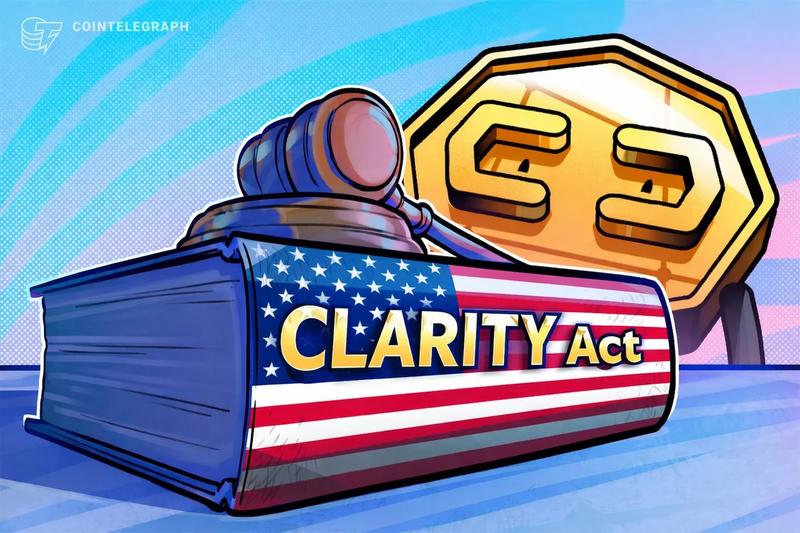
Investors and the broader cryptocurrency sector continue to wait as the US CLARITY Act faces ongoing delays caused by partisan disagreements and industry opposition to specific provisions.
This legislation would fundamentally transform the regulatory landscape for cryptocurrency, determining everything from which federal agency will provide oversight to how decentralized finance (DeFi) platforms will be regulated.
At present, US Senate legislators are working through contentious details, with major disagreements remaining. The Democratic caucus is pushing for a bipartisan approach that includes ethics requirements and prohibitions on government bailouts, which Republican senators have broadly rejected.
Elements of the cryptocurrency sector have also voiced concerns about certain provisions in the bill. In particular, Coinbase, which operates as the nation's largest digital asset exchange, opposes language that would block the platform from providing yields on stablecoins. The traditional banking lobby has actively fought against such yields, arguing they pose risks to conventional deposits and could destabilize the broader financial system.
Multiple versions of this legislation have emerged throughout the process. Below is a comprehensive timeline of its journey:
May 2025: CLARITY comes to Washington
Representative French Hill, who chairs the House Committee on Financial Services, brought the CLARITY Act forward for the first time on May 29, 2025.
According to the committee's statement, the legislation's purpose was to create "clear, functional requirements for digital asset market participants, prioritizing consumer protection while fostering innovation."
The committee articulated multiple justifications for the bill, primarily emphasizing that digital assets constitute the future of financial innovation in the digital age and that existing regulatory approaches were hampering potential growth and development.
June-July 2025: House passes crypto bill
The CLARITY Act progressed through the House of Representatives at an unusually rapid pace. During June, the legislation underwent markup sessions in both the House agriculture and financial services committees before being scheduled for a floor vote by June 23.
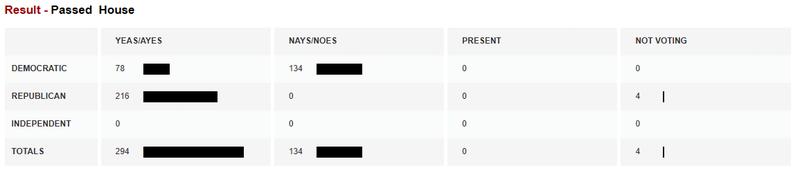
On July 17, Representatives voted to pass the bill with a tally of 294-134. The vote breakdown showed stronger backing from the Republican caucus. A total of 216 Republicans supported passage, with zero opposing and four choosing not to vote.
The vote also demonstrated some cross-party cooperation: 78 Democratic Representatives joined in supporting the bill, though the majority—134 Democrats—voted against it. Democratic members did not abstain from the vote.
Following passage, the legislation advanced to the Senate, the upper chamber of Congress, where it has remained under active discussion ever since.
July-September 2025: Senate starts work
Senate work on CLARITY commenced without delay. On July 22, Republican leadership on the US Senate Banking Committee published a preliminary draft of their version of the bill.
This discussion draft aimed to "establish clear distinctions between digital asset securities and commodities, modernize our regulatory framework, and position the United States as the global leader in digital asset innovation."
Tim Scott, who chairs the Senate Banking Committee, expressed optimism that the Senate would maintain the same expeditious timeline as the House, setting an initial target date of Sept. 30, 2025.
October-December 2025: Senators at odds during government shutdown
Democratic members of the Senate Banking Committee, notably including Senator Elizabeth Warren who has been skeptical of cryptocurrencies, raised objections to multiple elements of the discussion draft.
Warren specifically criticized the tax treatment provisions outlined in the bill, stating in a public comment that "proposals to clarify crypto's tax treatment could ultimately give crypto an unfair advantage over other financial products."
She additionally argued that the proposals "make it harder to track what's happening in crypto transactions if they are being used for illegal purposes."
Senate Democrats developed their own alternative approach to regulating DeFi under the bill. Legal experts at Skadden Arps Slate Meagher & Flom noted that these DeFi regulations attempted to "leverage existing regulatory frameworks to create a crypto market structure and show Congress' instinct to retrofit the current system rather than design one built for crypto."
This approach stood in direct opposition to what Republicans and cryptocurrency industry advocates envisioned, which was establishing an entirely new, purpose-built regulatory system for the digital asset sector.
On Nov. 11, 2025, the Senate Agricultural Committee published its own discussion draft of the CLARITY Act. This draft acknowledged that legislators were continuing to debate which federal regulatory body, either the Commodity Futures Trading Commission (CFTC) or the Securities Exchange Commission (SEC), should have primary oversight authority over the industry.
Additional obstacles emerged from the US federal government shutdown that lasted from Oct. 1 to Nov. 12—becoming the longest shutdown on record, surpassing even the previous one during President Donald Trump's first administration. The shutdown concluded only after a handful of Senate Democrats joined Republicans to approve a temporary funding resolution for government operations.
December 2025-January 2026: Markup session, crypto industry gets impatient
During the fall months, Senator Cynthia Lummis had forecast that the cryptocurrency framework legislation would be ready for Trump's signature by New Year's Eve. As 2025 concluded, this timeline appeared increasingly unrealistic.
On Dec. 19, David Sacks, the White House's crypto and AI czar, announced following discussions with leading senators working on CLARITY that a markup session would take place in January.
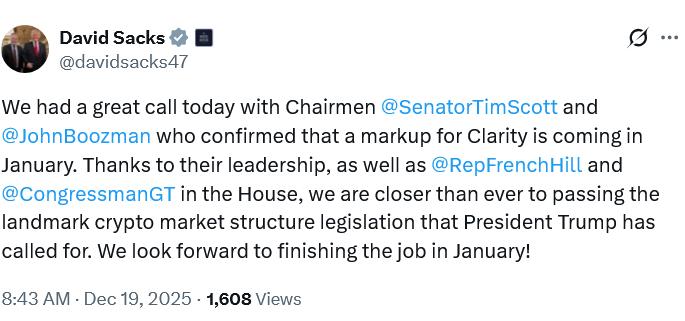
The anticipated markup session in the Senate Banking Committee was ultimately delayed, however, due to fundamental disagreements about the bill from both cryptocurrency industry lobbyists and traditional banking sector representatives.
Brian Armstrong, who serves as Coinbase CEO, publicly stated the company could not back the legislation because of provisions that would ban stablecoins from earning interest, along with language designating the SEC as the primary regulatory authority for the crypto industry.
This public opposition reportedly angered White House officials, who were pressing for swift completion of the framework legislation.
Other prominent financial industry leaders echoed Armstrong's concerns, with Goldman Sachs CEO David Solomon stating that the bill "has a long way to go."
Despite these setbacks, legislative work continued. The Senate Agriculture Committee scheduled its own markup session for Jan. 27. Democratic committee members proposed amendments to the legislation, including an ethics provision that would prohibit members of Congress from trading cryptocurrencies, along with language explicitly preventing any government bailouts of the crypto industry.
These proposed amendments were defeated in party-line votes, allowing the Republican majority to move the bill forward to the full Senate floor.
February 2026: High-level talks at the White House, political maneuvers
Cryptocurrency industry leaders, congressional lawmakers and banking executives are currently holding frequent meetings at the White House and throughout the Capitol building to resolve their outstanding disagreements. According to the Digital Chamber of Commerce, a meeting held on Feb. 3 centered on the contentious issue of stablecoin yields.
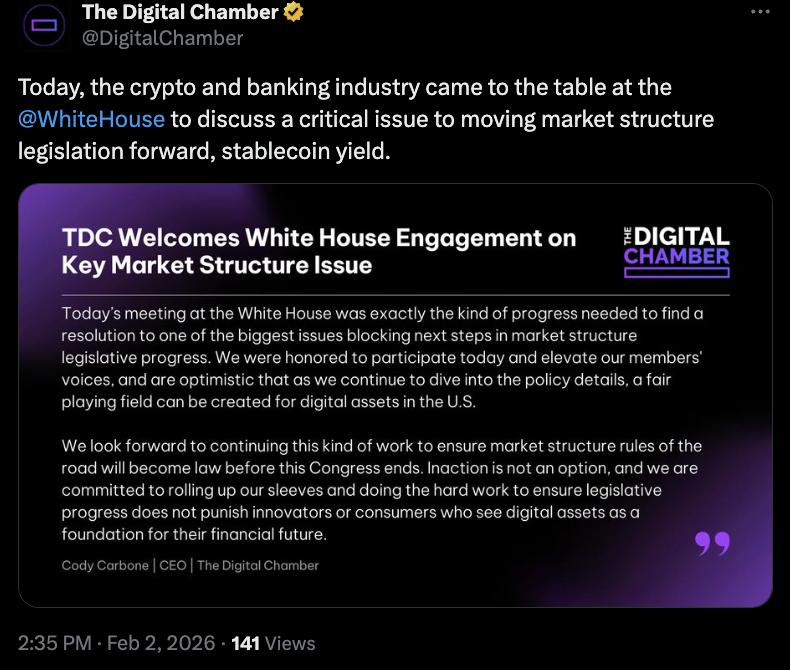
These negotiations have remained ongoing. On Tuesday, additional industry executives, including Stuart Alderoty who serves as Ripple's chief legal officer, participated in what was described as a "productive session."
Clear, bipartisan momentum remains behind sensible crypto market structure legislation. We should move now — while the window is still open.
Stuart Alderoty, Ripple chief legal officer
Nevertheless, no agreement has been reached. The delays have reportedly contributed to approximately $1 billion in outflows from cryptocurrency markets, based on data compiled by CoinShares. Some industry observers argue that the delays may ultimately benefit the sector, as they provide additional opportunities to negotiate more advantageous terms.
Market analyst Michaël van de Poppe commented, "I think if the bill were approved in its current form, it would have had a very bad impact on the markets in general. So, now, all the parties are aligned to continue the discussion. It reminds me a lot of the Markets in Crypto-Assets (MiCA) regulations in Europe."
Many stakeholders are pushing to finalize the legislation before midterm elections take place. The cryptocurrency lobbying apparatus has been expanding its political influence through substantial donations to political action committees (PACs). According to reports, both Republican and Democratic members of Congress want to pass favorable legislation before the 2026 campaign season begins in earnest and crypto PACs make their endorsement decisions.
The cryptocurrency sector's substantial support within the Republican Party may become problematic if the party experiences declining public approval. Historical patterns show that midterm elections typically favor the opposition party rather than the sitting president's party, and within a year, the crypto lobby might find itself dealing with a weakened president and tepid support from a Democratic majority in Congress.
Whether CLARITY succeeds may ultimately depend on a race against time.