
The Critical Role of Yen-Backed Stablecoins in Japan's Digital Currency Strategy
Financial regulators and major corporations in Japan are collaborating to integrate one of the world's most important funding currencies into decentralized finance, though individual investor participation continues to lag.

The Japanese financial sector is positioning itself for an era dominated by stablecoins and tokenized financial instruments, with banking institutions, regulatory bodies and major financial groups collaborating to integrate the yen into blockchain-based systems.
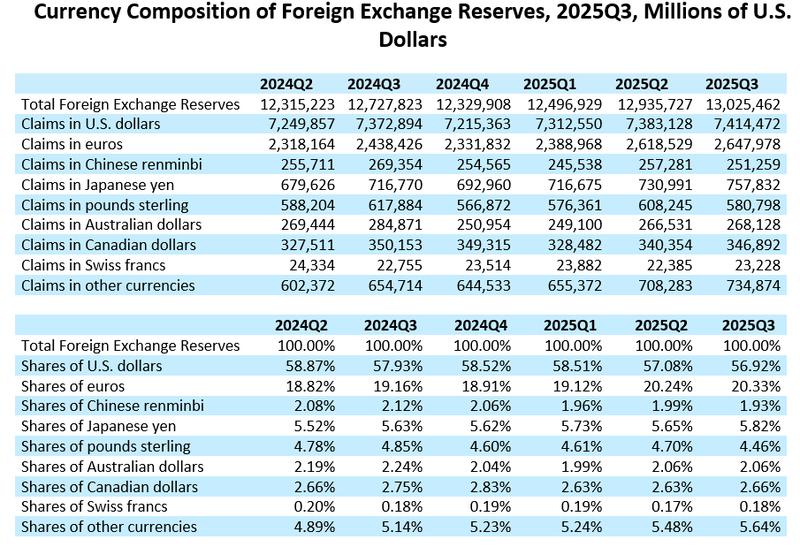
As the world's fourth-largest economic powerhouse, Japan's yen holds significant weight in international finance. Data from the International Monetary Fund reveals that the yen represents 5.82% of worldwide foreign exchange reserves, placing it third globally.
The yen's crucial position in global markets stems largely from the carry trade mechanism. With historically low borrowing costs, market participants take out inexpensive yen loans, exchange them for alternative currencies and allocate funds to higher-returning investments, establishing the yen as among the most reliable funding currencies in international finance.
Nevertheless, Japan's pivotal position in worldwide finance hasn't translated to prominence in blockchain-based economic systems. This dynamic started shifting following US President Donald Trump's inauguration in January of the previous year, spurring accelerated cryptocurrency policy conversations across the globe.
Similar to the United States, Japan's governing political coalition has articulated aspirations to establish itself as a worldwide Web3 hub. Realizing this objective may hinge on stablecoins that can successfully integrate the yen into blockchain networks. Despite this, retail cryptocurrency engagement in Japan stays comparatively subdued, notwithstanding support from some of the nation's most powerful financial institutions and banking groups.
Government and major corporations support Japan's cryptocurrency sector
Sanae Takaichi made history as Japan's inaugural female prime minister when she assumed office in October 2025. Within her initial months leading the government, she took the bold step of dissolving the lower house to call a snap election. Her Liberal Democratic Party (LDP) achieved a commanding two-thirds supermajority in the Feb. 8 vote, with parliamentarians selecting Takaichi for another term 10 days afterward.
Sota Watanabe, CEO of Startale Group, informed Cointelegraph that many observers view her as politically and strategically compatible with the Trump administration's approach, which is driving faster cryptocurrency integration domestically.
During April 2024, Takaichi's LDP published a comprehensive Web3 white paper declaring its goal to "make Japan the center of Web3." The policy document identified 11 cryptocurrency-related matters requiring "immediate" action, encompassing individual income tax restructuring, stablecoins and security tokens.

These same priorities align with the blockchain roadmap of SBI Group, among Japan's most prominent financial conglomerates, under the leadership of Yoshitaka Kitao.
"Kitao-san is the best person to commit to the crypto revolution in Japan because he created SBI under the evolution of the internet," Watanabe explained, whose Startale Group partnered in developing SBI's Strium blockchain. This layer 1 network seeks to establish itself as the settlement foundation for institutional transactions involving tokenized equities and real-world assets (RWAs).
Kitao held senior roles at Nomura, Japan's premier securities brokerage firm, before moving to SoftBank where he worked alongside Masayoshi Son, currently positioned second on Forbes' Japan rich list. Kitao subsequently established SBI on behalf of SoftBank.
According to Watanabe, SBI perceives the next phase of blockchain evolution as centered on securities and equities, though this requires governmental authorization.
"Right now, it is easy to make a derivative onchain, but to implement actual onchain dividends, actual voting rights of the stock, it needs to be regulation-compliant," Watanabe stated, noting that he maintains ongoing discussions with Japanese government officials.
Additionally, dividend payments for blockchain-based assets cannot be processed through traditional channels, necessitating a yen-denominated stablecoin.
The significance of a yen-denominated stablecoin
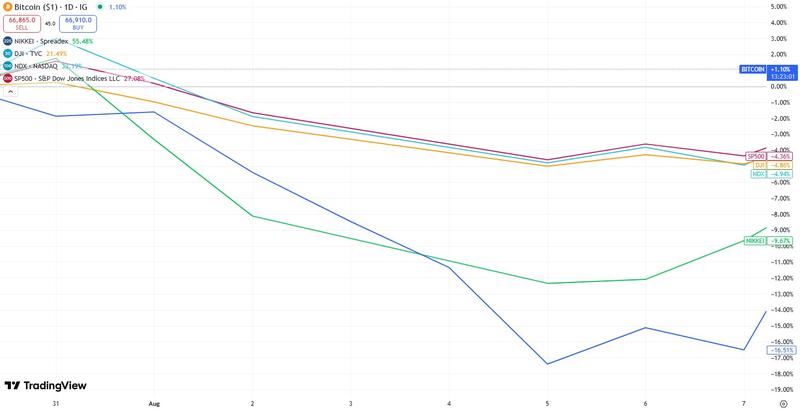
Japan's monetary policy rates and the yen carry trade represent powerful forces capable of influencing worldwide markets. The Bank of Japan increased interest rates during March 2024 from -0.1% to 0.1%, marking its initial hike across 17 years. The subsequent July witnessed the central bank announcing a more substantial increase to 0.25%, causing turbulence across global markets and Bitcoin (BTC).
A stablecoin backed by yen reserves could expand the carry trade into blockchain-based markets by transferring Japan's affordable borrowing rates onto distributed ledgers.
As an illustration, a market participant could secure a loan in a yen-pegged stablecoin at minimal interest charges. These resources could subsequently function as collateral for borrowing US dollar stablecoins, which could be allocated to decentralized finance (DeFi) lending platforms, liquidity pools or alternative yield-producing approaches.
Last Friday, Startale announced its proprietary yen-backed stablecoin, JPYSC, with a planned second-quarter rollout. Watanabe indicated that the stablecoin has been purpose-built to facilitate the yen carry trade on blockchain networks.
"Once we implement the trust bank-backed stablecoin, it will become possible for global investors and institutions to execute the yen carry trade onchain," he stated.
Carry trade operations generally require extended timeframes. The complete process can consume one or two days, given that Japan's and US' trading hours don't coincide.
"But if we could do it onchain, we can do it 24/7 and instantly," Watanabe remarked.
In theory, this development could introduce institutional yen lending to DeFi ecosystems. However, Justin d'Anethan, head of research at Arctic Digital, conveyed to Cointelegraph that an onchain carry trade mechanism won't generate significant impact without substantial institutional backing and considerable market capitalization.
Watanabe disclosed to Cointelegraph that he's engaged in conversations with America's largest financial institutions that have expressed interest in carry trade mechanisms and intraday swap operations, although he refrained from revealing specific names. He mentioned that he's also established contact with "top players" within DeFi.
The initiative still requires authorization from Japanese regulatory authorities, while the regulatory classification of stablecoins on banking balance sheets hasn't been finalized. Regulatory agencies such as the US Securities and Exchange Commission continue working toward establishing clear capital and accounting standards.

Japan's cryptocurrency environment is advancing, but individual investors remain sidelined
Japan already has a yen-denominated stablecoin operating domestically through JPYC, though it's principally engineered for payment transactions. Currently, its comparatively modest market capitalization hovering around $20 million renders it inappropriate for carry trade operations, which demand substantial liquidity pools and significant borrowing capabilities.
SBI isn't the sole financial entity investigating stablecoin possibilities in Japan. Three of the nation's most prominent banks — Mitsubishi UFJ, Sumitomo Mitsui Banking Corporation and Mizuho — are purportedly considering collaborative issuance of a yen-backed stablecoin.
Notwithstanding enthusiasm from domestic traditional finance powerhouses and governmental bodies, retail sector activity remains relatively quiet.
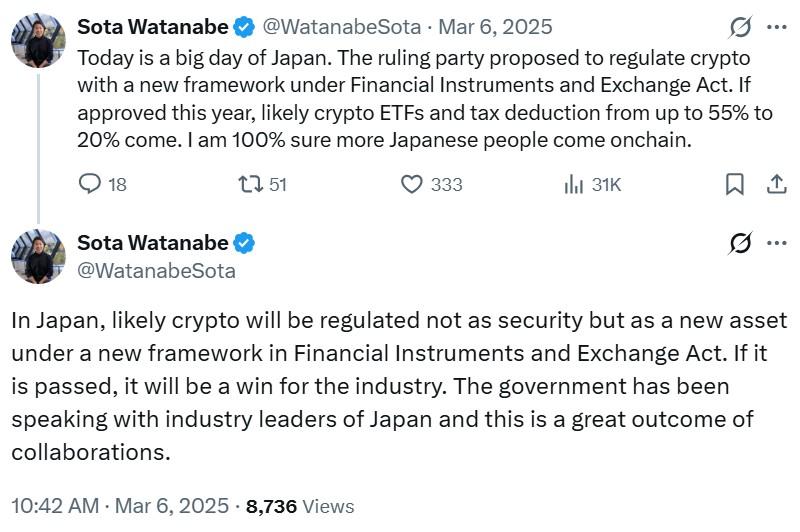
The sluggish retail uptake is frequently attributed to the up-to-55% tax burden cryptocurrency investors encounter. This situation may also be evolving. Japan is examining the potential reclassification of cryptocurrency from a payment instrument to a financial asset, which would reduce the crypto tax burden to 20% and permit exchange-traded funds based on crypto.
The tax reduction reform is anticipated to commence from 2028. This timeline proves inadequate, in Watanabe's assessment.
"The Japanese government is very slow," he commented. "Given that the US is accelerating onchain finance, to catch up, tax deduction in 2027 is necessary."
Throughout recent decades, the yen has functioned as a worldwide funding currency via carry trade mechanisms, yet it remains conspicuously absent from the cryptocurrency sector. Individual investor involvement stays constrained by burdensome taxation policies, though governmental bodies and institutional players are already maneuvering to position the yen for operation within blockchain-powered capital markets.