SoFiUSD stablecoin now available for Mastercard transaction settlements
Mastercard card issuers can now settle transactions using SoFi's cash-backed SoFiUSD stablecoin through the global payment network's infrastructure.
A new collaboration between SoFi Technologies and Mastercard will introduce SoFiUSD, a stablecoin backed by dollar reserves, as a settlement mechanism throughout Mastercard's worldwide payments infrastructure, providing card issuers and acquirers with the capability to complete transactions using a bank-issued digital dollar.
According to the terms of the partnership, SoFi Bank N.A. intends to process its own credit and debit card transactions through Mastercard using SoFiUSD, while the company's payments technology platform Galileo will provide partner banks and card issuers with access to the stablecoin for settling transactions throughout the network of the world's second-largest processor.
According to the company's announcement, SoFiUSD represents the first stablecoin created by a federally chartered and insured deposit bank in the United States on a public, permissionless blockchain, and it would facilitate transaction settlements around the clock, every day of the week, throughout Mastercard's payment infrastructure.
Introduced in December, SoFiUSD is created by SoFi Bank, which operates as an OCC-regulated insured depository institution, and maintains complete 1:1 backing through cash reserves. The stablecoin is anticipated to receive support from Mastercard's Multi-Token Network in conjunction with traditional fiat currencies, tokenized deposits and additional digital assets.
According to statements from both organizations, they plan to investigate further applications, encompassing cross-border remittance services, business-to-business payment transfers, programmable treasury solutions and card programs powered by stablecoins, contingent upon meeting regulatory requirements and adhering to Mastercard network standards.
This development emerges as Mastercard continues to deepen its involvement in the stablecoin ecosystem. Last November, the payment processor formed a partnership with Thunes to broaden stablecoin wallet payout capabilities via Mastercard Move, facilitating near real-time fund transfers to regulated stablecoin wallets through Thunes' Direct Global Network.
Rival Visa expands stablecoin settlement and payout infrastructure
Mastercard faces competition in incorporating stablecoins into payment systems, as industry leader Visa has also been broadening its utilization of digital dollars throughout settlement and payout operations.
Last September, Visa initiated testing of stablecoin-based international settlement processes, rolling out a Visa Direct pilot program that permits selected financial institutions to pre-fund cross-border transfers utilizing Circle's USDC and EURC. The payment processing leader subsequently broadened its support to encompass four stablecoins operating across four blockchain networks, facilitating conversion into over 25 fiat currencies.
Visa has additionally ventured into direct stablecoin disbursement services. Last November, the company unveiled a Visa Direct pilot program that enables businesses to transmit funds directly to recipients' stablecoin wallets, providing freelancers and marketplace platforms with the alternative to receive USD-backed tokens rather than conventional bank transfers.
This expansion reached international markets last month as Quantoz Payments, based in the Netherlands, achieved principal Visa member status, granting it authorization to issue Visa-branded debit cards supported by its regulated e-money tokens and provide support for fintech companies offering stablecoin-linked products throughout Europe.
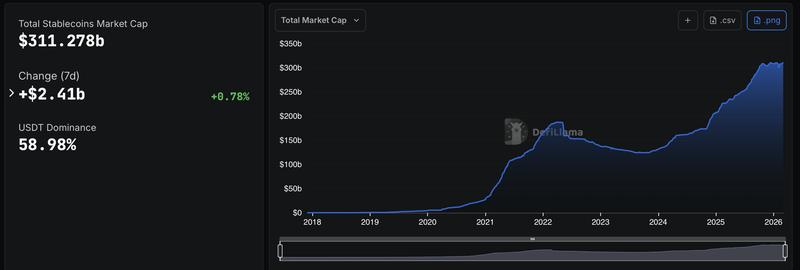
According to DefiLlama data, the overall stablecoin market capitalization stood at approximately $311.28 billion at the time of writing. Transaction volumes reached an all-time high of $969.9 billion in August 2025, with projections approaching $1 trillion in monthly volume by December 2026, as reported by CoinLedger in September.