
Ripple unveils enhanced stablecoin infrastructure targeting financial institutions
The enhancement brings together custody solutions, automated treasury management and settlement capabilities as Ripple intensifies its focus on enterprise-level international payments.

Ripple has announced an expansion of its stablecoin payments infrastructure designed specifically for banking institutions and fintech companies, with the goal of eliminating the requirement to maintain funds in foreign jurisdictions while accelerating international money transfers.
The company's global payments platform, Ripple Payments, which links financial institutions to blockchain-powered settlement infrastructure, has received an upgrade enabling it to facilitate a comprehensive stablecoin workflow that encompasses collection, custody, conversion and distribution functions, according to Tuesday's announcement from the San Francisco-headquartered firm.
This strategic expansion places Ripple in more direct competition with established payment service providers, as the enhanced platform is engineered to minimize dependence on pre-funded account structures and conventional correspondent banking systems, both of which can lock up capital and create delays in international payment processing.
The fintech company, which remains privately held, carries a valuation of $17.7 billion based on data from pre-IPO shares marketplace Forge Global.
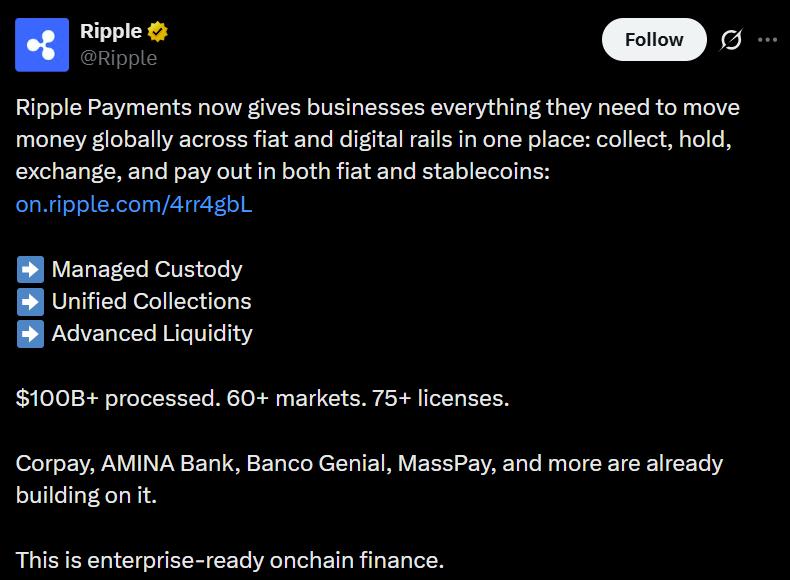
The Ripple Payments platform currently operates across more than 60 markets globally and has facilitated transaction volume exceeding $100 billion since inception. Among the institutions actively participating in the network, the company highlighted Switzerland-based AMINA Bank, Brazil's Banco Genial, Malaysia's ECIB and AltPayNet from the Philippines.
According to Ripple, this platform expansion leverages its recent strategic acquisitions, including Palisade, a provider of custody and treasury automation solutions, along with Rail, a platform enabling clients to maintain and exchange both fiat currencies and stablecoins. The acquisition of Rail was completed last August in a transaction valued at $200 million.
Ripple deepens institutional bet as RLUSD supply reaches $1.5 billion
This platform expansion arrives as Ripple maintains momentum in growing its stablecoin payment infrastructure, which includes increasingly comprehensive integration of its dollar-backed digital currency, Ripple USD (RLUSD).
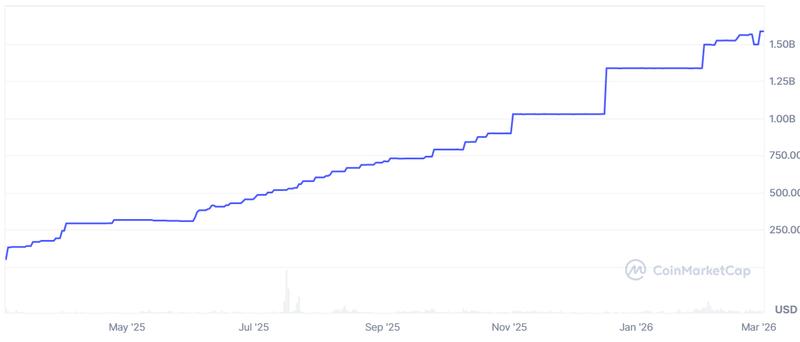
While RLUSD represents a relatively modest portion of the worldwide stablecoin ecosystem, it demonstrates steady expansion with a circulating supply approximately $1.5 billion.
This growth trajectory has been matched by favorable regulatory developments. Last December, the US Office of the Comptroller of the Currency issued conditional approvals for national trust bank charters to Ripple's proposed Ripple National Trust Bank, alongside similar approvals for additional cryptocurrency firms including Circle, BitGo, Paxos Trust Company and Fidelity Digital Assets.
Upon final approval, these charters would grant Ripple and comparable entities the authority to manage assets and stablecoin reserves operating under federal regulatory supervision, although the authorization would exclude traditional banking activities such as deposit-taking or lending functions.
The platform enhancement also aligns temporally with active deliberations taking place in Washington, DC, concerning proposed US crypto market structure legislation, where policymakers and industry stakeholders are engaged in negotiations regarding appropriate regulatory frameworks for stablecoins.
Stuart Alderoty, Ripple's chief legal officer, participated in a February White House meeting alongside other cryptocurrency and banking industry representatives to deliberate on the stablecoin-related provisions within the proposed legislation, highlighting the company's active engagement in influencing the development of nascent regulatory structures.