
Research Shows DCA Strategy Offers Most Secure Path to Bitcoin Profits Over Time
Historical analysis and predictive modeling demonstrate that consistently dollar-cost averaging into Bitcoin provides the optimal investment approach for BTC. Can this method deliver results in upcoming market cycles?

Savvy market participants modify their approach when facing bear market conditions and significant pullbacks such as the 50% decline observed in Bitcoin (BTC) throughout the past 5 months. This investment approach, called dollar-cost averaging (DCA), requires allocating identical sums at consistent intervals without regard to prevailing market dynamics.
Analysis of past market cycle patterns combined with forward-projected BTC valuation models offers enhanced understanding of how these consistent buying behaviors perform across varying entry points and investment timeframes.
Five-year Bitcoin DCA accumulation demonstrates substantial positive returns
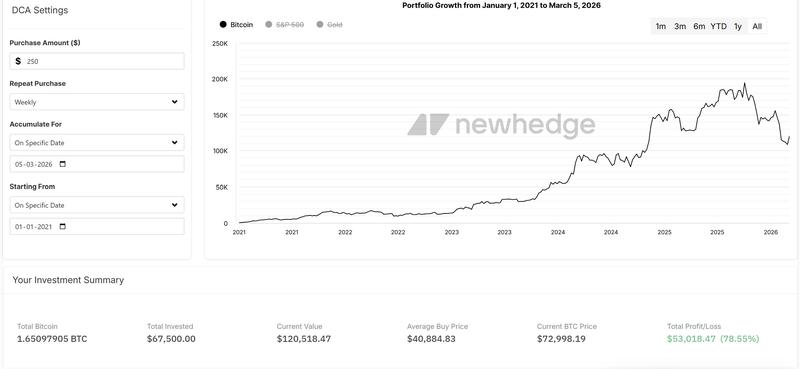
Committing $250 each week to Bitcoin purchases from January 2021 forward meant deploying $67,500 throughout a five-year timeframe. According to DCA simulation analysis, this approach accumulated 1.65097905 BTC with an average acquisition cost of $40,884.
With Bitcoin's current market price hovering around $71,000, those 1.65097905 BTC holdings carry a value of approximately $120,518, delivering a profit of $53,018 (76%) against the total capital deployed. During the period when Bitcoin reached $100,000, the portfolio was valued at roughly $165,098, whereas at the market cycle high approaching $126,000 in October 2025, the identical holdings were worth $208,023.
Examining a more condensed accumulation period demonstrates how starting point timing influences initial performance even as the method maintains consistent market exposure. Implementing a $250 weekly DCA strategy from January 2024 means allocating $28,500 total, accumulating 0.36863166 BTC at an average acquisition cost of $77,312.
With the present price at $71000, this position is valued at approximately $26,909, representing a –6% paper loss. When Bitcoin touched $100,000, the portfolio had appreciated to $36,863, whereas a $126,000 cycle peak would have valued the Bitcoin at $46,448.
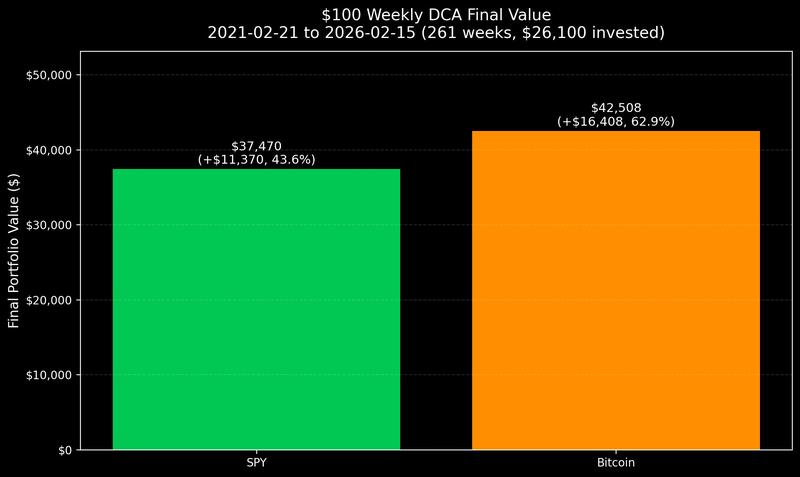
In a February X post, Swan Bitcoin analyst Adam Livingston presented a comparison between a similar DCA methodology and traditional equities across the previous five years. Allocating $100 weekly generated $42,508 in Bitcoin compared to $37,470 in S&P 500 (SPX), reflecting 62.9% and 43.6% returns, respectively.
Livingston emphasized that maintaining consistent Bitcoin purchases throughout market declines has traditionally delivered superior aggregate returns notwithstanding the asset's price fluctuations.
Extended-timeline projections highlight the importance of holding duration
Predictive modeling explores potential outcomes for the DCA methodology from 2026 moving forward. Implementing a $250 weekly DCA strategy starting January 2026 deploys approximately $54,250 through March 2030.
The valuation projections derive from Bitcoin's extended power-law expansion trajectory, which monitors Bitcoin's historical valuation against time using a logarithmic framework. This analytical tool generates an ascending support range and median trajectory that have generally corresponded with earlier market cycles.
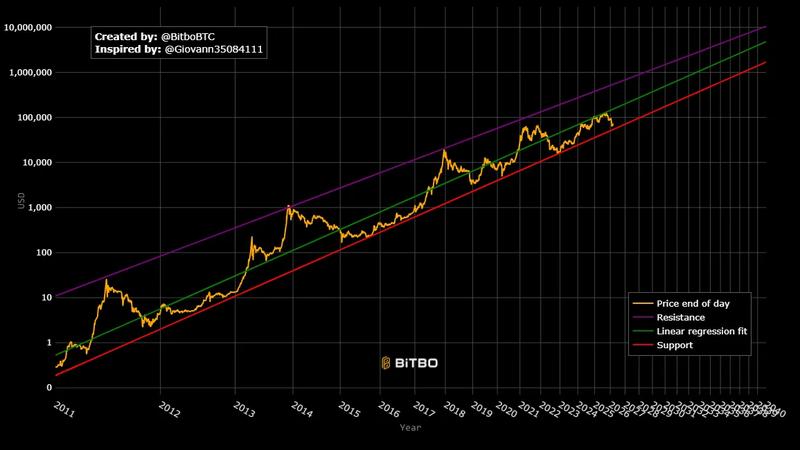
Leveraging this analytical structure, market observers project that by 2028, the extended-term trend floor could rise beyond $100,000, establishing the foundational assumption for prospective DCA analysis. Projections from Bitcoin Well position the median valuation around $430,278 by March 2030.
To encompass the broader probability spectrum surrounding that trajectory, the framework additionally incorporates deviation ranges of the power-law channel, yielding a conservative projection around $274,000 and an optimistic expansion possibility approaching $900,000.
Based on these assumptions, the weekly methodology accumulates approximately 0.30 BTC throughout four years.
- At $274,000, the portfolio is valued at roughly $82,200.
- At the $430,278 median projection, the holdings reach $129,000.
- At a $900,000 BTC valuation, the portfolio is worth approximately $270,000.
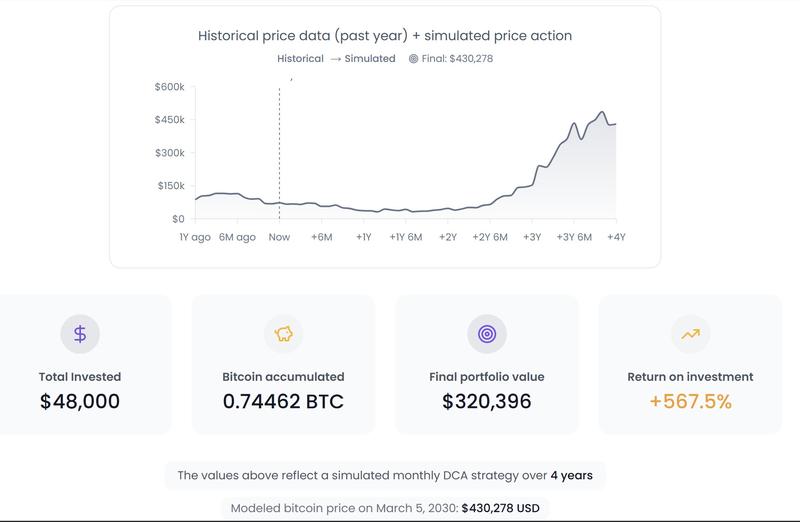
A November 2025 analysis by Bitcoin researcher Sminston With examined how starting point timing influences extended-horizon performance using comparable forecasts. Even purchasing 20% above $94,000 (the price of BTC at that time) and selling 20% below the forecasted 2035 median still generated approximately 300% gains on the residual holdings following a decade.
The aggregate savings attained 7.7 times the original capital within the simulation.
The analysis determined that starting point timing modifies the spectrum of potential outcomes, whereas extended holding durations account for the preponderance of the performance.