
Research indicates WLFI may serve as 'advance warning indicator' for cryptocurrency markets
The Trump-associated WLFI token plummeted over five hours prior to a massive $6.9 billion liquidation event in crypto markets, prompting speculation about its potential as an early market stress indicator.

A fresh analysis from data analytics firm Amberdata suggests that World Liberty Financial Token (WLFI), a decentralized finance governance token connected to the Trump family, might have provided advance warning of a significant market collapse several hours ahead of Bitcoin's movement.
The analysis examines market behavior on Oct. 10, 2025, a day when approximately $6.93 billion worth of leveraged cryptocurrency positions faced liquidation within a single hour. Bitcoin (BTC) experienced a decline of approximately 15% while Ether (ETH) saw losses around 20%, and certain smaller digital assets plummeted by as much as 70%.
According to Amberdata's findings, WLFI entered a steep downward trajectory more than five hours ahead of the widespread market collapse. During this period, Bitcoin continued trading close to $121,000 without displaying any obvious signs of immediate pressure.
"A five-hour lead time is hard to dismiss as coincidence," Mike Marshall, who authored the report, told Cointelegraph. "That duration is what separates a genuinely actionable warning from a statistical artefact," he added.
WLFI anomalies before the selloff
The research team examined three distinctive patterns, which included heightened trading activity, significant deviation from Bitcoin's trajectory, and excessive leverage levels, to assess whether WLFI demonstrated stress indicators ahead of the wider market decline.
The hourly trading volume for WLFI surged to approximately $474 million, representing about 21.7 times its typical activity level, just minutes following tariff-related political announcements. Concurrently, funding rates on WLFI perpetual futures contracts climbed to roughly 2.87% per eight-hour period, translating to an annualized borrowing expense approaching 131%.
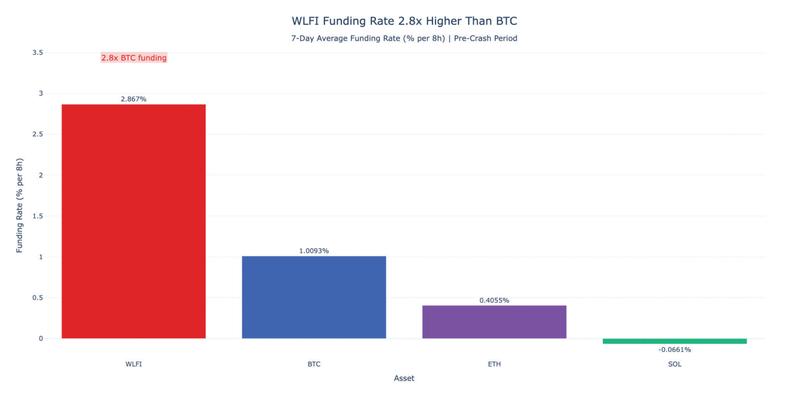
The research makes no allegations of insider trading taking place. Rather, it contends that the structural characteristics of cryptocurrency markets can elevate the significance of certain assets beyond what their market capitalization might suggest.
According to the report, WLFI's ownership structure is heavily concentrated among participants with political connections, contrasting sharply with Bitcoin's broadly dispersed holder base. Marshall characterized the trading pattern as "instrument-specific," indicating that activity centered on WLFI rather than spreading throughout the wider cryptocurrency ecosystem.
"If this were superior analysis (sophisticated participants reading the tariff headlines faster and drawing better conclusions) you'd expect to see that reflected more broadly," he said. "What we actually saw was concentrated activity in WLFI first."
The chronological sequence carries particular weight. Trading volume intensified approximately three minutes following the public tariff-related news release. According to Marshall, such rapid response implies pre-planned execution strategies rather than retail market participants analyzing headlines and reacting organically.
The connection between WLFI's decline and the subsequent broader market downturn centers on leverage mechanics. Numerous cryptocurrency trading platforms permit traders to utilize multiple assets as collateral for leveraged positions. As WLFI experienced a sharp decline, the underlying value of that collateral diminished, compelling traders to liquidate liquid assets such as Bitcoin and Ether to satisfy their margin requirements. These forced sales drove prices downward and initiated a cascade of additional liquidations throughout the market.
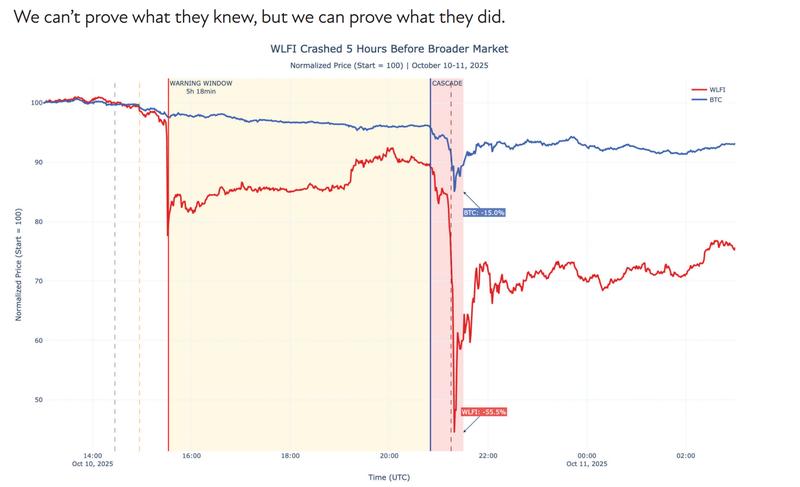
WLFI reacted faster than Bitcoin to stress
Data compiled by Amberdata indicates that WLFI's realized volatility climbed to nearly eight times Bitcoin's level throughout the incident, rendering it exceptionally vulnerable to market stress. The researchers contend that structurally vulnerable, heavily leveraged assets may demonstrate movement ahead of others during periods of market shock.
Marshall emphasized that the research findings should not be construed as evidence that WLFI possesses reliable predictive capabilities for market downturns. The examination focuses on a singular occurrence, and additional data points would be necessary to confirm statistical reliability. Nevertheless, he maintains that the observed behavior carries significance.
"So the useful life of this signal is finite. It's valuable now because it's under-monitored," he said. "The moment it becomes consensus, the alpha gets arbitraged away. That's how all market signals work. The ones that persist are the ones nobody's paying attention to."