
Prediction markets on blockchain endorsed by CFTC chair as instruments of truth
According to Michael Selig, prediction markets utilizing blockchain technology have potential to enhance information quality and price discovery, despite ongoing legal challenges from multiple US states.

Michael Selig, the Chair of the United States Commodity Futures Trading Commission (CFTC), has expressed his endorsement of prediction markets integrated with blockchain technology, stating they have the potential to serve as robust mechanisms for truth discovery.
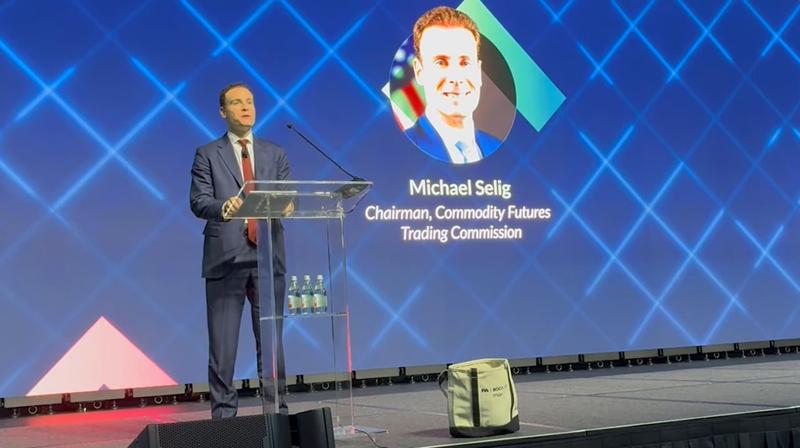
During his address at the FIA Global Cleared Markets Conference held in Boca Raton, Florida, on Monday, Selig made the case that prediction markets, alternatively referred to as event contracts, have the capability to deliver important insights regarding future developments when market participants commit financial resources to support their predictions, characterizing properly functioning markets as "truth machines."
"When participants express views on future events — and back those views with capital — they create accountability, transparency and information," Selig said. He further emphasized that prediction markets with substantial liquidity frequently generate indicators that the general public progressively regards as more dependable compared to conventional opinion polling.
"The reality is that prediction market platforms are now viewed by the public as more accurate than political polls," Selig claimed, referencing the 2024 US presidential election as a case in point where market valuations accurately reflected the magnitude of the electoral result.
US states take legal actions against prediction markets
Selig's endorsement of prediction markets emerges at a time when numerous US states have initiated legal proceedings or regulatory enforcement actions targeting these platforms, with the argument that their event-driven contracts constitute unlicensed forms of gambling.
During the previous week, a pair of US federal court decisions permitted Nevada's regulatory authorities to move forward with legal proceedings against prediction market operators Polymarket and Kalshi. In February, the state filed a lawsuit against Kalshi following the prediction market platform's unsuccessful court attempt to prevent the state's regulator from pursuing enforcement action regarding its sports-related prediction markets.
The state of Massachusetts has similarly pursued enforcement measures, initiating legal action against Kalshi concerning sports prediction contracts made available to state residents. At the same time, regulatory officials in Connecticut distributed cease-and-desist notifications to both Kalshi and Robinhood, commanding the companies to halt their offering of specific event contracts linked to sports-related outcomes.
The CFTC chair indicated that the regulatory body intends to establish more transparent regulations governing the manner in which event contracts may be listed and exchanged within the regulator's oversight structure. He stated that agency personnel have received instructions to prepare guidance that delineates the appropriate operational parameters for these markets while ensuring adherence to current derivatives legislation.
CFTC chair plans clearer crypto asset classification
Selig additionally revealed that the CFTC intends to develop a more precise classification system for crypto assets and offer guidance regarding the application of regulations to creators of non-custodial software products including digital wallets and decentralized finance applications.
He emphasized that the agency should prioritize transparent rulemaking over ambiguity and enforcement-oriented policy approaches, asserting that "America is now the crypto capital of the world."