
Negative ETH funding rates emerge, yet macro uncertainty dampens bullish implications
While negative funding rates typically signal buying opportunities in crypto markets, current US economic volatility and earnings reports may diminish the reliability of this indicator for Ethereum holders.

Key takeaways:
- A seven-day decline of 28% pushed Ether down to $2,110 as market participants reduced exposure and leveraged positions faced liquidation.
- Ethereum spot ETF products saw $447 million in net withdrawals while network usage contracted by 47%.
On Tuesday, Ether (ETH) crashed to $2,110, exposing underlying weakness after enduring a severe 28% selloff across seven consecutive days. Market participants shifted capital toward cash holdings and short-duration government securities while the technology-focused Nasdaq Index simultaneously declined 1.4%.
Market participants are expressing concern that asset prices have stretched beyond fundamental support and grown too dependent on artificial intelligence sector momentum. Market confidence deteriorated when Nvidia (NVDA US) CEO Jensen Huang publicly dismissed reports suggesting plans for a $100 billion investment in OpenAI.
Market participants prepared for heightened turbulence after fintech company Paypal (PYPL US) released lackluster quarterly earnings. In contrast, precious metals rallied sharply with gold advancing 6% and silver surging 9%, reflecting diminishing trust in the US Federal Reserve's capacity to stave off economic contraction.
Growing anxiety about excessive equity market valuations led market participants to adopt more defensive positioning, resulting in the complete disappearance of demand for leveraged long ETH exposure.
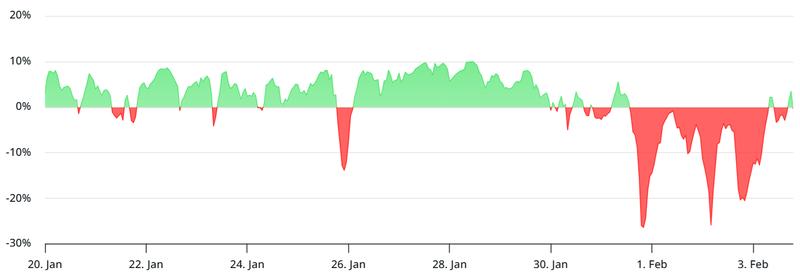
On Tuesday, the annualized funding rate for ETH perpetual futures contracts crossed into negative territory, signaling that short position holders (sellers) are now compensating longs to keep their trades open. This uncommon development reveals a substantial absence of optimism among long position holders (buyers).
Analysts are currently evaluating whether this heightened fear environment creates an opportune moment for accumulation, particularly given that ETH has lagged behind the wider cryptocurrency market performance by 10% throughout the preceding 30-day period.
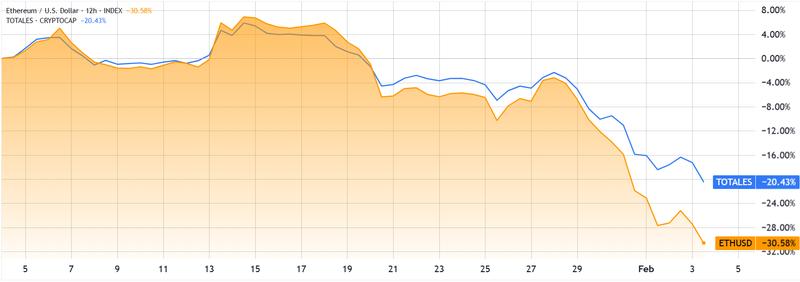
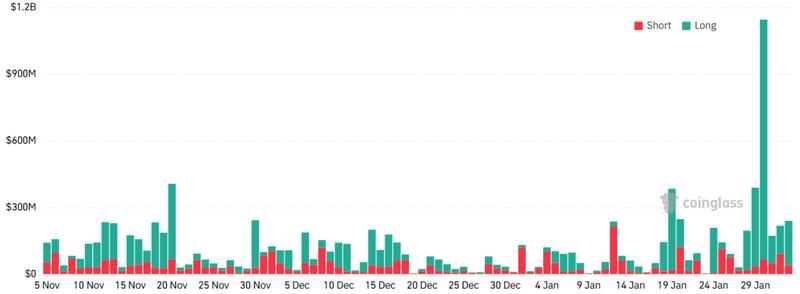
Holders of Ether became increasingly concerned as competing major digital assets experienced comparatively milder price declines during the last month; Bitcoin (BTC) shed 17%, BNB (BNB) lost 14%, and Tron (TRX) decreased by 4%. The sharp weekly descent of Ether to $2,110 resulted in the forced closure of more than $2 billion worth of leveraged long ETH futures contracts, intensifying worries about additional price deterioration as bearish sentiment takes hold.
Ethereum faces headwinds as spot ETF withdrawals indicate weakening institutional appetite
The Ether price confronted additional downward pressure from $447 million in cumulative net withdrawals from US-based Ethereum spot exchange-traded funds (ETFs) spanning five consecutive trading days. Participation from institutional players has diminished, notwithstanding ongoing accumulation efforts by companies including Bitmine Immersion (BMNR US), Sharplink (SBET US), and The Ether Machine (ETHM US). Market participants continue to monitor potential selling pressure originating from the combined $14.4 billion in assets under management across Ethereum ETF products.
With enthusiasm for decentralized applications (dApps) fading, demand for ETH experienced a substantial contraction.
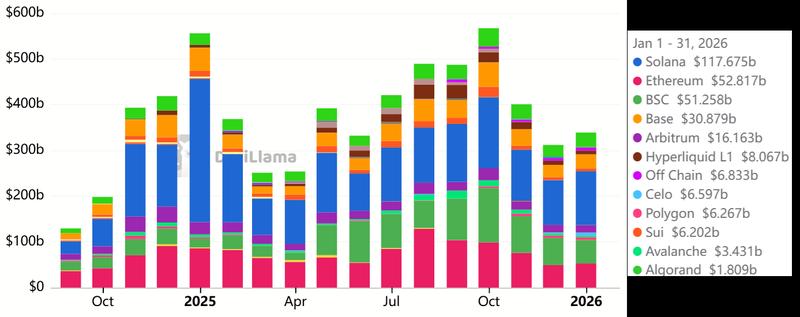
Monthly trading activity on Ethereum decentralized exchanges (DEX) totaled $52.8 billion during January, marking a substantial retreat from the $98.9 billion recorded in October 2025. This 47% contraction in network utilization decreases the motivation for token retention; under normal circumstances, elevated demand for blockchain transaction processing activates the network's deflationary burn mechanism, which reduces the overall ETH circulation.
Wallet addresses associated with Ethereum co-founder Vitalik Buterin liquidated roughly $2.3 million worth of ETH following his announcement allocating $45 million in contributions toward initiatives supporting privacy technologies, open hardware development, and secure software infrastructure. Buterin indicated that a sum of 16,384 ETH from his individual holdings would be systematically distributed throughout the next several years.
The present absence of enthusiasm for bullish ETH perpetual futures positions should not be interpreted as an indication of imminent price recovery. Blockchain activity indicators continue to display deterioration, and prevailing market sentiment remains defensive in light of the ongoing macroeconomic uncertainty.