
Kalshi co-founder addresses Iran Supreme Leader market resolution policy
Users of the prediction marketplace will receive reimbursements, with markets being settled at prices from before confirmation of the Iranian leader's passing.

Following Kalshi's decision to invalidate certain positions opened subsequent to the confirmed death of Iran's Supreme Leader Ayatollah Ali Khamenei, co-founder Tarek Mansour has released a statement with additional details on the platform's approach.
"We don't list markets directly tied to death. When there are markets where potential outcomes involve death, we design the rules to prevent people from profiting from death. That is what we did here," Mansour said in a post on X.
The passing was announced by Iranian state media in the early hours of Sunday, following an assault conducted by Israel and the United States the previous day.
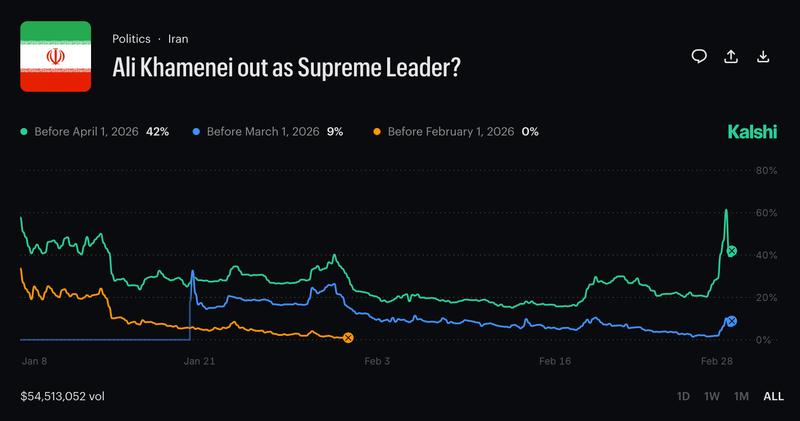
According to Mansour, Kalshi will refund all transaction fees associated with the "Ali Khamenei out as Supreme Leader" market, while compensating traders who held positions prior to Khamenei's passing based on the "last-traded price before his death."
Furthermore, individuals who established positions following Khamenei's death received reimbursement for the differential between the elevated entry price they paid and the final traded price recorded before the announcement.
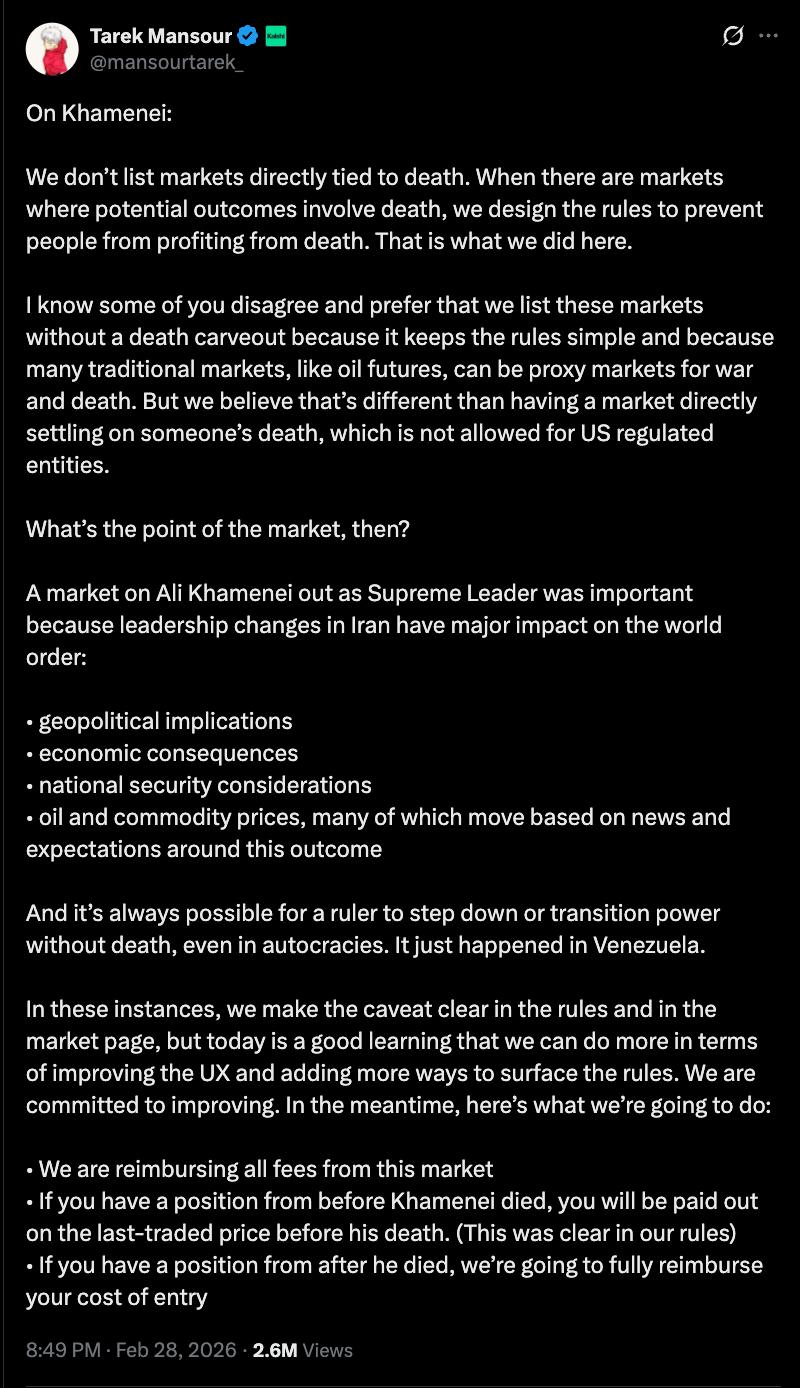
In a statement to Cointelegraph, a Kalshi representative emphasized that the platform maintains an explicit and established policy prohibiting "death markets."
The policy was reinforced by the platform on Saturday, with Mansour noting that the carveout provisions regarding death were explicitly outlined in the market's governing rules. Nevertheless, the resolution approach triggered criticism from members of the online community, with accusations that the platform was limiting potential user earnings.
Suspicions of insider trading activity on prediction market platforms rise amid geopolitical tensions
During February, half a dozen traders operating on competing prediction marketplace Polymarket earned approximately $1 million through wagers that the United States would execute a military strike against Iran prior to the conclusion of that month.
The six wallet addresses were all established during February, predominantly participated in markets concerning potential strikes on Iran, and certain positions were executed mere hours ahead of initial explosions being reported over Tehran, Iran's capital city, as documented by Bloomberg.
These particular trading behaviors triggered concerns regarding potential insider trading operations among blockchain investigators and market analysts.
During January, United States President Donald Trump revealed that the person responsible for leaking classified information connected to the military operation and apprehension of former Venezuelan President Nicolás Maduro had been taken into custody by US law enforcement authorities.
Trump's remarks generated widespread conjecture from blockchain analysis firm Lookonchain suggesting that the leaker referenced by Trump could potentially be connected to profitable wagers placed on Polymarket immediately preceding the US military operation in Caracas.