Institutional Giants Expand Bitmine Holdings While DeFi Platforms Face Liquidity Crisis: Finance Redefined
Major financial institutions increased BMNR positions as decentralized lending platforms cease operations due to liquidity challenges. ETF outflows persisted as Kraken's xStocks tokenized securities platform experienced rapid growth.
Major institutional players maintained their strategy of accumulating positions in crypto treasury firms throughout the previous week, while bear-market liquidity constraints triggered additional consolidation throughout the decentralized finance (DeFi) sector.
During Q4 2025, the principal corporate stakeholders of Bitmine Immersion Technologies, such as Morgan Stanley and Bank of America, expanded their positions in the Ether (ETH) treasury firm despite broader market turbulence and declining valuations.
Nevertheless, persistent bear-market liquidity challenges are compelling certain protocols to cease their activities, with DeFi lending platform ZeroLend announcing its closure. Additionally, Parsec, a crypto analytics service provider, has also terminated operations, pointing to cryptocurrency market instability as its principal cause.
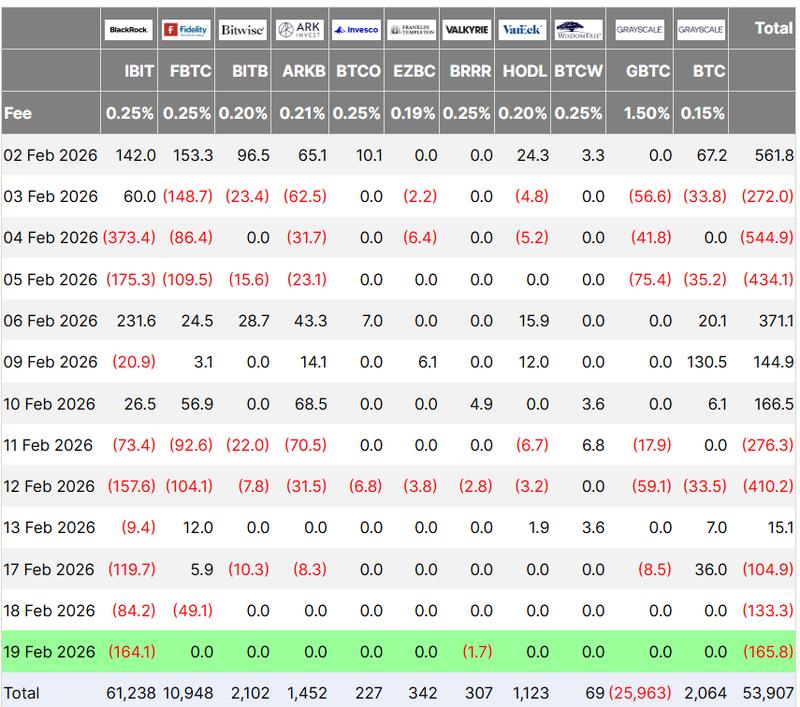
During the same timeframe, Bitcoin (BTC) and ETH both climbed approximately 2.6% throughout the previous week, occurring alongside significant withdrawals from US spot Bitcoin exchange-traded funds (ETFs), which recorded three straight days of net selling culminating in Thursday's $165 million withdrawal, according to information from Farside Investors.
Ether ETFs began the week on Tuesday with $48 million in net additions, but subsequently reversed course to record two consecutive days of withdrawals, totaling $41 million in net outflows on Wednesday and $130 million on Thursday.
Morgan Stanley and additional major stakeholders expand Bitmine positions during market downturn
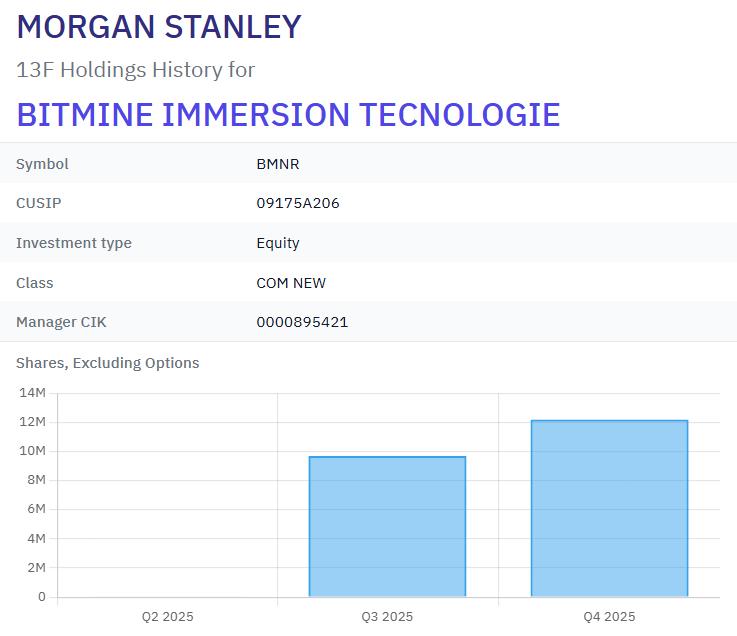
The principal stakeholders of Bitmine Immersion Technologies (BMNR) stock expanded their allocations in the prominent Ethereum treasury firm during the fourth quarter of 2025 notwithstanding a broader cryptocurrency market decline and unfavorable stock price movement.
Morgan Stanley, identified as the leading reported stakeholder, expanded its holdings by approximately 26% to exceed 12.1 million shares, representing a value of $331 million at quarter's conclusion, based on its Form 13F submission to the US Securities and Exchange Commission. ARK Investment Management, representing the second-largest stakeholder, grew its position by roughly 27% to surpass 9.4 million shares valued at $256 million, according to its regulatory disclosure.
Multiple additional major institutional stakeholders similarly expanded their positions. BlackRock grew its BMNR stake by 166%, Goldman Sachs by 588%, Vanguard by 66% and Bank of America by 1,668%.
Financial institutions expand BMNR positions amid 48% equity decline
All of the top 11 principal stakeholders expanded their BMNR positions during Q4 of 2025, including Charles Schwab, Van Eck, Royal Bank of Canada, Citigroup and the Bank of New York Mellon Corporation, based on regulatory disclosures aggregated by cryptocurrency investor Collin.
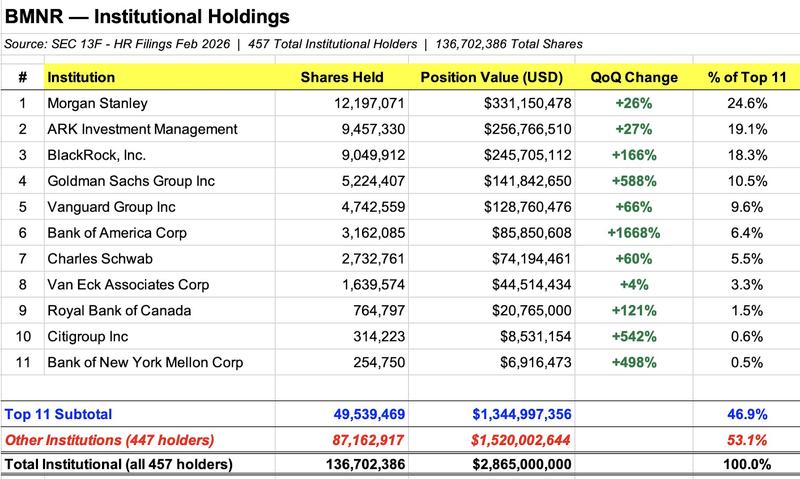
This institutional accumulation occurred despite a substantial decline in Bitmine's equity valuation. BMNR declined approximately 48% during the fourth quarter of 2025 and roughly 60% throughout the preceding six months, with shares trading around $19.90 during premarket activity Thursday, based on Google Finance information.
DeFi lending platform ZeroLend ceases operations, cites blockchain liquidity issues
Decentralized lending service ZeroLend announced it is completely terminating operations following prolonged challenges with insufficient user activity and liquidity on the blockchains where it conducts business.
After three years of building and operating the protocol, we have made the difficult decision to wind down operations.
Ryker, ZeroLend founder
"Despite the team's continued efforts, it has become clear that the protocol is no longer sustainable in its current form," he added.
ZeroLend concentrated its offerings on Ethereum layer-2 blockchain networks, previously promoted by Ethereum co-founder Vitalik Buterin as an essential component of the network's strategy to achieve scalability and maintain competitiveness.
Nevertheless, Buterin stated earlier this month that his approach for achieving scalability through layer 2s "no longer makes sense," that numerous implementations have failed to adequately incorporate Ethereum's security features, and that scalability should progressively originate from the mainnet and native rollups.
DerivaDEX introduces Bermuda-regulated derivatives DEX platform
DerivaDEX has introduced a Bermuda-regulated cryptocurrency derivatives trading platform, establishing itself as what it claims is the inaugural DAO-governed decentralized exchange operating under official regulatory authorization.
Based on an announcement from the platform, the exchange obtained a T license from the Bermuda Monetary Authority and has commenced providing crypto perpetual swaps trading to a restricted group of sophisticated retail and institutional users.
The BMA's T, or test license, is granted for a digital asset business seeking to test a proof of concept.
Upon launch, DerivaDEX provides support for prominent crypto perpetual products and indicated plans to diversify into additional markets, encompassing prediction markets and conventional securities. The organization stated the platform integrates offchain order matching with onchain settlement to Ethereum, while enabling users to maintain non-custodial control of funds.
Parsec terminates operations amid continuing cryptocurrency market instability
Onchain data analytics firm Parsec is terminating operations following five years of service, as cryptocurrency trader activity and onchain behavior patterns no longer mirror their historical characteristics.
"Parsec is shutting down," the organization announced in an X post on Thursday, while its CEO, Will Sheehan, acknowledged the "market zigged while we zagged a few too many times."
Sheehan further explained that Parsec's core concentration on decentralized finance and non-fungible tokens (NFTs) became misaligned with the current direction of the industry.
Post FTX DeFi spot lending leverage never really came back in the same way, it changed, morphed into something we understood less.
Will Sheehan, Parsec CEO
NFT sales totaled approximately $5.63 billion in 2025, representing a 37% decline from the $8.9 billion documented in 2024. Average transaction prices also decreased year-on-year, dropping to $96 from $124, based on CryptoSlam statistics.
Kraken's xStocks surpasses $25 billion in transaction volume with over 80,000 onchain participants
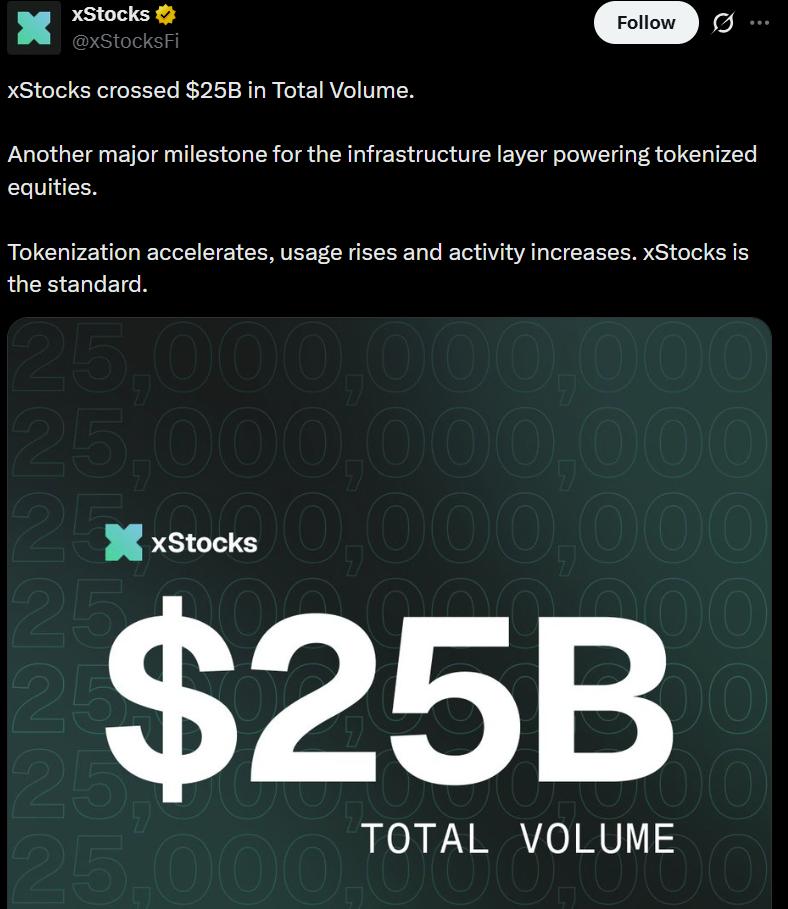
Kraken's tokenized stock trading platform, xStocks, has exceeded $25 billion in aggregate transaction volume fewer than eight months following its introduction, demonstrating accelerating market adoption as tokenization attracts increasing interest among mainstream investment participants.
Kraken revealed Thursday that the $25 billion metric encompasses trading activity across centralized exchanges and decentralized exchanges, in addition to minting and redemption transactions. The achievement represents a 150% expansion since November, when xStocks surpassed $10 billion in aggregate transaction volume.
The xStocks tokens are produced by Backed Finance, a regulated asset issuer that generates 1:1 backed tokenized versions of publicly traded stocks and exchange-traded funds. Kraken functions as a principal distribution and trading platform, while Backed bears responsibility for organizing and issuing the tokenized financial instruments.
When xStocks launched in 2025, it provided more than 60 tokenized stocks, incorporating shares connected to prominent US technology corporations like Amazon, Meta Platforms, Nvidia and Tesla.
Kraken indicated onchain participation has functioned as a primary growth catalyst since introduction, with xStocks producing $3.5 billion in onchain trading activity and exceeding 80,000 distinct onchain participants.
In contrast to trading that transpires exclusively within centralized exchanges' proprietary order books, onchain activity occurs directly on public blockchain networks, where transactions remain transparent and wallets can self-custody holdings.
Expanding onchain engagement indicates users are not merely trading tokenized stocks but also incorporating them into broader decentralized finance (DeFi) infrastructure.
Kraken stated that eight of the 11 largest tokenized stocks by unique participant count are currently integrated within the xStocks platform, indicating expanded market penetration in the developing tokenized equities industry.
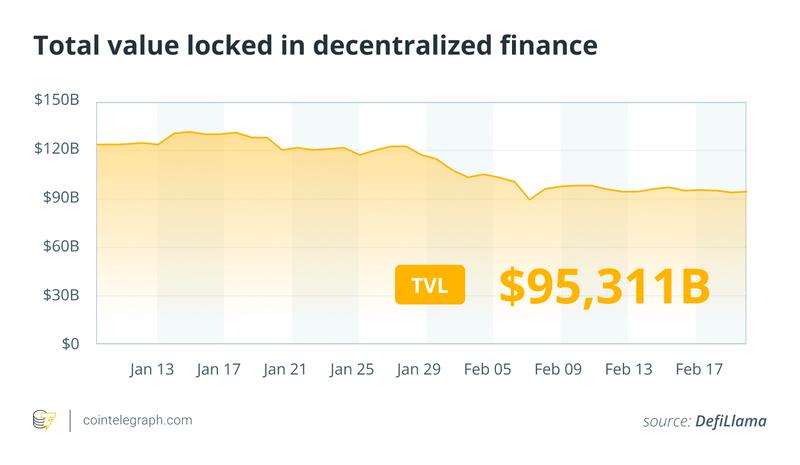
DeFi market overview
Based on information from Cointelegraph Markets Pro and TradingView, the majority of the 100 largest cryptocurrencies by market capitalization concluded the week with positive returns.
The layer-1 blockchain Kite (KITE) token increased 38% as the strongest performer in the top 100, succeeded by stablecoin payment ecosystem token Stable (STABLE), climbing over 30% throughout the past week.