Gold surges as Middle East conflict drives investors toward safe-haven assets
Growing conflict between the US and Iran is driving safe-haven flows, with gold drawing significant investor interest as stock markets and Bitcoin experience selling pressure.

Heightened geopolitical tensions across the Middle East are driving a shift in investor positioning, with safe-haven gold experiencing increased demand as market participants exit equities and cryptocurrency holdings.
Reports emerged on Wednesday indicating that Iran has dramatically boosted its crude oil export volumes, with shipments departing from Kharg Island totaling approximately 20.1 million barrels during the period spanning Feb. 15 through Feb. 20, representing roughly triple the volume recorded in January, functioning as both a proactive supply surge and protection against potential supply chain interruptions should hostilities with the United States intensify.
Concurrently, progressively more aggressive American policy statements concerning Iran's nuclear capabilities have heightened prospects for confrontation, based on analysis from Bitunix. "In the event of a direct US–Iran military conflict, gold could rise by roughly 15% within two weeks on safe-haven demand, targeting a range of $5,500-$5,800 per ounce," the analysts wrote in a note shared with Cointelegraph.
Cryptocurrency markets are similarly exposed to these broader macroeconomic dynamics, the analysts noted, pointing out that safe-haven capital movements into the US dollar could exert downward pressure on Bitcoin (BTC) prices toward the $64,000-$65,000 zone. On the other hand, if inflation concerns dominate over dollar strength, capital could rotate into alternative hedges and push BTC toward $69,000 liquidity levels, Bitunix analysts said.
Uncertainty drives flight to safety
This reallocation toward protective assets is becoming evident in current investor positioning. Information provided by The Kobeissi Letter on Thursday demonstrates that Indian market participants are aggressively shifting capital into gold holdings. Gold ETF inflows in India have climbed to about 250 billion rupees (around $2.7 billion), an all-time high, surpassing equity mutual fund inflows for the first time.
The surge in capital flowing into gold investment vehicles coincides with declining equity allocations, with gold ETF demand rising more than 900% since July as stock-fund inflows dropped by roughly 170 billion rupees (around $1.9 billion), according to The Kobeissi Letter.
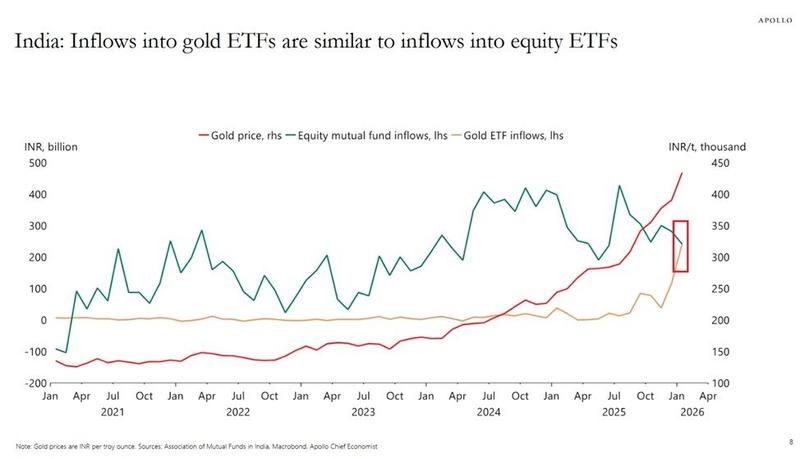
"As the world's 2nd-largest gold consumer and one of its biggest importers, India's shift toward gold ETFs marks a fundamental change in how its investors are allocating their capital," the analyst said.
Weak demand keeps Bitcoin range-bound
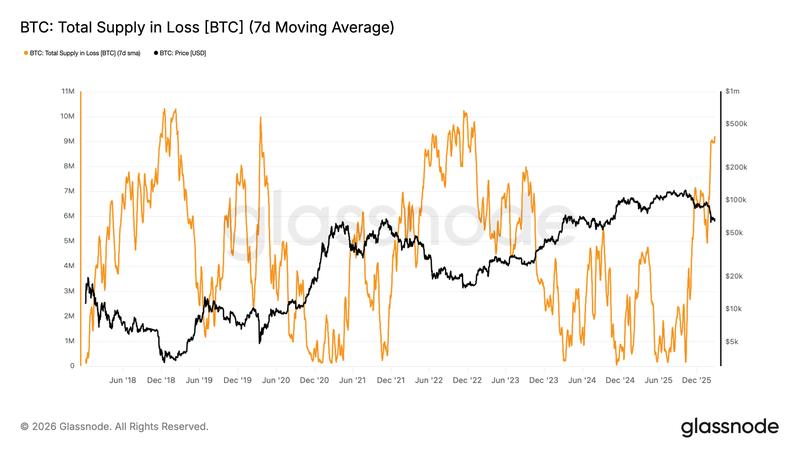
As gold attracts defensive capital allocation, blockchain data suggests cryptocurrency market conviction remains constrained. In a recent report, Glassnode said that Bitcoin continues trading between $60,000 and $70,000 with weak whale accumulation and persistent ETF outflows.
The analysis also showed that nearly 9.2 million BTC are currently held at a loss. Furthermore, the 90-day realized profit-to-loss ratio has fallen under 1, indicating more holders are selling at a loss than taking profits.
US-listed spot Bitcoin ETFs saw a rebound on Wednesday as Bitcoin climbed back above $68,000. The funds attracted about $506.5 million in daily inflows, the largest since early February, putting the funds on track for their first weekly inflow after five weeks of $3.8 billion in outflows.