
Gold-backed tokens drive tokenized commodities past $6B milestone during precious metal surge
Tokenized commodities have experienced explosive growth of 53% year-to-date, surpassing $6 billion in total value, with gold-backed digital assets leading the charge.

In a remarkable expansion occurring in fewer than six weeks, the market for tokenized commodities has surged by 53% to exceed $6.1 billion, establishing itself as the most rapidly expanding sector within the broader real-world asset tokenization ecosystem as increasing quantities of gold transition to blockchain networks.
At the beginning of the current year, the tokenized commodities sector stood at a valuation slightly above $4 billion, which indicates that approximately $2 billion in additional value has been incorporated into the market since January 1, based on information provided by Token Terminal, a cryptocurrency analytics platform.
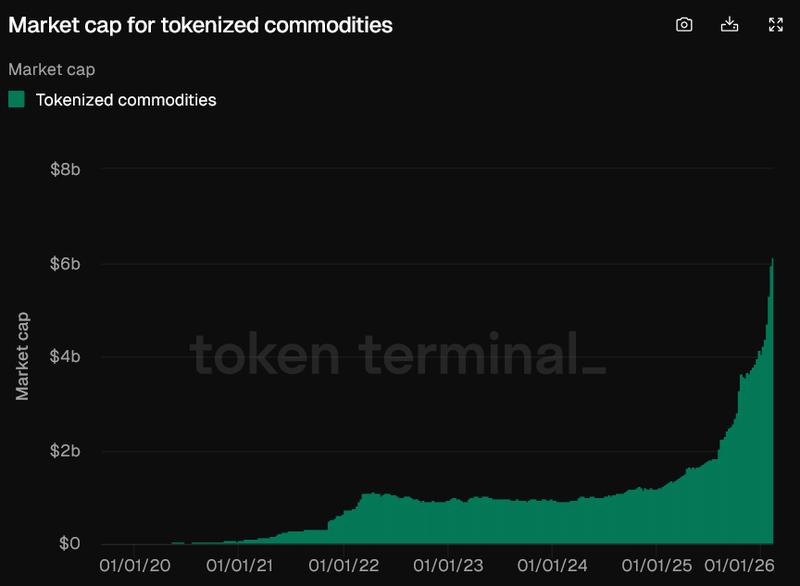
Available information reveals that gold products maintain a commanding presence within the tokenized commodities marketplace.
The gold-backed token issued by stablecoin provider Tether, known as Tether Gold (XAUt), has emerged as the primary driver behind this upward trajectory, experiencing a market capitalization expansion of 51.6% during the previous month to reach $3.6 billion, whereas PAX Gold (PAXG), which is listed by Paxos, has grown by 33.2% to attain $2.3 billion throughout the identical period.
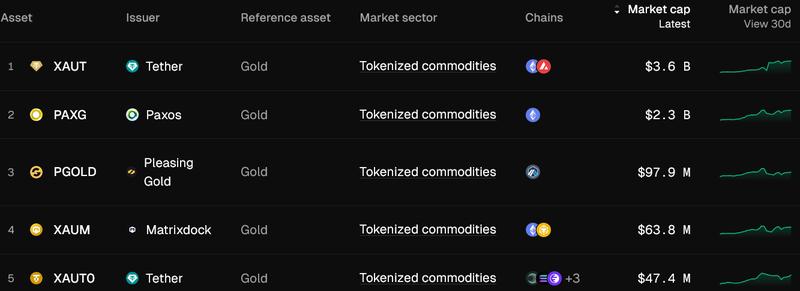
The tokenized commodities sector has now experienced a year-over-year increase of 360%, with the expansion observed since the beginning of 2026 surpassing the growth rates seen in both the tokenized stocks and tokenized funds markets, which stand at 42% and 3.6%, respectively.
This growth trajectory also positions the tokenized commodities market at slightly more than one-third the scale of the $17.2 billion tokenized funds marketplace. Additionally, it significantly exceeds the size of tokenized stocks, which currently hold a valuation of $538 million.
On Thursday, Tether broadened its approach to tokenized commodities through the acquisition of a $150 million equity position in Gold.com, a precious metals platform, as part of an initiative to expand accessibility to tokenized gold products.
According to Tether's announcement, its XAUt token will be incorporated into the Gold.com platform, and the company is investigating possibilities that would enable customers to buy physical gold using USDt (USDT) stablecoin.
Gold picks up the pace as Bitcoin stuck below $70,000
The expansion in tokenized gold products coincides with gold's spot price experiencing a rally exceeding 80% throughout the previous year, ultimately establishing a fresh all-time high of $5,600 on January 29.
Following a modest correction, gold retreated to the $4,700 level earlier during this month, though it has subsequently climbed back to $5,050 as of the current time of publication.
In contrast, Bitcoin (BTC) along with the broader cryptocurrency market have experienced a downturn since October 10, when a significant crypto market collapse resulted in the liquidation of $19 billion in positions.
Bitcoin experienced a decline of 52.4% from its peak in early October of $126,080 to approximately $60,000 on Friday, though it has since recovered to $69,050, according to data from CoinGecko.
The decline of Bitcoin occurring simultaneously with an increase in traditional safe-haven assets has prompted certain industry observers, including Strike CEO Jack Mallers, to theorize that Bitcoin continues to be perceived as a software stock despite possessing hard money attributes.
Similarly, Grayscale, a crypto asset management firm, commented that Bitcoin's longstanding characterization as "digital gold" has faced significant challenges, noting that its recent market behavior increasingly mirrors that of a high-risk growth asset instead of a conventional safe-haven investment.