
Five Key Bitcoin Developments This Week as BTC Reaches Critical Bottom Formation
Analysts predict Bitcoin may be completing a multi-month bottom formation as global economic turmoil and political tensions create market uncertainty.

As January draws to a close, Bitcoin (BTC) finds itself navigating treacherous waters amid escalating macroeconomic uncertainty.
- BTC concludes the trading week beneath critical support levels, potentially paving the way for further downside.
- The upcoming FOMC meeting shares the spotlight with concerns over Japan's economy, trade tariffs, and global political tensions.
- Historic all-time highs in precious metals markets contrast sharply with cryptocurrency underperformance.
- On-chain metrics reveal Bitcoin's short-term holder cohort experiencing unprecedented capitulation at these price points.
- Current selling activity appears "tactical" in nature, with market liquidity proving capable of handling the distribution.
Technical analysis points to potential downside for BTC
As Sunday's weekly close approached, Bitcoin experienced a decline to the $86,000 level — a price point that traders had previously identified as a potential target.
According to information from TradingView, buyers stepped in to defend this threshold during the opening hours of Asia's Monday trading session, though the $90,000 level remained elusive for bulls.
"There's so much volatility ahead of us coming week. Not only on the Bitcoin & Crypto markets, but also in forex, commodities & bond markets," crypto trader, analyst and entrepreneur Michaël van de Poppe summarized in a post on X.
"Crypto is preparing for the worst, hence the deep selloff and that's why I think coming week brings a generational opportunity across the board."
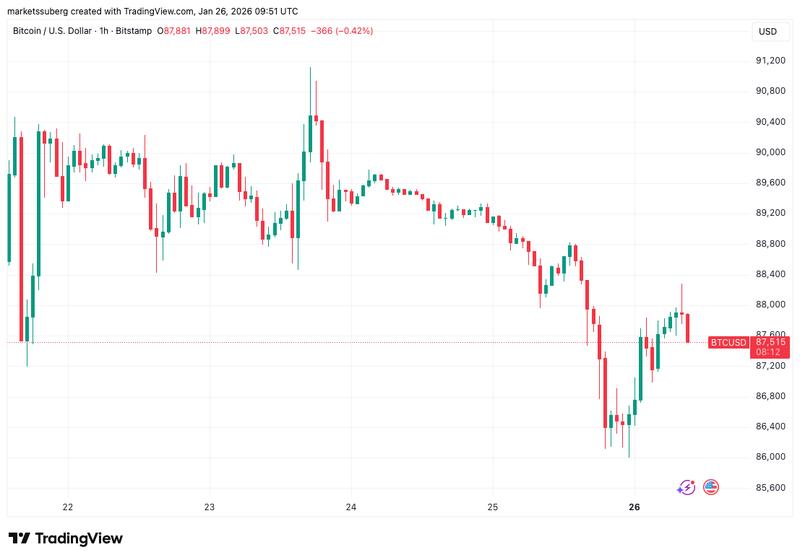
Following a weekly close beneath the $86,500 threshold, the BTC/USD trading pair has entered decidedly bearish territory, according to Material Indicators cofounder Keith Alan.
Alan's most recent analysis highlighted potential ramifications should the weekly candle close below both the 2026 yearly opening price around $87,500 and the 100-week simple moving average (SMA) positioned at $87,250.
"Wicks don't count, it's the close that matters," he added in a separate post showing exchange order-book liquidity data and whale orders.
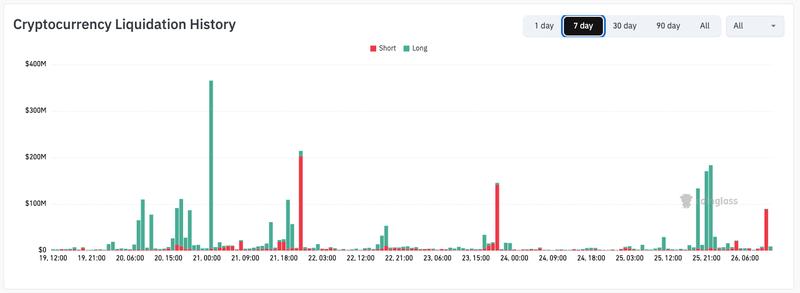
Information from monitoring resource CoinGlass confirmed 24-hour cross-crypto liquidations of nearly $750 million at the time of writing.
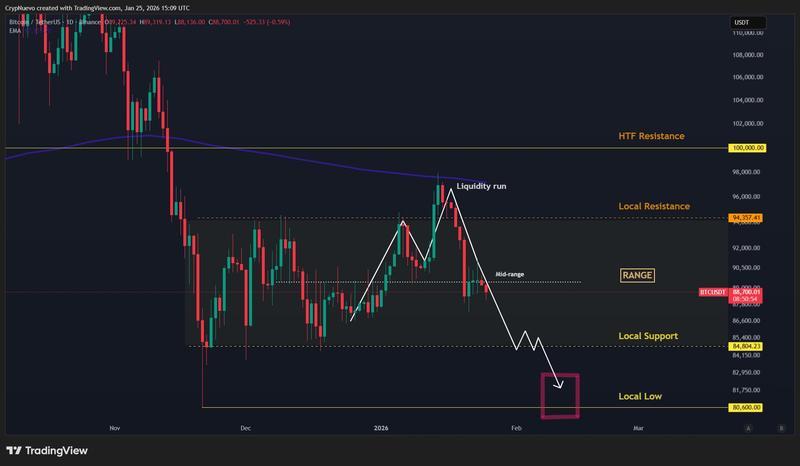
"Based on Bitcoin losing the mid-range; HTF liquidations to the downside; and the possible US Gov. shutdown, we still think that the most likely scenario is that Bitcoin drops back to low $80s in the coming weeks," trader CrypNuevo forecast at the weekend.
Taking a contrarian stance, trader, analyst and commentator BitQuant issued a bold statement announcing a pivotal moment for Bitcoin's price trajectory.
"The coming week is significant in that it marks the end of the bottoming phase," he told X followers.
BitQuant maintains his perspective that Bitcoin's ultimate long-term peak has yet to materialize, projecting this top will occur at $145,000.
FOMC meeting headlines "wild year" amid multiple volatility catalysts
While the Federal Reserve's interest rate decision represents the week's primary macroeconomic event, market participants face numerous sources of potential turbulence.
Additional concerns include anxiety surrounding Japan's economic situation and the Fed's decision to purchase yen, alongside unresolved questions regarding international trade policy.
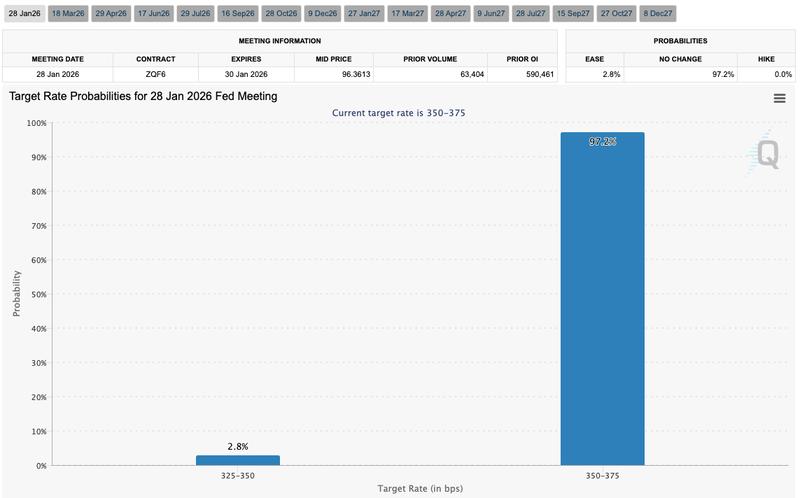
This Wednesday will see the Federal Open Market Committee (FOMC) reveal any adjustments to its benchmark interest rate, with Chair Jerome Powell providing forward guidance through his accompanying speech and press conference.
Financial markets will pay particularly close attention to Powell's rhetoric for indications of potential policy shifts. Market consensus has long anticipated that rates will remain unchanged at this particular meeting.
Simultaneously, ongoing friction between Powell and US President Donald Trump persists, compounded by a legal inquiry into Federal Reserve building renovations that Powell characterized as a justification for attempting to alter his policy approach ahead of his approaching replacement.
"The Chief Investment Officer of BlackRock is now expected to be the next Fed Chair. And, Trump says cutting rates is a 'requirement' for the next Fed Chair and is actively calling for 1% interest rates. 2026 is going to be a wild year," trading resource The Kobeissi Letter commented on X.
Recent macroeconomic data releases have painted a contradictory picture regarding US inflationary pressures. Nevertheless, equity markets continue their robust beginning to 2026, while cryptocurrency assets remain stagnant.
"Core measures of consumer inflation have remained near the 3% level on a year-over-year basis, with the disinflation trend since mid-2022 stalling out well above the Fed's 2% inflation target."
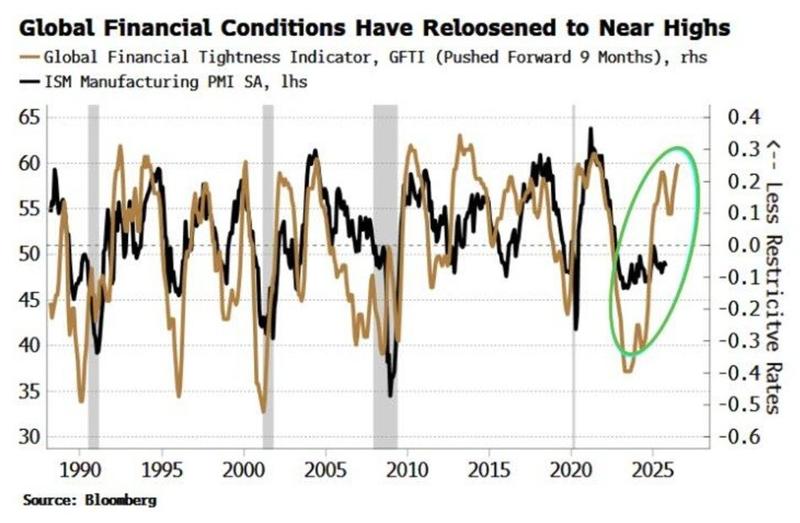
Analysis from Mosaic suggested that any resurgence in inflationary pressures throughout this year could precipitate market dynamics reminiscent of the 1970s era.
In addition, the current week will feature the December Producer Price Index (PPI) release. The November PPI data exceeded market forecasts.
Precious metals reach all-time highs while cryptocurrency markets lag behind
In an anticipated development, both gold and silver breached historic price milestones to commence the week, surpassing the $5,000 and $100 thresholds, respectively.
The XAU/USD pair climbed to $5,111 per ounce, while XAG/USD touched $110 for the first time ever during the Monday Asia trading hours.
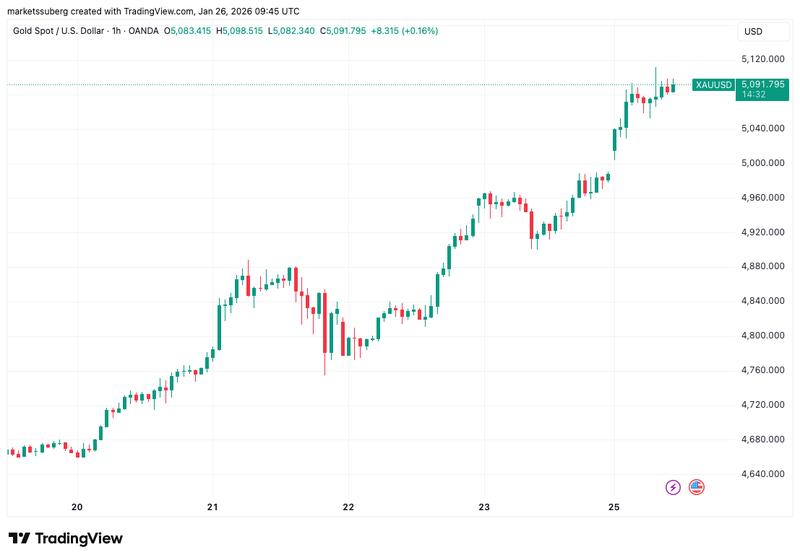
The uninterrupted ascent of precious metals persists while Bitcoin and alternative cryptocurrencies struggle to attract buying interest, having remained confined within a tight trading range throughout recent months.
This inverse correlation is now starting to generate attention beyond cryptocurrency trading circles.
"Where is Bitcoin?" The Kobeissi Letter queried in a dedicated X post on the phenomenon.
"Silver prices are now outperforming Bitcoin by one of their widest margins on record. In ~13 months, Silver is up +270% as Bitcoin has fallen -11%. This makes Silver's market cap 3.5 TIMES larger than Bitcoin. The world is waiting on crypto."
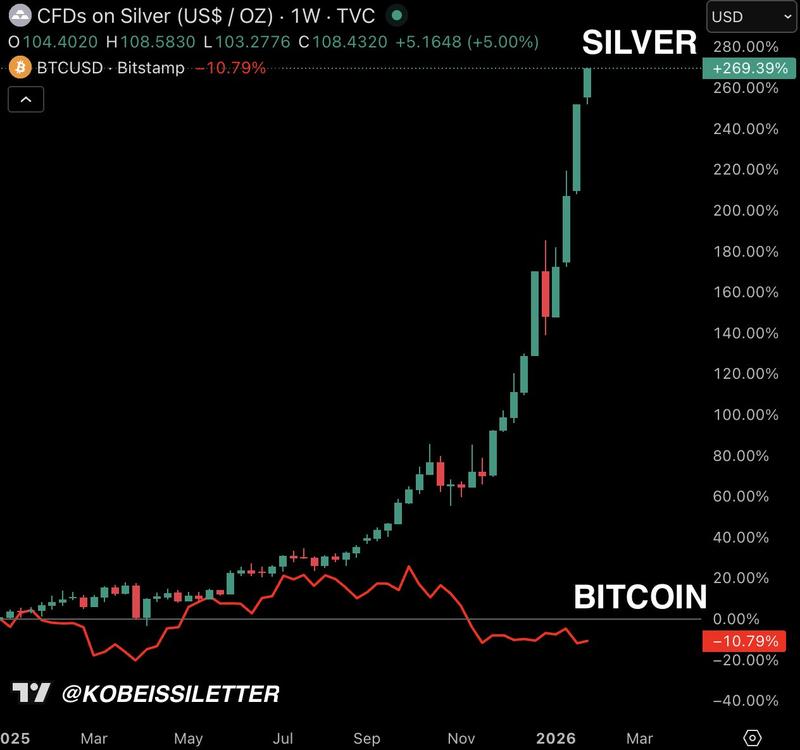
Kobeissi indicated that the prospect of another United States government shutdown, which the firm characterized as "likely," was "adding fuel to the fire" throughout precious metals markets.
Van de Poppe articulated the bullish cryptocurrency sentiment regarding the Bitcoin-gold relationship.
"Bitcoin vs. Gold is the cheapest it has ever been. At least, the gap between the two has never been this big in terms of fair value. The 2-Week RSI is the lowest ever. Lower than in 2022, lower than in 2018," he wrote Sunday.
"It doesn't make sense to be valuing an asset like Bitcoin against the dollar, it makes sense to value Bitcoin against other assets, in this case Gold. In that aspect, Gold is expensive, Bitcoin is super cheap."
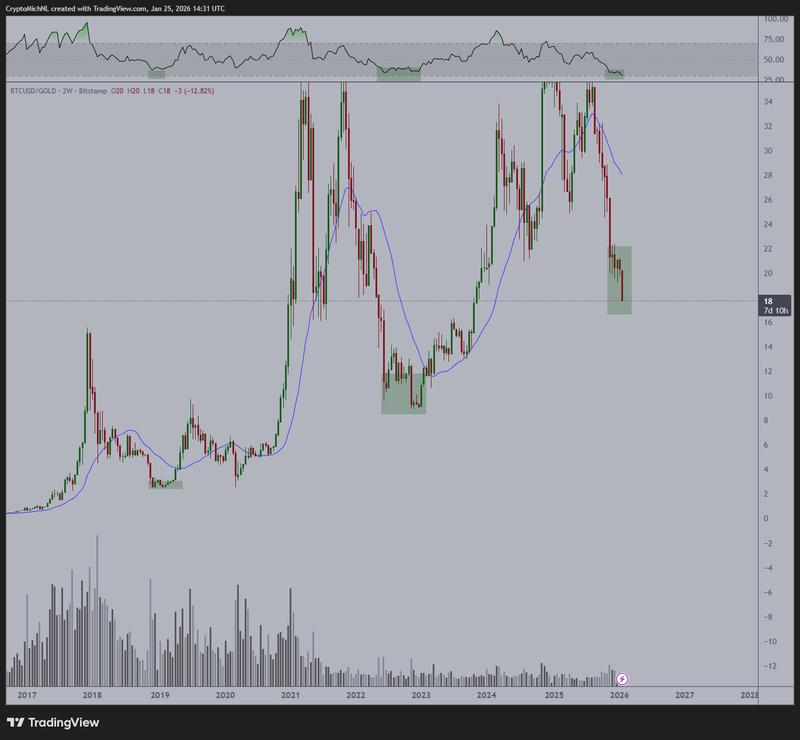
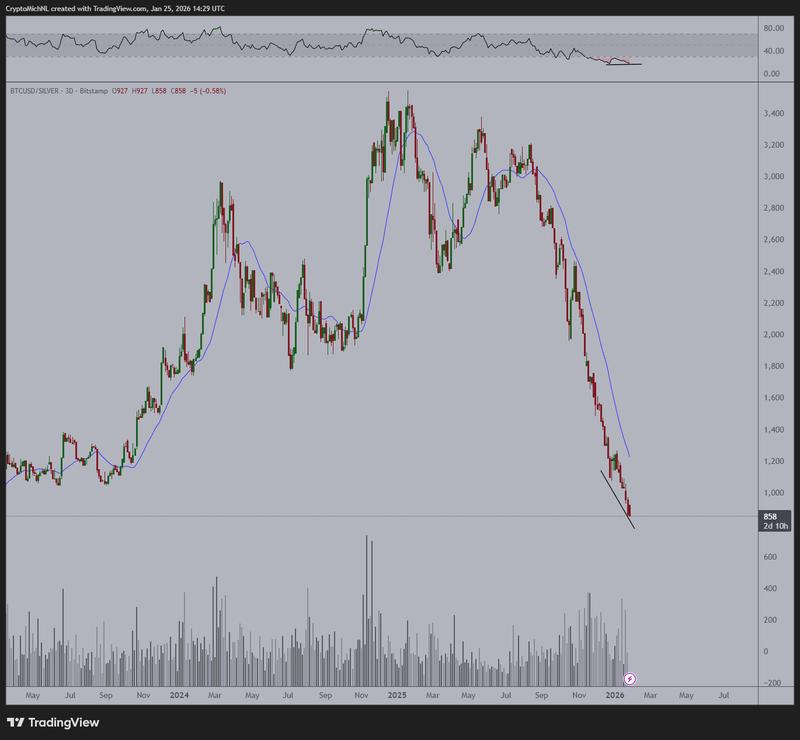
Simultaneously, Van de Poppe disclosed an extraordinary potential bullish divergence pattern on the BTC/XAG trading pair.
"What does this say? This does say that the coming week is going to be extremely volatile and could indicate a bottom on this metric and therefore, Silver is likely to peak and money is likely rotating towards other assets," he commented.
Recent Bitcoin buyers experiencing record capitulation levels
While BTC price movement may appear range-bound, blockchain data reveals that recent market entrants remain highly reactive to sudden price fluctuations.
Sharing information on X from onchain analytics resource Checkonchain, the analytics account named after famous economist Frank Fetter wrote that loss-making trades were making history.
"Short-term holders are realizing losses at historic levels on the bitcoin CRASH to $86k," it stated.
The analysis highlighted the realized profit/loss ratio specific to Bitcoin's short-term holder (STH) cohort — defined as wallet addresses holding their respective BTC amounts for six months or less.
The percentage of transactions originating from STH wallets where Bitcoin is being transferred at prices below its previous movement price has reached unprecedented levels. This ratio currently sits lower than during the 2022 bear market trough, when the BTC/USD pair reached $15,600 following an approximately 80% decline from its previous 2021 all-time peak.
Additionally, onchain analytics platform CryptoQuant validates that the aggregate BTC supply has breached a concerning profitability threshold.
The total supply currently in profit stands at 62% — marking the lowest reading since September 2024, when Bitcoin was trading near the $30,000 level.
"When Bitcoin Supply in Profit drops below 70% and fails to recover above 80%, it is historically a sign of a potential further decline and often a confirmation of a bear market," contributor El Crypto Tavo wrote in an accompanying "Quicktake" blog post.
Current Bitcoin distribution appears "genuine but controlled"
Examining the weekend's descent to $86,000, CryptoQuant analysts maintained a calm perspective.
Through evaluation of volume delta metrics across exchange order books, contributor Arab Chain contended that markets were not witnessing a mass exodus.
Volume delta measurements reached a comparatively moderate $59.6 million on the Binance exchange throughout the price dip, suggesting only marginal seller dominance over buyers.
"Numerically, this represents significant selling pressure; however, its true significance becomes apparent when compared to price action," Arab Chain explained.
"Despite this large negative figure, no sharp price collapse was observed, indicating strong liquidity absorption within the order book."
Volume delta z-score measurements, the analysis continued, indicated "short-term tactical selling pressure rather than a phase of panic or widespread forced liquidation."
During the previous week, Cointelegraph documented divergent perspectives among institutional Bitcoin investors amid ambiguous price trends heavily influenced by external factors.
"These values reflect genuine but controlled selling pressure, characterized by elevated selling liquidity, limited imbalance, and moderate statistical deviation," Arab Chain concluded.
"This combination often defines rebalancing phases, during which momentum temporarily weakens without a breakdown in market structure."