
Europe's Crypto Future: What Lies Ahead as Lagarde Exits the ECB?
Christine Lagarde, the ECB's president, has maintained a skeptical stance on digital currencies, yet the candidates poised to succeed her share similarly cautious views on crypto.

Christine Lagarde, who currently serves as president of the European Central Bank (ECB), plans to exit her position ahead of France's upcoming presidential election next year.
During her tenure at the ECB, Lagarde oversaw consultations regarding the Markets in Crypto Assets (MiCA) legislation, which established the regulatory framework for cryptocurrencies throughout the European Union. Additionally, the leading European financial institution initiated development of the digital euro — representing the future evolution of the Eurozone's monetary system.
However, significant work remains on cryptocurrency policy across Europe. In its present iteration, MiCA fails to provide regulatory oversight for decentralized finance (DeFi), while ECB policymakers continue their deliberations regarding the digital euro's ultimate specifications.
Although the precise date of Lagarde's exit remains unconfirmed, commentators have already begun speculating about her potential replacement and the implications for European crypto policy.
Lagarde maintained a crypto-skeptical position, particularly regarding stablecoins
Similar to numerous other central banking officials, Lagarde has demonstrated caution, at most, toward cryptocurrencies. During 2022, she expressed her views on crypto by stating, "My very humble assessment is that it is worth nothing."
"It is based on nothing ... There is no underlying asset to act as an anchor of safety."
She advocated for cryptocurrency regulation, expressing concerns that investors lacked proper understanding of the risks inherent in crypto investments and might "lose it all."
This established the framework for subsequent ECB consultations regarding MiCA. While the ECB lacks direct legislative authority, the institution advised, monitored and provided commentary throughout the lawmaking process, especially concerning matters related to monetary policy and payment system regulations.
Following MiCA's passage, Lagarde continued pushing for stringent stablecoin regulations and harmonized international standards. During September 2025, she urged European lawmakers to establish protective measures for stablecoins and equivalence requirements for foreign stablecoin issuers to mitigate the danger of stablecoin bank runs.
"European legislation should ensure that such schemes cannot operate in the EU unless supported by robust equivalence regimes in other jurisdictions and safeguards relating to the transfer of assets between the EU and non-EU entities," she said.
"This also highlights why international cooperation is indispensable. Without a level global playing field, risks will always seek the path of least resistance."
She additionally argued that stablecoins pose a danger to national sovereignty and transform money from serving as a public good into becoming a privately managed enterprise.
"When stablecoins are left unchecked, we risk creating a system in which money is controlled by the private sector. That is not the mandate we were appointed to serve as public servants."
Consumer demand for digital currency and the euro
Despite her well-documented crypto skepticism, Lagarde recognized the growing demand for digital currencies as early as 2021. During a World Economic Forum interview that year, Lagarde stated, "If customers prefer to use digital currencies rather than have banknotes and cash available, it should be available."
"We should respond to that demand and have a solution that is European based, that is secure, that is available, and friendly terms that can be used as a means of payment." For the ECB, this response manifested in the development of the digital euro.
However, Brussels' bureaucratic machinery operates at a deliberate pace. The investigative phase for a digital euro commenced as far back as October 2021. By October 2025, the ECB concluded the preparation phase after its governing council made the decision to begin preparing for actual issuance.
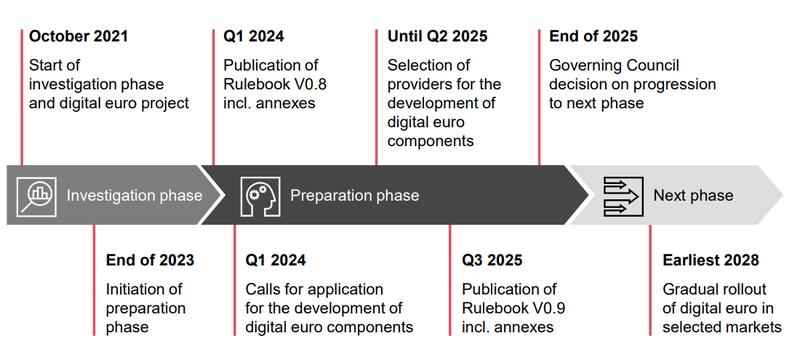
The digital euro has encountered substantial criticism, primarily concerns that it would provide central banks with an additional mechanism to track consumer activities, regulate spending patterns and eliminate anonymous financial transactions. Additional worries have emerged regarding offline functionality and excessive dependence on digital infrastructure.
The ECB maintains that the digital euro will incorporate rigorous privacy protections and deliver all the advantages of physical cash within the digital monetary ecosystem. In October 2025, Lagarde declared that the ECB aims to make the euro "fit for the future, redesigning and modernising our banknotes and preparing for the issuance of digital cash."
Her colleague, Piero Cipollone, a member of the ECB executive board, emphasized that the digital euro "will ensure that people enjoy the benefits of cash also in the digital era. In doing so, it will enhance the resilience of Europe's payment landscape, lower costs for merchants, and create a platform for private companies to innovate, scale up and compete."
Leading ECB candidates appear unlikely to shift from cautious approach
Lagarde's choice to resign arrives during a period of political turbulence. Her departure prior to France's next presidential election will enable President Emmanuel Macron to participate in selecting her successor.
As the EU's second-largest economy, France holds considerable influence, and according to Reuters, no ECB president has been appointed without approval from Paris.
The right-wing National Rally has gained momentum in recent polling, while Macron has struggled to provide consistent governance, cycling through seven different prime ministers during his presidency. Jordan Bardella, president of the National Rally, asserts that by selecting a new ECB president, Macron would be able to wield influence extending beyond his official term's conclusion.
Based on Financial Times reporting, the current leading candidates to succeed Lagarde include Pablo Hernández de Cos, former governor of Spain's central bank, and Klaas Knot, former governor of the Dutch central bank.
During a 2022 Bank of International Settlements (BIS) conference, Hernández de Cos stated that crypto can "pose highly significant risks that are hard to understand and measure, even for the most experienced agents."
He advocated for a comprehensive regulatory framework to shift crypto from "that hyperbolic 'Wild West' myth to a more desirable orderly 'railroad of civilisation.'"
Knot has demonstrated comparable caution. Addressing the BIS in 2024, he acknowledged potential advantages offered by certain elements of blockchain technology.
"Creating a digital representation of an asset and placing it on a distributed ledger could bring benefits to the financial system. This includes efficiency gains and potentially increased liquidity of certain assets. Of course, there may also be risks for financial stability."
Nevertheless, he emphasized that regulators were evaluating the consequences these technologies might have on overall financial stability, declaring that, "We cannot presume that this innovation, and potentially more decentralization, will bring significant benefits to the global financial system."
During June 2025, he specifically addressed stablecoins. Knot suggested that whether the future form of money emerges through stablecoins or established payment networks "should be something we are agnostic on."
Although maintaining neutrality regarding the technological methods supporting financial innovation, he emphasized that "fostering innovation must not come at the expense of stability."
Despite frequent criticism regarding its slow-moving progress, the EU succeeded in implementing a comprehensive crypto regulatory framework before the considerably more crypto-friendly United States. This framework incorporated guidance and contributions from a crypto-cautious central bank, led by a skeptical president.