
Ethereum Surges Past $2,100 Amid Broader Market Recovery: Has the Decline Ended?
Ethereum's value climbed beyond $2,150 alongside gains in Bitcoin and traditional US equities, yet questions remain about whether derivatives market participants have adopted an optimistic stance.

Key takeaways:
- The Ethereum network continues to lead in total value locked metrics, though it confronts criticism regarding its layer-2 scaling approach.
- ETH experienced inflationary pressure reaching 0.8% amid declining onchain activity, whereas concerns over US macroeconomic conditions maintained a pessimistic tone within derivatives trading.
The price of Ether (ETH) successfully recovered above the $2,100 threshold after experiencing a dramatic 43% decline spanning nine days, which saw the digital asset reach a bottom of $1,750 on Friday. Even though a 22% rebound occurred following its lowest valuation since April 2025, ETH derivatives trading continues to demonstrate investor apprehension regarding potential further declines. Whether macroeconomic conditions are the primary driver behind investor anxiety or not, the likelihood of sustained bullish price action for ETH over the near term appears limited.
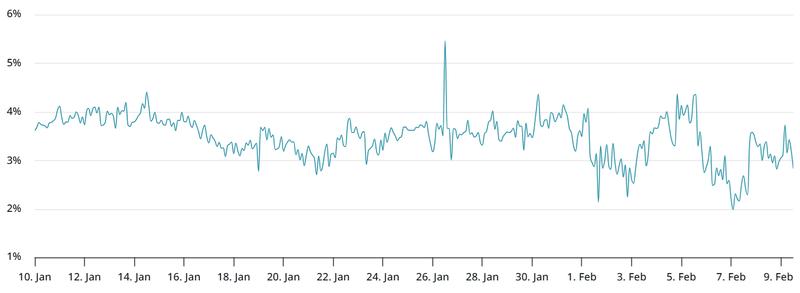
Ethereum's monthly futures contracts were trading at a 3% premium compared to conventional spot exchanges on Monday, falling short of the 5% neutral benchmark. This absence of optimistic sentiment among Ethereum market participants has persisted throughout the previous month, displaying no indication of recovery despite the price approaching $1,800. In the absence of bullish investors demonstrating robust risk appetite at current price levels, bearish market participants will probably maintain their dominant position.
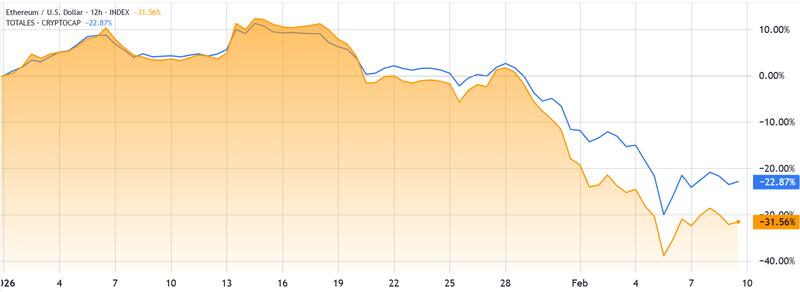
Throughout 2026, ETH has lagged behind the overall cryptocurrency market capitalization by 9%, prompting market participants to analyze the factors contributing to capital outflows. Taking a wider view, the reduced enthusiasm for decentralized applications (DApps) extends beyond the Ethereum ecosystem alone. When combining its layer-2 scaling solutions, the network maintains its position as the clear leader in Total Value Locked (TVL) and fee revenue generation.
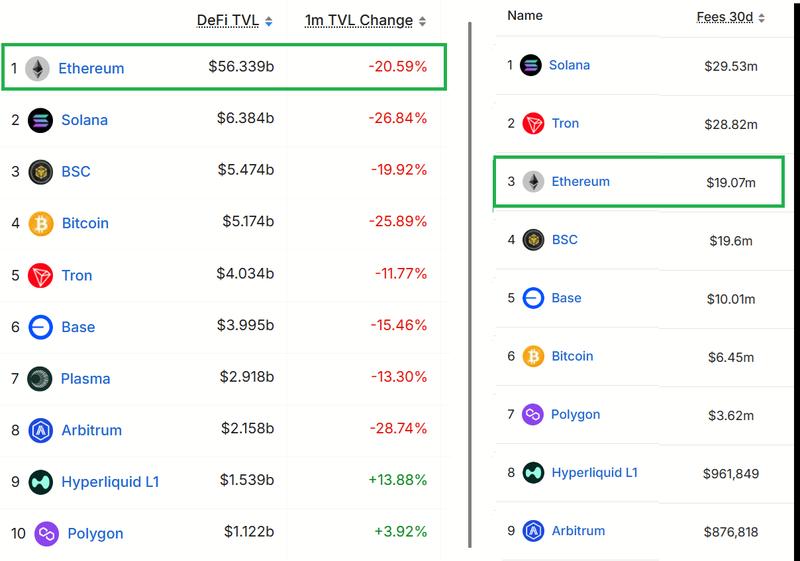
The Ethereum base layer holds 58% of all deposits across the blockchain industry; this percentage increases beyond 65% when factoring in Base, Arbitrum, and Optimism. To illustrate, Solana's largest application barely reaches $2 billion in deposits. In contrast, the biggest DApp operating on Ethereum's base layer contains more than $23 billion in TVL. Solana's Jupiter wouldn't even rank among the top 14 applications on Ethereum.
ETH supply growth and layer-2 subsidies remain problematic
In terms of network fee generation, the Ethereum base layer secured third position, producing $19 million during the 30-day period, while its layer-2 ecosystem added an additional $14.6 million. Criticism has been directed at Ethereum for providing substantial subsidies to scalability through optimistic rollups—an approach that Vitalik Buterin personally acknowledged requires refinement. On Tuesday, the Ethereum co-founder contended that the network ought to emphasize base layer scalability as a priority.
In Buterin's assessment, achieving decentralization through the layer-2 pathway proved more challenging than initially expected. Current implementations allegedly depend on multisig-controlled bridges, which fail to satisfy the security requirements established by Ethereum's foundational vision. Buterin clarifies that this doesn't represent the final destination for layer-2 solutions, as demand will persist for networks providing privacy capabilities and application-specific architectures, particularly for non-financial applications.
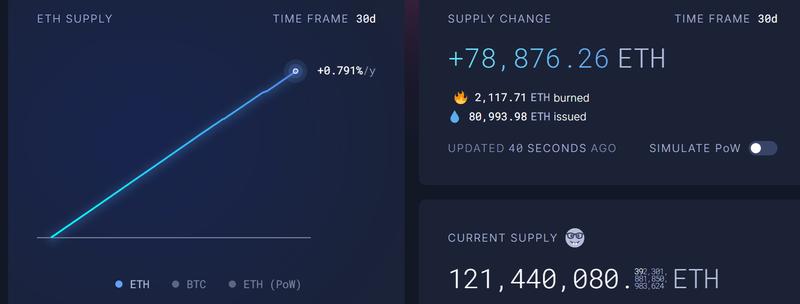
Investor dissatisfaction can be partially attributed to the unsuccessful implementation of Ether's deflationary strategy, which represents a secondary consequence of diminished Ethereum network usage. The integrated burn mechanism relies upon demand for base layer data transactions; in its absence, a net expansion in ETH supply occurs. Over the past 30 days, the annualized expansion rate of total ETH in circulation climbed to 0.8%, marking a substantial increase compared to one year earlier when comparable inflation hovered around 0%.
Market participants trading Ether maintain a skeptical outlook regarding the possibility of a sustainable price rally occurring in the immediate future, primarily due to heightened uncertainty surrounding the US employment landscape and questions about the long-term viability of artificial intelligence infrastructure investments. As a result, the weakness observed in ETH derivatives markets serves as an indicator of widespread risk aversion combined with reduced onchain activity—elements that will probably require additional time to reach equilibrium.