
Ethereum Co-Founder Vitalik Buterin Champions Software Update to Streamline Node Operations
Buterin emphasizes the importance of transforming Ethereum node operation into an accessible, user-friendly process that empowers individual users to maintain their own "self-sovereign" infrastructure.

On Saturday, Vitalik Buterin, who co-founded Ethereum, published a proposal in the form of a pull request that aims to combine the backend software programs utilized by network nodes for interacting with both Ethereum's Beacon Chain—responsible for managing consensus mechanisms and staking operations—and the execution layer of the protocol into a single, unified codebase designed to streamline the node configuration process.
Those who operate Ethereum nodes, alternatively referred to as validators, are presently required to operate two distinct software programs, with each one demanding its own setup procedures and synchronization processes to ensure proper coordination and communication of information generated by both the consensus and execution layers of the Ethereum network.
This situation increases the level of technical sophistication needed to operate a node or deliver validation services for the Ethereum blockchain, creating barriers that discourage average users from managing their own network infrastructure and compelling them to depend on third-party service providers instead.
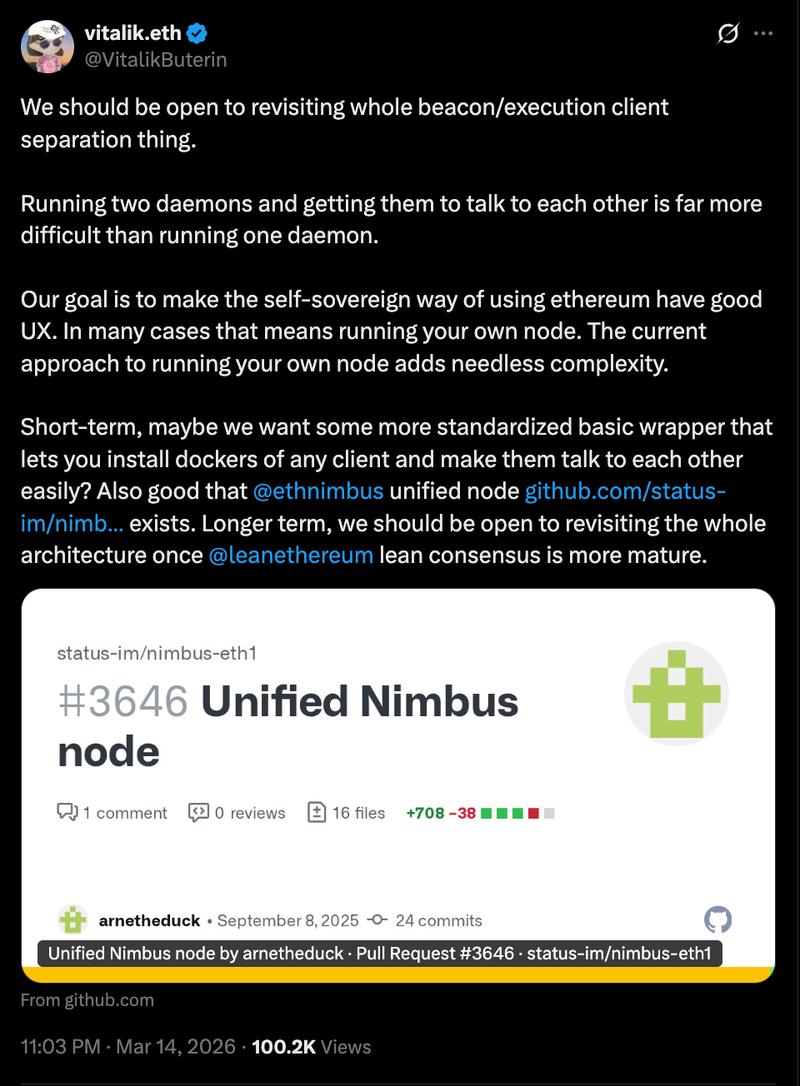
"I feel like at every level, we have implicitly made this decision that running a node is this oh so scary DevOps task that it is ok to leave to professionals," Buterin said in a post on X. He continued:
"It is not. We need to reverse this. Running your own Ethereum infrastructure should be the basic right of every individual and household. 'The hardware requirement is high, therefore it's okay for the DevOps skill and time requirements to also be high,' is not an excuse."
According to Buterin, even individuals who possess the financial means to acquire the high-performance computing equipment necessary for establishing an Ethereum node and who have the required technical knowledge generally lack sufficient time to complete the setup process, emphasizing his point that "nodes should be easy."
The Ethereum blockchain platform, along with other smart contract-enabled networks, has encountered criticism regarding the technical sophistication and computing hardware specifications needed to operate a node, which has additionally sparked concerns about centralization within these networks.
Buterin proposes partially stateless nodes to further decentralize the network
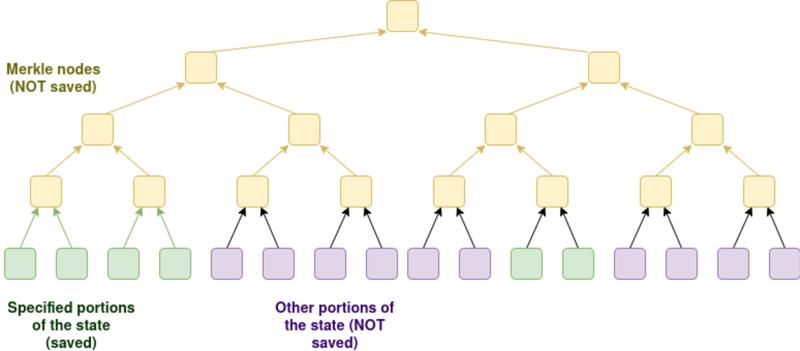
During May 2025, Buterin put forward a proposal for partially stateless nodes, which eliminate the need to maintain the complete block history and instead only preserve data that the individual node operator specifically needs.
This approach decreases both the hardware expenditures and data storage demands for individuals who run nodes for their own personal use cases, such as submitting transactions and conducting blockchain verification.
According to Go-Ethereum (GETH), disk space typically represents the main constraint for those operating nodes. Smart contract-based blockchain networks such as Ethereum produce substantial volumes of data that demand continuously expanding storage capacity, which makes specialized node hardware equipment a requirement.
"A market structure dominated by a few remote procedure call (RPC) providers is one that will face strong pressure to deplatform or censor users. Many RPC providers already exclude entire countries," Buterin wrote.
Toward the end of January, Buterin announced that he had allocated 16,384 Ether, valued at approximately $45 million, from his own personal cryptocurrency holdings to provide support for privacy-preserving technologies, open hardware initiatives, and secure, verifiable software development. He further stated that these funds would be distributed incrementally over the next several years as the Ethereum Foundation transitions into a phase of what he characterized as "mild austerity," while simultaneously maintaining progress on its technical roadmap.