
Elite BTC Traders Maintain Cautious Stance Despite 14% Price Recovery: Analysis
Despite Bitcoin's impressive double-digit rally and temporary surge past $72,000 suggesting $60,000 marked the floor, market data reveals leading traders remain hesitant to establish long positions.

Key takeaways:
- Binance's Bitcoin long-to-short metric reached its lowest point in 30 days, indicating a significant drop in appetite for bullish leveraged positions.
- Bitcoin exchange-traded funds listed in the United States broke a negative pattern with $516 million worth of net inflows after experiencing substantial liquidations.
Over the past four days, Bitcoin (BTC) has traded within a narrow 8% band, stabilizing around $69,000 following a sudden drop to $60,130 last Friday. Market participants are now attempting to understand the main drivers behind this pullback, especially considering the S&P 500 remains close to all-time highs while gold has surged 20% during a two-month stretch.
The ambiguity stemming from Bitcoin's 52% pullback from its $126,220 peak reached in October 2025 has seemingly triggered an extremely cautious approach among leading traders, fueling worries about additional price drops ahead.
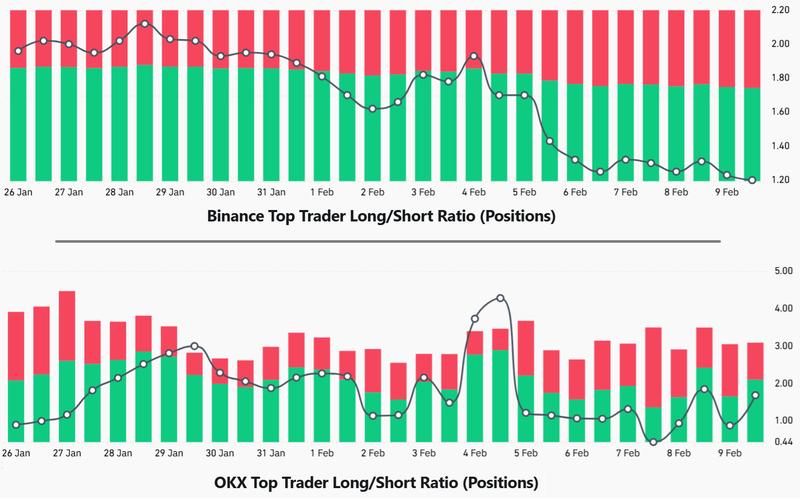
Large holders and market-making entities on Binance have consistently reduced their bullish positions since the middle of last week. This trend becomes evident when examining the long-to-short ratio, which fell to 1.20 from 1.93. This measurement marks the lowest level seen on the platform in 30 days, indicating that interest in leveraged bullish positions across margin and futures trading has diminished, despite BTC touching 15-month lows.
At the same time, OKX's long-to-short ratio among elite traders reached 1.7 this Tuesday, marking a dramatic shift from the 4.3 high recorded last Thursday. This change coincides with a $1 billion forced liquidation event involving leveraged long BTC futures positions, during which traders were compelled to close their holdings because of insufficient margin requirements. Critically, this particular metric represents forced liquidations rather than a strategic choice to bet on continued downward movement.
Robust ETF Demand Indicates Bitcoin Whales Haven't Turned Bearish
Interest in spot Bitcoin exchange-traded funds (ETFs) provides compelling proof that large-scale holders have not adopted a bearish outlook, notwithstanding the recent price vulnerability.
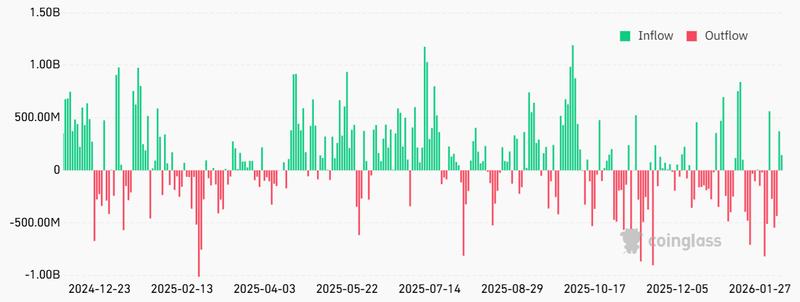
Beginning Friday, Bitcoin ETFs trading on US exchanges have recorded $516 million in net inflows, overturning a pattern observed during the preceding three trading sessions. As a result, the circumstances that caused the $2.2 billion in net outflows spanning Jan. 27 through Feb. 5 seem to have subsided. A prevailing hypothesis for that selling pressure suggested an Asian investment vehicle that imploded following the use of leverage on ETF options positions through inexpensive Japanese yen borrowing.
Franklin Bi, who serves as a general partner at Pantera Capital, maintained that a non-crypto-native trading entity represents the most probable source. He observed that a wider cross-asset margin liquidation occurred simultaneously with steep declines across metals markets. To illustrate, silver experienced a remarkable 45% plunge during the seven-day period concluding Feb. 5, wiping out two months worth of appreciation. Nevertheless, official information has not yet been published to confirm this hypothesis.
The options market for Bitcoin exhibited a comparable pattern, with an uptick in neutral-to-bearish trading approaches on Thursday. Market participants adjusted their positions after Bitcoin's valuation dropped beneath $72,000 instead of preemptively preparing for deteriorating circumstances.
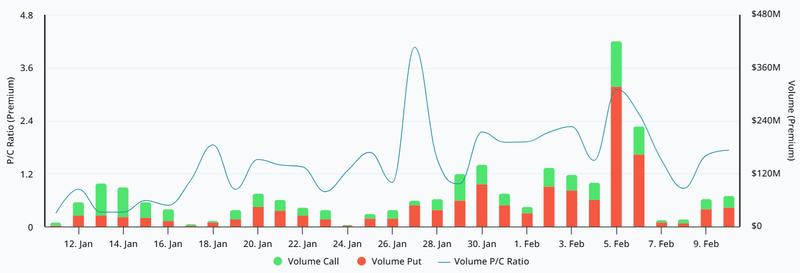
At Deribit, the BTC options premium put-to-call ratio climbed to 3.1 last Thursday, showing overwhelming preference for put (sell) contracts, although the measure has subsequently fallen back to 1.7. In aggregate, the previous two weeks have been characterized by subdued interest in establishing bullish positions via BTC derivatives instruments. Although market sentiment has deteriorated, reduced leverage levels create a more solid foundation for sustained price appreciation once momentum reverses.
What might trigger a shift in investor sentiment back toward favoring Bitcoin remains uncertain, given that fundamental attributes such as censorship resistance and rigorous monetary policy remain constant. The lackluster demand for Bitcoin derivatives instruments should not be construed as diminished confidence. Rather, it signifies an increase in uncertainty pending confirmation that trading platforms and market makers emerged unscathed from the price collapse.