
Crypto adoption signals from Wall Street fall on deaf ears among traditional investors: Bitwise
Despite Wall Street's clear embrace of cryptocurrency infrastructure, conventional investors remain too prejudiced to capitalize on the emerging opportunity, according to Matt Hougan from Bitwise.

Conventional investors have yet to comprehend the potential influence cryptocurrency could wield over financial markets, suggesting there may be a window of opportunity to invest in what the technology is poised to become, according to Matt Hougan, chief investment officer at Bitwise.
"Everywhere I look, Wall Street is screaming that finance is moving on-chain. Not a little of it; all of it," Hougan said in a note on Tuesday. "Yet traditional investors can't hear it."
According to Hougan, investors are experiencing "anchoring bias" and remain stuck on the perception of crypto from its nascent stages — a period when it remained an obscure technology primarily utilized by cypherpunks and illicit marketplaces on the dark web.
"They look at crypto and still see a punk skateboarder with tattoos. They don't realize he's shaved, put on a suit, and is deploying infrastructure that will underpin the next generation of capital markets," Hougan said.
Leading financial institutions have either introduced or are testing various aspects of cryptocurrency technology, primarily tokenization and stablecoins, encouraged by US regulators and policymakers advancing support for the industry.
Crypto investors not registering the shift
According to Hougan, cryptocurrency investors are likewise failing to recognize the ongoing transformation, given that traditional financial institutions have previously shown fleeting interest in the sector.
"They're suffering from 'the boy who cried wolf' syndrome," he said. "They've heard the promises of institutional adoption for so long that they no longer register."
Hougan contended, however, that prominent financial institutions have started transitioning on-chain with regulatory support, specifically citing the Securities and Exchange Commission's "Project Crypto," introduced in July to "enable America's financial markets to move on-chain," as stated by its chair, Paul Atkins.
The aggregate value of tokenized assets existing on blockchains, including US Treasurys and commodities, has rapidly approached $20 billion, he noted, representing more than a four-fold increase throughout 2025.
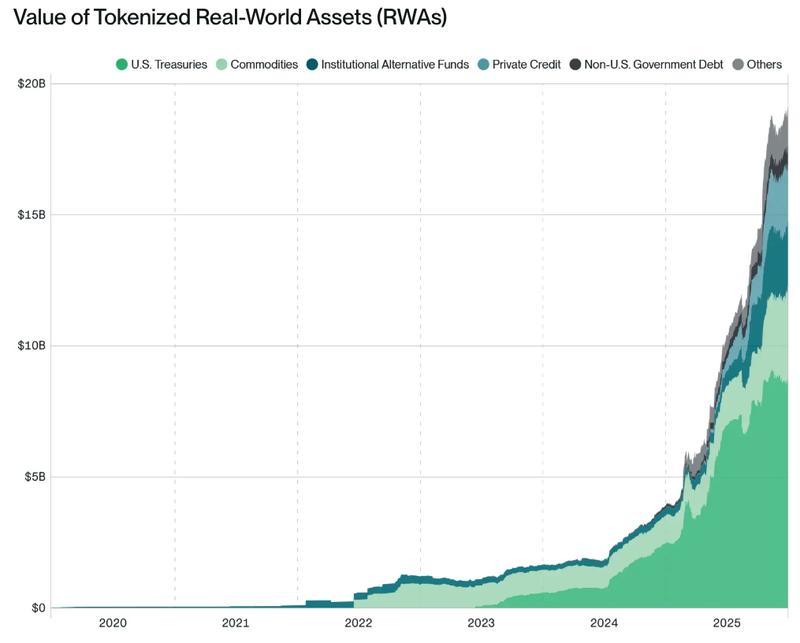
"The numbers in question are enormous," he said, noting that the hundreds of trillions of dollars circulating within exchange-traded funds, stocks and bonds indicates the tokenization market "can grow 10,000x and still have room to grow."
Hougan further noted that BlackRock and credit manager Apollo have introduced tokenized funds on-chain valued at billions of dollars, while major banking institutions JPMorgan, Bank of America, Citigroup, and Wells Fargo are currently in discussions regarding a stablecoin.
"There is a large delta between what people think is happening in crypto and what is actually happening," Hougan said.
"From where I sit, that gap creates a significant opportunity — not to try to pick winners prematurely, but to build broad exposure to the space while the market is still mispricing the structural shift," he added.