
Congressional Bill Aims to Shield Blockchain Developers from Criminal Charges
Backed by industry leaders, the Promoting Innovation in Blockchain Development Act represents Congress's effort to prevent the criminalization of software code creation.
Legislators from both sides of the political aisle in the United States House of Representatives have put forward a new bill designed to prevent criminal prosecution of software programmers who do not maintain custody or exercise control over other people's cryptocurrency assets.
According to an announcement made Thursday, House members Scott Fitzgerald, Ben Cline and Zoe Lofgren revealed they would be introducing the Promoting Innovation in Blockchain Development Act with the goal of transforming the approach to criminal prosecutions potentially involving developers working in the blockchain space.
The proposed legislation seeks to make clear that Section 1960 of US federal law, which addresses the "prohibition of illegal money transmitting businesses," should be enforced exclusively against parties who maintain control over the digital assets of other individuals.
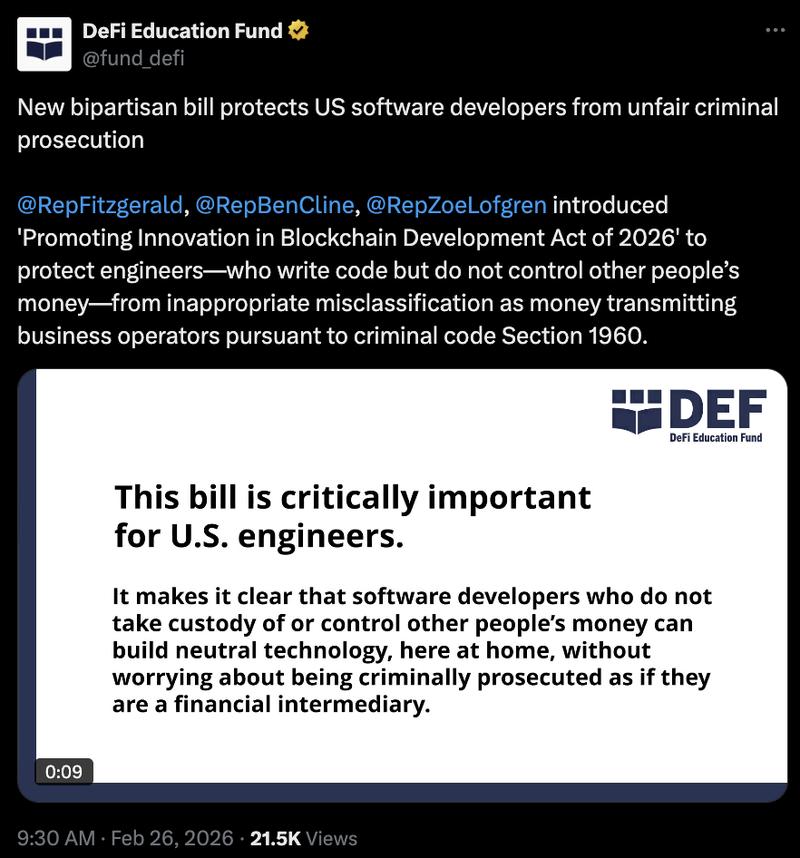
A minimum of two cryptocurrency advocacy groups have expressed public backing for the proposed legislation. According to the Blockchain Association, the measure represents a "critical step" toward supporting developers based in the United States. Meanwhile, the DeFi Education Fund (DEF) stated that the bill would probably end prosecutions resembling those brought against Tornado Cash developer Roman Storm or those who created the Samourai Wallet.
[The bill] makes it clear software developers who do not take custody of or control other people's money can build neutral technology, here at home, without worrying about being criminally prosecuted as if they are a financial intermediary
DeFi Education Fund
Whether the legislation, should it become law, would halt previously initiated legal proceedings against software developers remains uncertain. In August 2025, Storm was convicted of operating an unlicensed money transmitter business, whereas Samourai Wallet co-founders Keonne Rodriguez and Will Lonergan Hill entered guilty pleas to comparable charges in July and subsequently received prison sentences of five and four years, in that order.
By Thursday, Storm remained without a sentence and potentially faced a retrial concerning two additional charges against him.
US Senate to potentially address blockchain bill
Senators in the United States upper chamber have already presented their own legislative proposal aimed at protecting developers. During January, Senators Cynthia Lummis and Ron Wyden unveiled the Blockchain Regulatory Certainty Act, intended to establish that developers who write code or maintain networks do not satisfy the criteria for being held criminally responsible as an unlicensed money transmitter.
During this period, the Senate has been deliberating on how to proceed with a wide-ranging digital asset market structure bill that was transmitted from the House in July 2025.
Although the CLARITY Act successfully passed through the Senate Agriculture Committee in January, it remains unaddressed with a markup session in the Senate Banking Committee. Whether the final version of the bill potentially approved by the complete chamber might incorporate developer protections remains uncertain, particularly given opposition from certain lawmakers.