
CoinDCX Co-Founders Cleared: Indian Court Rules Impersonation Scam Involved No Direct Involvement
Co-founders of CoinDCX have been released on bail after a Thane court determined there was insufficient evidence connecting them to a $75,000 fraud scheme involving a fraudulent website impersonating the cryptocurrency exchange.

In Thane, India, a magistrate court has released CoinDCX co-founders Sumit Surendra Gupta and Niraj Ashok Khandelwal on bail, determining that no prima facie case existed against them in connection with a cheating complaint involving 71 lakh Indian rupees ($75,000) tied to a fraudulent trading platform that impersonated the Indian cryptocurrency exchange.
The magistrate's common order dated March 23 regarding their bail petitions found that the co-founders were entitled to release because the available evidence, even upon preliminary examination, did not establish a case against them. The pair had been brought in for questioning on Saturday and held in custody throughout the weekend following allegations from a complainant who claimed they had defrauded an investor.
According to the magistrate's order, the investigating officer raised "no objection" to granting them bail, and the court documented that the applicants were not physically present in Mumbra at the time the alleged crime occurred, further noting that "some other person by representing as accused cheated the informant," a fact which the complainant himself acknowledged before the court.
CoinDCX says bail order backs "third‑party impersonation"
Through a statement posted on X on March 24, CoinDCX indicated that the court's proceedings validated a "third-party impersonation" narrative and confirmed that the fraudulent activity took place on a copycat website, coindcx.pro, which the company emphasized has no affiliation whatsoever with its legitimate operations.
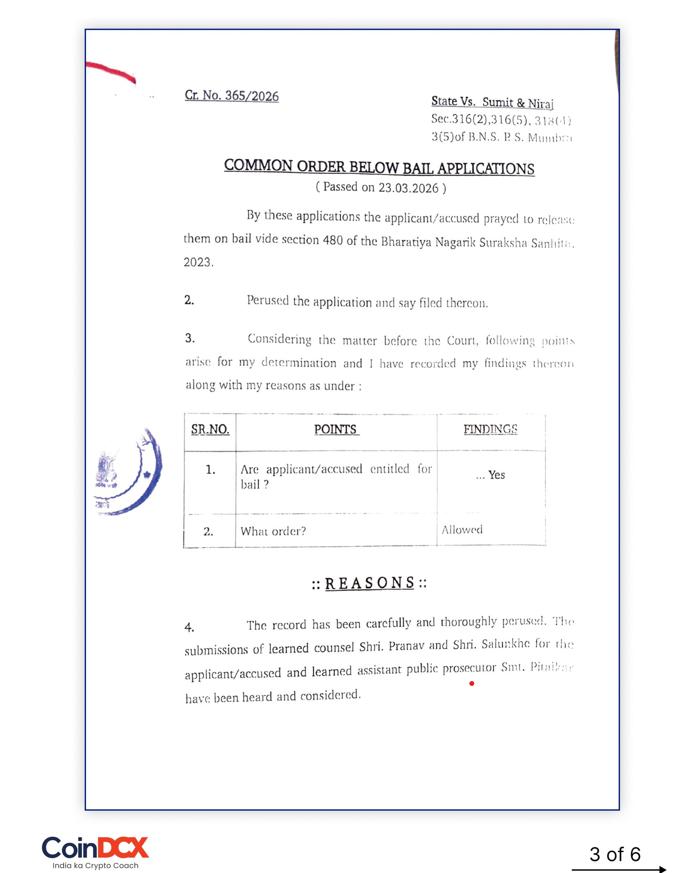
The presiding judge observed that the complainant submitted a sworn affidavit indicating that another individual named in the case, Rana, had reimbursed him for the fraudulently obtained sum and that the applicants were not the individuals he had actually met at a café located in Kausa Mumbra where the deceptive transaction was conducted.
Given that the dispute had been "amicably settled" between the complainant and the primary accused party, the court concluded there was no possibility of the co-founders interfering with evidence or attempting to influence witnesses.
Both individuals were directed to be released on bail after posting a bond of 50,000 Indian rupees (approximately $530) each, subject to the requirement that they provide full cooperation during both the investigation phase and any subsequent trial proceedings.
CoinDCX characterized this incident as representative of a growing trend of impersonation and phishing fraud schemes that have been increasingly targeting prominent brands within India's financial services and cryptocurrency industries, and strongly advised users to carefully verify domain names and ensure they only engage with the exchange's authentic platform and verified social media accounts.