
CBDC Ban Demand from GOP Lawmakers Threatens Progress on Affordable Housing Legislation
House Republicans are putting a bipartisan affordable housing measure at risk by insisting on the inclusion of a complete prohibition against central bank digital currencies.

Members of the Republican Party in the United States Congress are determined to prevent any chance of a central bank digital currency (CBDC) from becoming reality. Their strategy involves jeopardizing advancement on legislation aimed at addressing housing affordability that has bipartisan backing.
Several Republican lawmakers in the US House of Representatives drafted a correspondence on March 6, highlighting what they described as the "dire need to prohibit a Central Bank Digital Currency from ever happening in the United States."
The correspondence referenced well-worn talking points asserting that a CBDC poses risks to financial privacy while providing the US Federal Reserve with unparalleled powers of financial surveillance over citizens.
Observers are raising questions about the Republican urgency to ban a CBDC, especially considering that major global economic powers including the European Union and China are advancing their own digital currency initiatives. Nevertheless, the Republican lawmakers appear willing to withdraw their backing from a bipartisan housing measure to achieve their objective.
GOP Lawmakers Tie CBDC Prohibition to 21st Century ROAD to Housing Act
A total of twenty-eight Republican representatives put their signatures on correspondence addressed to House Speaker Mike Johnson. Within the letter, they acknowledged that the 21st Century ROAD to Housing Act, currently advancing through the Senate Banking Committee, included language that would prohibit CBDCs.
However, the legislators argued the prohibition lacked sufficient strength. They pointed out that the ban included a sunset provision scheduled for 2030, and further stated that the current language fails to prevent the Fed from conducting research on a CBDC, something Minnesota Rep. Tom Emmer's bill from the previous year attempted to prohibit.
The lawmakers issued demands that both elements be stripped from the Senate version before it arrives in the House, asserting that any "prohibition on a Central Bank Digital Currency must be permanent." They issued a warning regarding the housing bill's fate if their demands weren't met:
Otherwise, we will do everything to ensure that the 21st Century ROAD to Housing Act is dead-on arrival.
Republican Representative Anna Paulina Luna stated, "This will probably get nasty so I am telling everyone now. We would appreciate your air support on this."
This action places a relatively obscure and largely unfamiliar monetary policy issue into legislation that would ostensibly tackle widespread concerns about housing affordability across the United States.
Data from a June 2025 survey conducted by fintech firm Aevi reveals that 61% of Americans are completely unaware of what a CBDC is. This percentage climbs even higher when examining older demographics, with more than 70% of those aged 55 to 64 reporting they've never encountered the term.
At the same time, the cost of housing across the US continues to climb. Information compiled by LongtermTrends from the Fed and the S&P/Case-Shiller Home Price Index demonstrates that the average single-family home now costs 7.14 times the median annual household income.
This represents the most extreme home price-to-median household income ratio ever recorded in data extending back to the late 1940s, surpassing even the peak of the 2006 housing bubble.
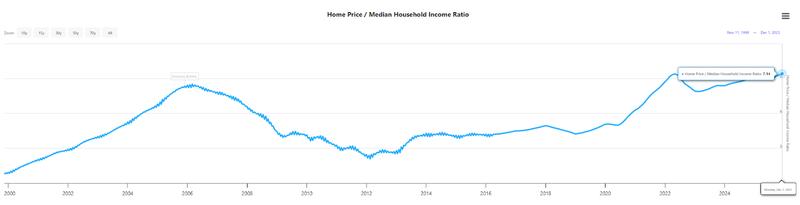
One contributing factor is a shortage in housing supply. Construction of new homes plummeted following the 2008 financial crisis. This downward trend has persisted throughout the second Trump administration.
The bipartisan 21st Century ROAD to Housing Act that has emerged contains multiple provisions designed to facilitate new housing construction and consequently reduce costs. These measures encompass accelerated environmental reviews and expanded Federal Housing Administration family loan limits.
"The package includes the vast majority of the Senate's unanimously supported ROAD to Housing Act, incorporates bipartisan housing ideas from the House, and takes a good first step to rein in corporate landlords that are squeezing families out of homeownership," Senator Elizabeth Warren said in a statement.
The current presidential administration has already indicated its endorsement of the legislation, which includes a ban on CBDCs.
Obstructing legislation focused on housing affordability over the issue of a CBDC, a concept most voters have minimal knowledge about, could prove problematic politically, particularly as President Donald Trump and Congress experience declining approval ratings while economic issues remain at the forefront of voter concerns.
Is a CBDC Necessary for Maintaining Dollar Dominance?
Members of the Republican Party express concerns regarding the privacy ramifications of a CBDC, and these worries are not unique to them. Addressing the digital euro, the European Central Bank's proposed CBDC, Luxembourg-based economist Elisabeth Krecké raised questions about how the balance between privacy and functionality could be effectively maintained.
"The digital euro drafters simply assert that Europe's legal framework offers the 'strongest privacy protections in the world,'" she said. "The real question is: What happens to the data in the end? Who will have access to it and, ultimately, who will control it?"
Members of the Democratic Party demonstrate considerably less skepticism toward a CBDC compared to their Republican counterparts. This is particularly noteworthy given that, according to Krecké, over 90% of the world's central banks are investigating the technology.
In a criticism of Emmer's early efforts to ban a CBDC, Congresswoman Maxine Waters said in a statement, "When Republicans raise concerns about CBDCs they are talking about retail CBDCs, but because they are so averse to knowledge and studying things, they have no idea that their bill blocks research into other forms of digitizing the dollar that could truly cut costs for people."
She further argued that possessing a functional and operational digital currency would enable China to offer an appealing alternative to the dollar's position as the global reserve currency.
Congressional leaders continue negotiating the specifics of the CLARITY Act, the highly anticipated crypto framework legislation, and at this juncture the fate of a CBDC is being weighed against the goal of more affordable housing as midterm elections approach.