
BTC Struggles Below $72K Mark While Four On-Chain Indicators Signal 'Weakening Market Interest'
BTC value continues to face resistance under the $72,000 threshold, with distribution patterns among holders, reduced large-wallet transactions, and weakening network expansion raising concerns about near-term price action.

The price of Bitcoin (BTC) encountered significant resistance in its attempts to surge past the $72,000 threshold, with multiple critical onchain indicators revealing diminishing interest in BTC, raising questions about its capacity for upward momentum.
Key takeaways:
- Bitcoin investors shift to distribution as whales and smaller cohorts aggressively sell under weak market conditions.
- Bitcoin whale transaction count hits multi-year lows, as smart money waits for policy and geopolitical clarity.
- Bitcoin's hash rate fell sharply amid rising energy costs, increasing chances of miner capitulation.
Bitcoin holders transition toward distribution phase
Holders of Bitcoin have been adopting an increasingly cautious stance, offloading their BTC positions during the recent period of price vulnerability driven by tensions between the US and Israel-Iran conflict, alongside additional macroeconomic challenges.
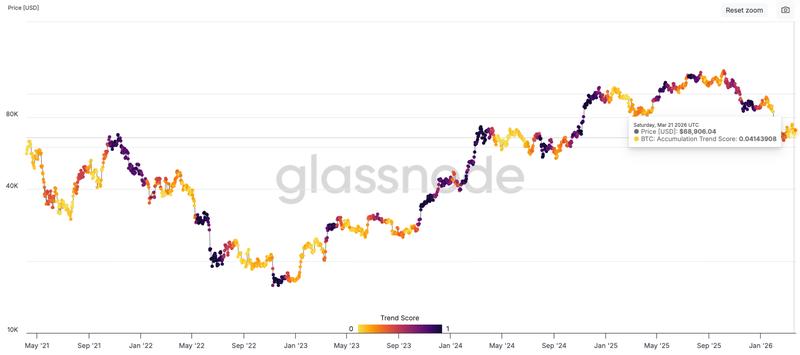
According to Glassnode's Accumulation Trend Score (ATS), readings are hovering near zero (light yellow), signaling that major holders are either selling off their BTC positions or refraining from further accumulation activities.
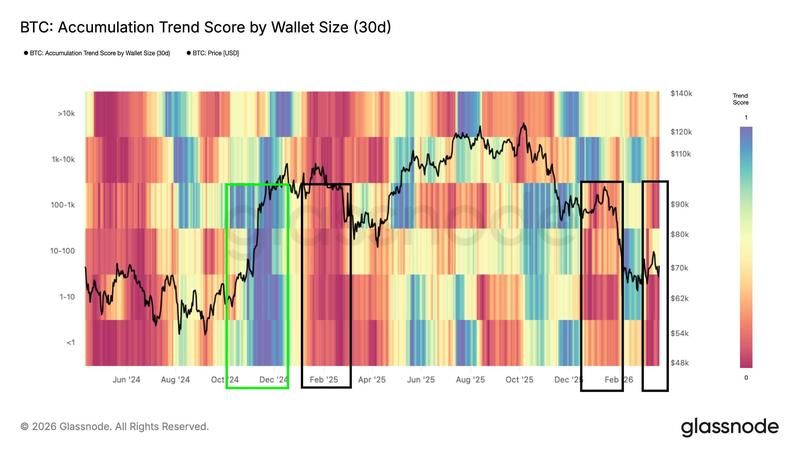
The decline in this trend score reveals a transformation from accumulation behavior to distribution patterns across nearly all wallet size categories. This behavioral shift resembles a comparable pattern witnessed in early 2025, which coincided with Bitcoin's decline to $74,500 in April 2025.
Further information from Glassnode reveals a "shift toward distribution or inactivity" among smaller to medium-sized wallets containing fewer than 1,000 BTC.
This stands in stark contrast to "Q4 2024, where broad cohort accumulation preceded a sustained rally," the onchain data provider said in a Tuesday post on X, adding:
"Heavy participation across wallet sizes remains a precondition for any durable recovery."
Large Bitcoin holder transactions reach "historically quiet" levels
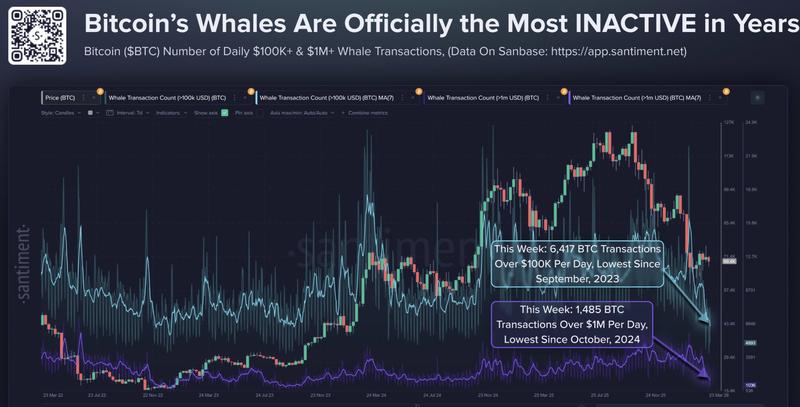
Mirroring this shift toward distribution or reduced accumulation patterns is the activity level among Bitcoin whales, which has reached "historically quiet" territory, according to Santiment.
During the previous week, the number of daily BTC transfers exceeding $100,000 plummeted to merely 6,417, marking the lowest point since September 2023. Simultaneously, transactions surpassing $1 million declined to 1,485, reaching levels not observed since October 2024.
The reduction in whale transaction volume is primarily attributed to market players awaiting "clarity from the CLARITY Act," along with a permanent resolution to the war, according to the data analytics company.
This suggests that "smart money is reluctant to make moves with so much policy and global uncertainty at play," Santiment added.
Network engagement on Bitcoin blockchain shows deterioration
The failure of Bitcoin to maintain its recovery trajectory is additionally demonstrated by reduced network engagement and diminished onchain interest.
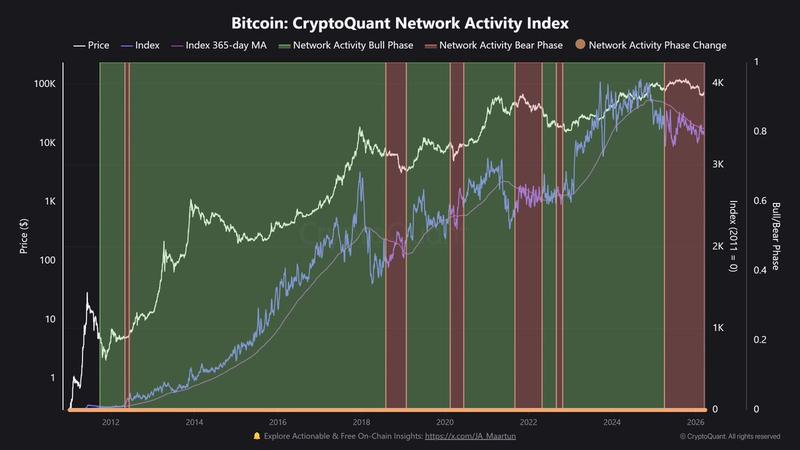
The Bitcoin network activity index from CryptoQuant, which monitors essential metrics including daily active addresses, total transactions count, and UTXO count, has experienced a downward trajectory since August 2025.
This signals "weaker demand across the network," CryptoQuant analyst Maartunn said in a recent post on X.
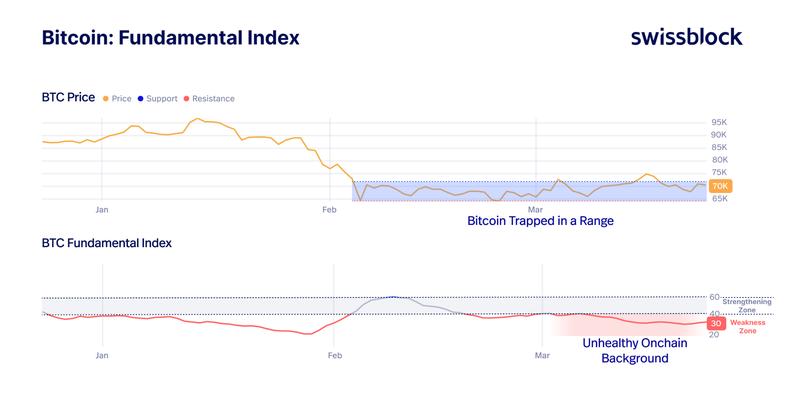
This corresponds with fragile onchain fundamentals including liquidity and network growth as measured by Bitcoin Vector's fundamental index.
This indicator "keeps trending lower and remains well below the strengthening zone," Bitcoin Vector said in a Tuesday X post.
The onchain analytics firm characterized the prevailing market environment as "stability without support," rather than a healthy consolidation, adding:
"As long as onchain conditions stay weak, upside looks increasingly dependent on flow, short covering, or external catalysts, not organic strength. If fundamentals don't recover, this kind of divergence usually doesn't support a sustained mid-term recovery."
Bitcoin's mining computational power experiences 22% decline
The hash rate of Bitcoin, an indicator that reveals the intensity of mining operations, has experienced a significant downturn throughout the past several weeks, indicating that mining operators are powering down their equipment.
The computational power has declined to 813 EH/s on Wednesday, down from 1.2 ZH/s on March 5, representing a 22% decrease.
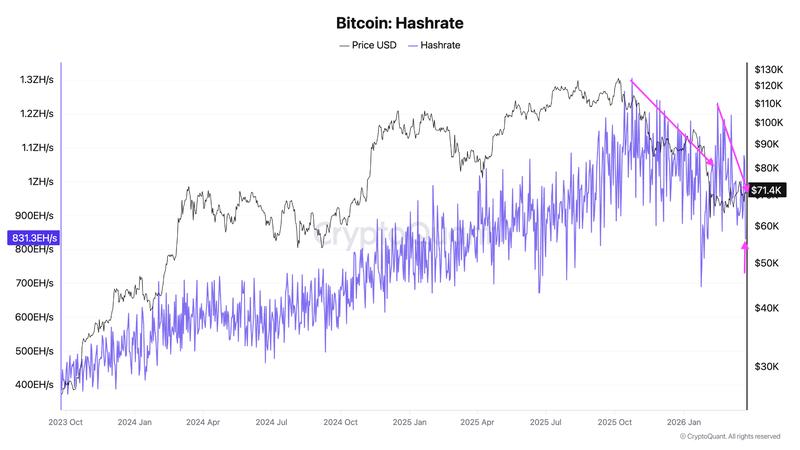
Escalating electricity expenses, intensified by the US and Israel-Iran war, have pushed the hash price down below $34 per PH/s/day, which falls beneath the profitability threshold for numerous mining operations.
"Bitcoin miners are losing $19,000 on every coin they produce, and difficulty just dropped 7.8% as the miner exodus accelerates," analysts at Token Metrics said in a recent post on X, adding:
"If difficulty drops another 5%+ within the next 7 days, miner capitulation is accelerating and spot sell pressure will intensify."