
BTC gains speed in upward trend while $78K ceiling proves stubborn
Despite Bitcoin's accelerating uptrend, nearly half of all holders face unrealized losses, pushing traders toward protective put options. Can this week's momentum sustain?

Key takeaways:
- Onchain and derivatives metrics reveal limited bullish confidence, with 43% of Bitcoin holders continuing to face losses even after the recent price surge.
- Record-breaking AI energy consumption is compressing mining profitability to unprecedented lows, compelling prominent publicly-traded miners to sell BTC and shift toward computing operations.
- A psychological resistance point emerges at $76,000, representing the average acquisition price for major institutional holders such as Strategy.
Bitcoin (BTC) climbed to its highest level in four weeks during Wednesday's trading session, potentially establishing a foundation for a climb back toward the $78,700 monthly closing figure achieved in January. Even with a 22% increase from the $60,000 local low point reached on Feb. 6, multiple onchain indicators and derivatives measurements indicate that bearish traders maintain their confidence.
The appetite for protective measures through Bitcoin options keeps controlling market sentiment.
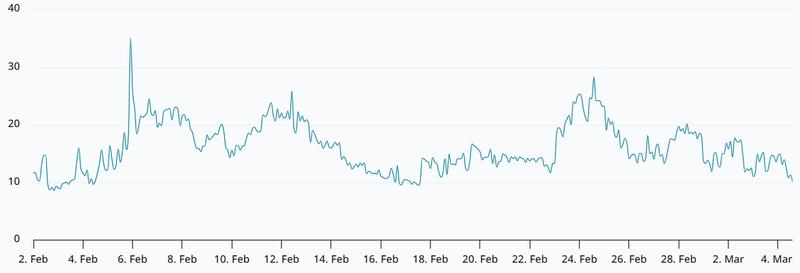
Put (sell) options have recently commanded a 10% premium when compared to equivalent call (buy) instruments. Under neutral market circumstances, this metric generally fluctuates between -6% and 6%, a range last witnessed in mid-January during Bitcoin's trading activity near $95,000.
Sophisticated market participants seem to anticipate additional price declines, whereas enthusiasm for bullish BTC futures contracts remains flat; the annualized premium, commonly known as the basis rate, presently hovers beneath the neutral 5% benchmark.
This softness in Bitcoin derivatives mirrors the month-long price consolidation that followed the 32% plunge throughout the opening week of February. Nevertheless, the absence of strong conviction among bulls even with prices climbing above $73,000 points to a more profound uncertainty. This hesitant sentiment most likely originates from the reality that a considerable percentage of holders continue to experience unrealized losses.
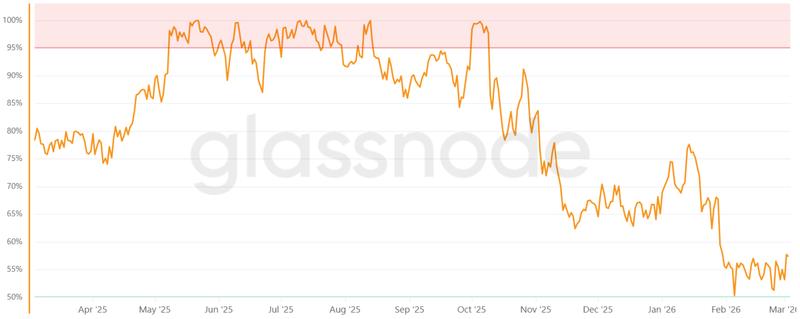
At present, 43% of the supply remains held at a loss when measured by the price at which coins last transferred, based on Glassnode data. This proportion of holders experiencing losses jumped from 30% during Bitcoin's trading near $90,000 in late January. Market participants worry that investors holding these underwater positions will slowly liquidate their stakes as prices climb higher, generating continuous overhead selling pressure that might restrict additional upward movement.
An additional worry emerges from the Bitcoin mining industry, which has encountered substantial challenges stemming from the explosive expansion in artificial intelligence demand. Escalating energy expenses and diminishing demand for the Bitcoin blockchain registry have driven miner profitability toward historic lows. Multiple prominent publicly-listed mining companies have reoriented their operations toward AI computing, selling off their Bitcoin reserves during this transition.
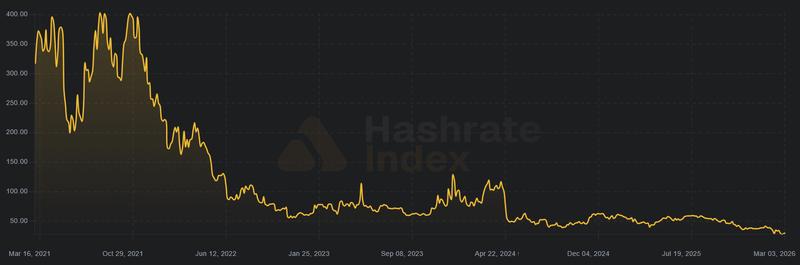
The Bitcoin Hashprice index, representing the projected daily value generated by one terahash per second of hashing power, collapsed to $30 on Tuesday, declining from $39 three months prior. Market participants express concern that miners could transform into net sellers following an extended phase of accumulation.
Mining enterprises that had previously sustained a Bitcoin strategic reserve are currently rumored to be evaluating more lucrative prospects within alternative high-performance computing industries.
Strategy's $76,000 cost basis could be the turning point for Bitcoin momentum
Strategy (MSTR US) continues to stand as the foremost illustration of a Bitcoin-focused balance sheet approach. Following the acquisition of 720,737 BTC since the strategy's initial implementation in August 2020, the corporation encountered heightened examination as Bitcoin fell beneath its average purchase price of roughly $76,000.
Additional publicly-traded organizations, encompassing Metaplanet (3350 JP) and Twenty One Capital (XXI US), have experienced comparable valuation difficulties throughout the ongoing bear market environment.
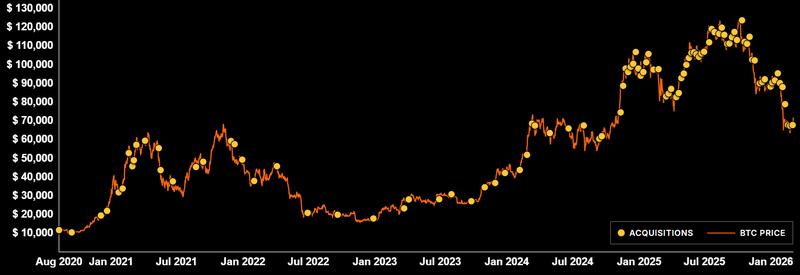
Although Strategy faces neither immediate liquidation threats nor insufficient cash reserves for servicing interest obligations on yield-generating instruments like STRC, bearish traders understand that valuations exceeding the Bitcoin cost basis enable stock issuance without creating dilution for existing shareholders.
In essence, market forces seeking to suppress valuations possess powerful motivations to maintain Bitcoin anchored beneath $76,000. Consequently, a recovery journey toward $78,700 might require more time than anticipated, although bullish momentum could accelerate decisively in favor of buyers once that critical threshold gets surpassed.