
BTC dominates while altcoin metrics sink to compelling depths: Is altseason approaching?
BTC maintains its position as the crypto market leader, with 36% of alternative cryptocurrencies hovering close to all-time lows. Could current altcoin pricing data indicate an imminent altseason?

The recent climb of Bitcoin (BTC) beyond the $71,000 threshold indicates that the price floor has been established, with positive momentum evident throughout the cryptocurrency marketplace. The TOTAL2 metric, representing the combined market capitalization of all digital assets aside from Bitcoin, has maintained its position at the 200-week moving average support level, but does this signal the beginning of an altcoin season?
The growing gap between Bitcoin's upward movement and the subdued performance of alternative coins is starting to capture attention regarding altseason indicators, prompting speculation about whether the wider cryptocurrency market might soon track BTC's trajectory.
TOTAL2 examines critical long-term support beneath $1 trillion threshold
The TOTAL2 market capitalization reached its zenith around $1.7 trillion during October 2025 but presently stands at $970 billion, representing approximately a 43% decline. The downturn intensified throughout January following the market cap's breach of a three-year upward trendline positioned near $1.15 trillion.
Focus from market participants has now turned toward higher-timeframe support zones. Within the weekly timeframe, the TOTAL2 market capitalization hovers near its 200-week moving average around $900 billion, a threshold that provided support during market pullbacks in September 2024 and April 2025.
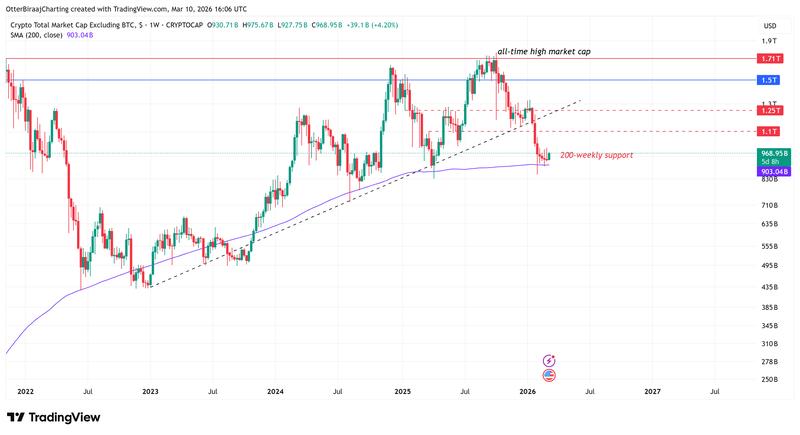
The daily timeframe reveals consolidation below the previous trendline and the resistance zone ranging from $1.1 trillion to $1.25 trillion, an area that historically contained substantial liquidity concentrations.
Altcoin positioning data corresponds with the TOTAL2 decline. Information from CryptoQuant emphasized that 36.8% of alternative cryptocurrencies are currently trading in proximity to their historical lows, not including Bitcoin, Ether (ETH), and stablecoins.
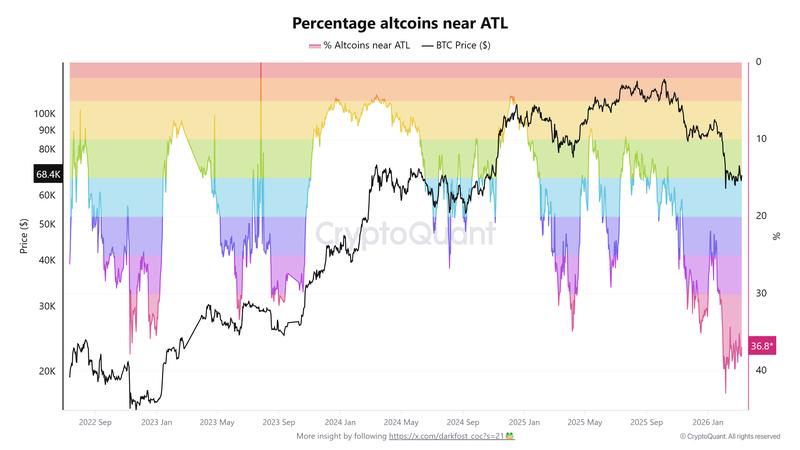
Such elevated percentages typically emerge when capital becomes concentrated within larger digital assets. According to XWIN Research, inflows into spot Bitcoin ETF products combined with the expanding quantity of tokens have heightened liquidity competition across smaller cryptocurrencies throughout the previous year.
Mean altcoin performance approaches cycle bottom territory
Analysis from CryptoQuant demonstrated the extent to which alternative coins have lagged behind Bitcoin. The typical altcoin is positioned 44.4% beneath its 200-day simple moving average (SMA), a depth historically observed near bear market bottoms.
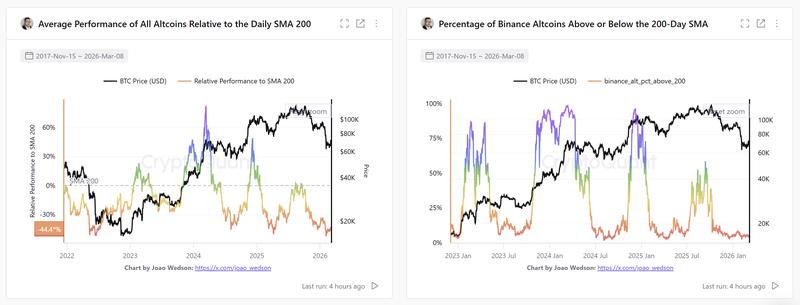
Information from exchanges demonstrates comparable fragility. A mere 4.59% of altcoins listed on Binance are trading above their 200-day SMA, validating a robust Bitcoin-dominated market phase.
Alternative cryptocurrency expansion generally commences with Ether's (ETH) market leadership. The ETH/BTC trading pair has failed to establish an upward trend and remains confined within a descending channel pattern on the weekly timeframe.
An advance beyond 0.036 could represent the initial breach of the channel's local resistance level and indicate improving relative performance for ETH. A more pronounced transition in capital distribution might materialize if the pair recovers 0.043, a threshold that formerly served as resistance prior to the extensive decline throughout 2025.
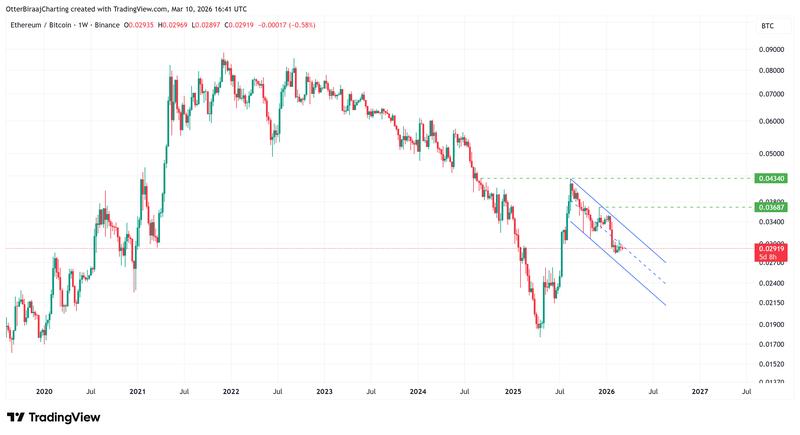
Before these critical levels are recaptured, Bitcoin-driven momentum remains the dominant force within the recuperating cryptocurrency market.
Market commentators are simultaneously questioning whether the upcoming altcoin cycle will mirror previous surges. Matt Hougan, Chief Investment Officer at Bitwise, recently expressed that forthcoming altcoin seasons may not elevate the entire market uniformly, contending that capital will likely flow predominantly toward projects demonstrating superior adoption rates and practical real-world use cases.