
Blockchain-Based Gold Takes Over Weekend Price Formation as Traditional Futures Markets Close
Digital gold tokens including PAXG and XAUt dominate price discovery throughout weekends when traditional CME futures trading halts operations.

The mechanism of gold price discovery transitions to blockchain-based platforms whenever traditional US futures exchanges shut down operations during weekends, as explained by Iggy Ioppe, who previously served as chief investment officer at Credit Suisse and currently holds the position of chief investment officer (CIO) at Theo, a liquidity infrastructure firm.
Trading for CME gold futures comes to a halt at 5:00 pm ET every Friday and doesn't resume until 6:00 pm ET on Sunday evening. Throughout this downtime period, regulated futures exchanges remain dormant, and the majority of any remaining trading happens via private over-the-counter transactions in Asian markets that lack public reporting requirements. Consequently, blockchain-based gold tokens like PAX Gold (PAXG) and Tether Gold (XAUt) emerge as the sole trading platforms offering continuous availability.
"In terms of publicly visible price formation, onchain markets are responsible for virtually 100% of weekend price discovery,"
Ioppe told Cointelegraph
Ioppe further explained that once futures markets restart their operations, pricing frequently reflects the movements that had already taken place across blockchain-based markets. "We are seeing weekend moves reflected when CME reopens," he said.
Tokenized gold market cap jumps to $4.4 billion
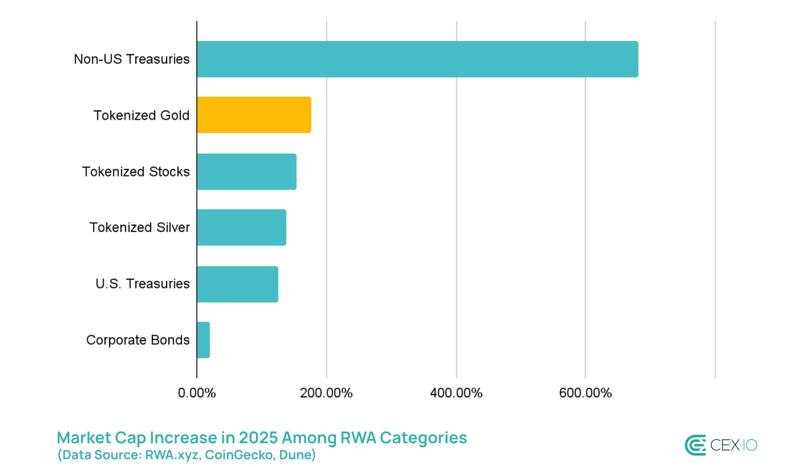
This transformation is occurring against a backdrop of increasing trading volumes for blockchain-based gold products. According to previous Cointelegraph coverage, the tokenized gold sector experienced substantial expansion throughout the previous year, accumulating close to $2.8 billion in additional value while growing from approximately $1.6 billion to reach $4.4 billion in overall market capitalization.
Market capitalization within the sector increased by 177%, significantly surpassing the performance of the wider gold market along with most prominent spot gold ETFs, as the number of token holders nearly tripled through the addition of more than 115,000 new wallet addresses. This expansion accounted for roughly one-quarter of total net inflows directed into the real-world asset (RWA) sector overall and surpassed the combined growth achieved by tokenized stocks, corporate bonds and non-US Treasurys collectively.
Volume in trading activity similarly experienced dramatic growth, as tokenized gold registered approximately $178 billion in total 2025 trading volume while reaching a peak exceeding $126 billion throughout the fourth quarter alone. This trading volume level would position it as the second-largest gold investment product on a global scale by trading volume, trailing only SPDR Gold Shares.
According to Ioppe, market makers along with cross-venue liquidity providers represent the dominant participants, engaging in arbitrage of price discrepancies between digital platforms and traditional markets. Traders with crypto-native macro strategies also constitute a significant participant group, utilizing tokenized gold not merely for gaining exposure to bullion pricing but additionally for purposes of collateral, hedging and implementing yield strategies throughout periods marked by geopolitical tensions or macroeconomic uncertainty.
"Some institutions are monitoring weekend onchain gold markets, particularly macro and cross-asset desks that track gap risk ahead of the CME reopen,"
He observed that the majority of institutional participants regard the signal as having informational value rather than serving as a foundation for active position-taking.
24/7 tokenized gold trading lets investors manage risk
Markets for tokenized gold enable round-the-clock trading activity, which provides a meaningful advantage for risk management purposes. Should a geopolitical event unfold during hours when futures markets remain closed, participants in traditional markets lack the ability to modify their positions. Tokenized markets facilitate immediate portfolio rebalancing.
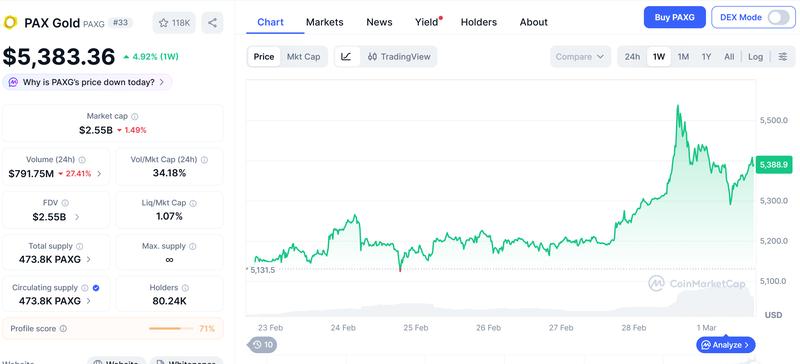
This past Saturday, tokenized gold experienced a rally as geopolitical tensions intensified in the wake of US and Israeli strikes on Iran, with market participants shifting capital into XAUT and PAXG while Bitcoin (BTC) and Ether (ETH) declined in value. XAUT momentarily rose above $5,450 while PAXG approached $5,536 throughout the trading day before subsequently reducing those gains, based on data provided by CoinMarketCap.
Nevertheless, Ioppe indicated that mainstream adoption continues to encounter various obstacles. Available liquidity remains more limited compared to futures markets or exchange-traded funds (ETFs), which makes executing large-scale trades more difficult without causing price impact. "Regulatory clarity is improving, but fragmentation across jurisdictions slows institutional deployment. Custody, accounting, and capital rules still vary widely," he said.
For the time being, tokenized gold is anticipated to function alongside traditional investment products rather than serving as a replacement for them. "The most likely near-term evolution is that of tokenized and traditional markets existing in parallel, each serving a different function," Ioppe concluded.