
Bithumb recovers 99.7% of erroneously distributed Bitcoin, compensates remaining gap
The South Korean exchange successfully retrieved the majority of incorrectly credited BTC following a promotional system glitch and compensated 1,788 Bitcoin using corporate reserves that users had already liquidated.

Bithumb, a leading South Korean digital asset exchange, has announced it successfully addressed a technical malfunction that resulted in improper Bitcoin allocations to select user wallets during a promotional campaign.
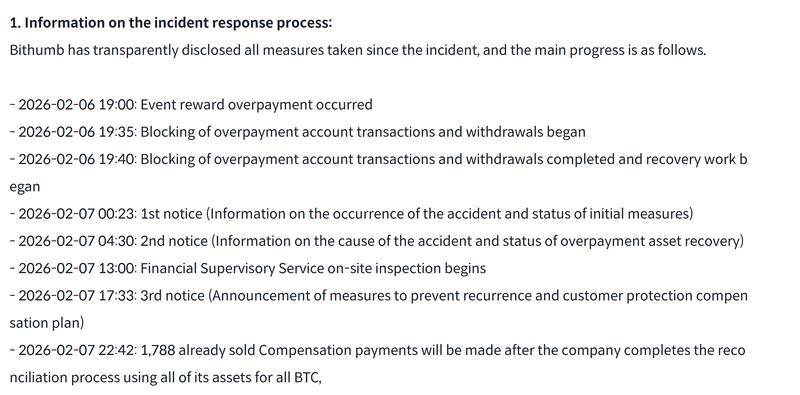
The exchange issued a statement on Sunday revealing it had successfully reclaimed 99.7% of the incorrectly distributed Bitcoin (BTC) within the same day the technical error took place. For the outstanding 0.3%, amounting to 1,788 Bitcoin that users had already liquidated on the market, the company utilized its own corporate treasury to ensure all customer account balances were completely reconciled.
Bithumb's holdings of all virtual assets, including Bitcoin (BTC), are 100% equivalent to or exceeding user deposits
Bithumb explained that the bulk of the incorrectly allocated Bitcoin was directly recovered from user wallets, whereas the segment that had already been traded in the marketplace necessitated compensation through the company's own financial reserves.
Bithumb rolls out compensation plan
Additionally, the trading platform unveiled a series of remediation initiatives. Account holders who were actively logged into the exchange when the malfunction happened will each be credited with 20,000 Korean won ($15). Market participants who liquidated Bitcoin positions at disadvantageous rates throughout the service disruption will be granted complete restitution of their transaction values along with an extra 10% compensation payment. Furthermore, the exchange will eliminate all trading fees across every market for a seven-day period commencing Monday.
The technical malfunction originated on Friday when a system error occurring during a marketing promotion incorrectly allocated an abnormally substantial quantity of Bitcoin to certain account holders, momentarily triggering volatile price fluctuations on the platform as beneficiaries commenced liquidating the digital assets. Bithumb promptly implemented restrictions on the impacted user accounts and restored market stability within a matter of minutes, successfully averting more extensive forced liquidations.
The trading platform clarified that the occurrence had no connection to any cybersecurity breach and emphasized that zero client funds were compromised, with deposit and withdrawal operations continuing without interruption throughout. Although Bithumb refrained from publishing the precise total sum affected, certain platform users asserted that approximately 2,000 BTC had been incorrectly allocated to accounts.
Centralized crypto exchanges face operational issues
Centralized digital currency trading platforms have persistently experienced various operational challenges. Back in June, Coinbase acknowledged that account restriction policies had represented a significant challenge and announced it had achieved an 82% reduction in unwarranted account freezes following enhancements to its machine-learning algorithms and backend infrastructure, addressing prolonged user grievances about being denied access to their accounts for extended periods despite no confirmed security compromises.
Comparable issues surfaced throughout the Oct. 10 market downturn, during which Binance account holders documented technical malfunctions that obstructed certain market participants from liquidating positions amid heightened market volatility. Despite the platform's assertion that its primary trading infrastructure maintained full operational capacity and its attribution of the majority of forced liquidations to prevailing market dynamics, the exchange subsequently allocated approximately $728 million in remediation payments to impacted traders.