
Bitcoin Miners Pivot Toward AI and HPC Infrastructure as MARA Reconsiders Holding Strategy
A Monday filing with the SEC revealed that the American Bitcoin mining firm is now willing to liquidate portions of its cryptocurrency reserves based on prevailing market dynamics.
MARA Holdings, a cryptocurrency mining operation based in the United States, created significant attention following a regulatory disclosure that suggested the firm might be reconsidering its long-standing Bitcoin accumulation approach.
Through a filing submitted Monday to the US Securities and Exchange Commission (SEC), MARA indicated its willingness to divest portions of its Bitcoin (BTC) reserves on an occasional basis, contingent upon prevailing market dynamics and the company's strategic investment objectives. The mining firm explained that it modified its approach to permit BTC liquidations in 2026, whereas the sale of Bitcoin generated through the company's mining operations has been authorized since 2025.
The strategic adjustment by MARA occurs at a time when numerous cryptocurrency mining enterprises are redirecting portions of their computational resources toward artificial intelligence (AI) and high-performance computing (HPC) operations, driven by escalating BTC mining difficulty levels and the accompanying operational expenses. Riot disclosed on Monday that it experienced a net deficit of $663 million throughout 2025, partially attributed to the valuation of its Bitcoin portfolio, whereas Core Scientific announced that its revenue for Q4 2025 declined by 16% compared to the corresponding period in the previous year.
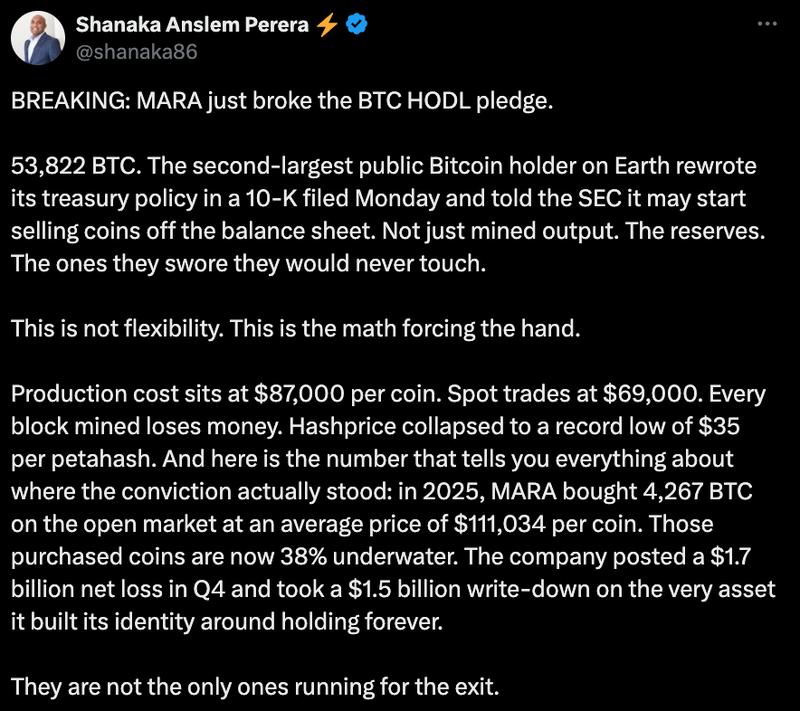
"This is not flexibility," stated analyst Shanaka Anslem Perera in a Tuesday post on X regarding MARA's SEC disclosure. "This is the math forcing the hand. Production cost sits at $87,000 per coin. Spot trades at $69,000. Every block mined loses money. Hashprice collapsed to a record low of $35 per petahash."
He added:
"The entities that mine Bitcoin no longer want to hold it. The entity that holds the most Bitcoin [Michael Saylor's Strategy] has never mined a single satoshi. Production and accumulation have fully decoupled for the first time in this asset's sixteen-year history."
Last month, MARA revealed that it had purchased a 64% ownership position in computing infrastructure operator Exaion, as part of an effort to bolster its competitive standing in the HPC and AI sectors. In a similar vein, Terawulf, a digital infrastructure enterprise, disclosed the previous week that it anticipates continued expansion throughout 2026 driven by contracts related to AI and HPC services.
As of the time this article was published, BTC was changing hands at $67,717, representing a decline of more than 13% over the preceding 30-day period. MARA disclosed that it maintained 53,822 BTC in its holdings as of Dec. 31, valued at approximately $4.7 billion at that time. Based on the current market valuation, that portfolio amounts to $3.64 billion.
How the US-Iran conflict is affecting Bitcoin
Military operations conducted by the United States and Israel targeting Iran over the weekend triggered apprehensions regarding petroleum supply chains and inflationary pressures. Bitcoin's price struggled to maintain levels above $70,000 on Tuesday, while traditional safe-haven assets such as gold also displayed volatility amid fears of an extended military confrontation.