
Bitcoin Could Rally if Federal Reserve Backs Japanese Bonds, Says Arthur Hayes
According to BitMEX founder Arthur Hayes, the declining yen coupled with increasing yields on Japanese government bonds may prompt Japanese investors to liquidate their US Treasury holdings.

The cryptocurrency Bitcoin may emerge from its current stagnant trading pattern if the central bank of the United States intervenes to support Japan's struggling bond market through monetary expansion, according to Arthur Hayes, the founder of BitMEX.
On Wednesday, Hayes put forward a hypothesis regarding how the Federal Reserve "could be printing money to manipulate the yen and JGB [Japanese government bond] markets."
The nation of Japan is confronting a double-edged crisis: the yen is experiencing depreciation at the same time that yields on Japanese government bonds are climbing, indicating a possible erosion of confidence in the market. The situation also has ramifications for the United States, as Japanese investors could potentially liquidate their holdings of US treasuries in favor of purchasing JGBs that offer higher yields.
"Will a meltdown of the yen and JGB markets cause some sort of money printing by the BOJ [Bank of Japan] or the Fed? The answer is yes," said Hayes.
"This discussion of Japanese financial markets is important because for Bitcoin to exit its sideways funk, it needs a healthy dose of money printing."
Fed's intervention mechanism could be a liquidity trigger
According to Hayes' analysis, the Fed will step in by establishing dollar reserves through financial institutions such as JPMorgan, exchanging dollars for yen — a move that bolsters the yen's value — and subsequently deploying yen to acquire JGBs, thereby pushing Japanese bond yields downward.
He explained that this process results in the expansion of the Fed's balance sheet under the category "Foreign Currency Denominated Assets."
"This Fed intervention is just what the filthy fiat system needs to limp along a little longer."
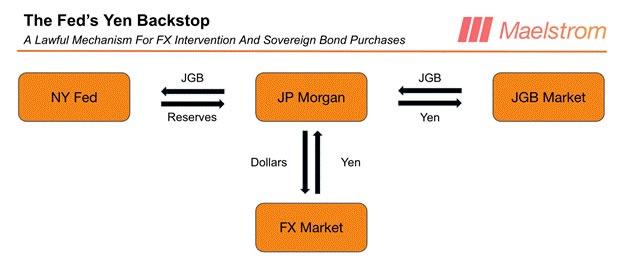
Hayes seems to be backing his hypothesis with financial commitment and is anticipating action from the central bank's monetary expansion apparatus, closely monitoring the Fed's balance sheet through its weekly H.4.1 report releases.
"Bitcoin fell as the yen strengthened against the dollar. I will not increase risk before I confirm the Fed is printing money to intervene in the yen and JGB markets," he said.
Dollar "doing great" at four-year low
On Tuesday, the US dollar index (DXY) dropped to 95.6, representing its weakest position since January 2022, according to data from TradingView.
While the greenback has experienced a 10% decline throughout the previous year, US President Donald Trump nevertheless asserted it was "doing great" during a speech he delivered in Iowa on Tuesday.
"I mean, the value of the dollar, look at the business we're doing. No, the dollar is doing great. You know it's very interesting, if you look at China or Japan, I used to fight like hell with them because they always wanted to devalue their yen ... you know that, the yen and yuan, and they'd always want to devalue it," he said, according to CNBC.
"They devalue, devalue, devalue. And I said, 'not fair.' They devalue, because it's hard to compete when they devalue."