
Bitcoin could attract capital flows if UBS bearish outlook on US equities materializes
Though Bitcoin shows short-term price correlation with equities, it stands out as a prime destination for capital reallocation should stock market gains plateau amid rising institutional acceptance.

Key takeaways:
- Analysts downgraded US stocks due to high valuations, a weak dollar, and policy risks despite AI-driven earnings growth.
- Limited S&P 500 upside may shift capital toward Bitcoin, especially if major sovereign funds announce BTC reserves.
The price of Bitcoin (BTC) dropped beneath the $65,500 threshold on Friday, wiping out the advances made earlier in the week on Wednesday. The downturn mirrored intraday price action in the S&P 500 following the release of US wholesale inflation figures that sparked heightened risk-off sentiment among investors. An investment bank report from UBS that downgraded American equities to a neutral stance probably contributed to the accelerated movement toward safe-haven fixed-income securities.
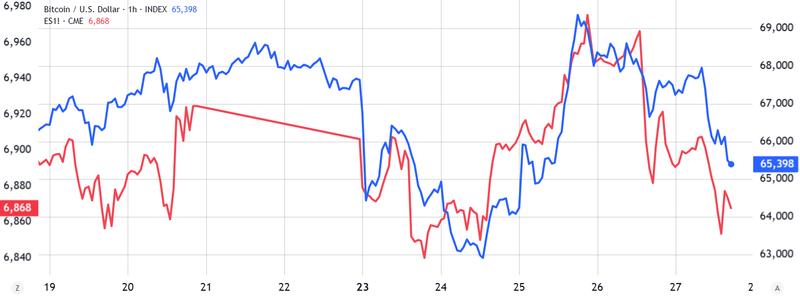
Market participants harbor concerns that a catastrophic scenario for American stock markets might push Bitcoin toward fresh yearly lows. Though heightened expenditures on artificial intelligence infrastructure continue to worry certain investors, the long-term path for Bitcoin is not expected to stay tethered to the tech sector indefinitely.
Growing institutional Bitcoin acceptance may enhance market confidence
The UBS global equity strategy team's assessment suggests that US equity market valuations no longer present compelling opportunities when compared to alternative global markets. The analysts highlighted growing threats stemming from dollar weakness and uncertainty surrounding US policy decisions, factors that generate asymmetric downside vulnerabilities. Additionally, share repurchase programs from corporations seem to be diminishing in their capacity to support stock prices.
The significance of the $70 trillion market capitalization represented by US equities shouldn't be exaggerated, even though it influences price patterns in ostensibly uncorrelated assets such as Bitcoin. Nevertheless, the UBS analysis falls short of painting an apocalyptic picture, particularly given that their projected year-end target for the S&P 500 stands at 7,500.
A portion of the recent slide to $65,500 can be attributed to Friday's US Producer Price Index data showing a 0.5% increase in January 2026 compared to the preceding month. Whenever inflation indicators exceed expectations, market participants typically grow more skeptical about the likelihood of interest rate reductions from the US Federal Reserve. Tight monetary policy exerts negative pressure on economic activity since borrowing costs remain elevated and businesses face reduced motivation to scale up operations.
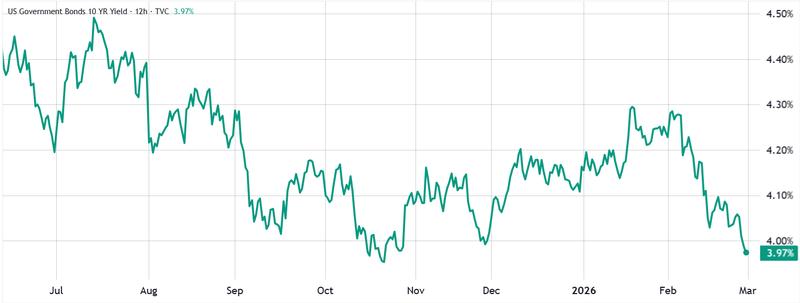
Treasury yields in the United States function as an indicator of how investors gauge risk. When uncertainty prevails, market participants gravitate toward government debt instruments, irrespective of prevailing inflationary conditions. The notable drop in the US 10-year Treasury yield to 3.97% from 4.21% merely three weeks earlier indicates a movement toward defensive positioning. This development carries particular significance given that the S&P 500 displayed weakness despite companies reporting better-than-anticipated earnings results.
According to the UBS global equity strategy report, American stocks are currently valued at 35% higher than their international counterparts, compared to a historical average premium of 4% recorded since 2010. The analysts referenced increased uncertainty introduced by US policy initiatives including proposals to impose caps on credit card interest rates, introduce further import tariffs, and potentially restrict private equity participation in the housing sector. That said, the bank anticipates that AI integration throughout the US economy will continue supporting revenue growth across critical industries, according to CNBC.
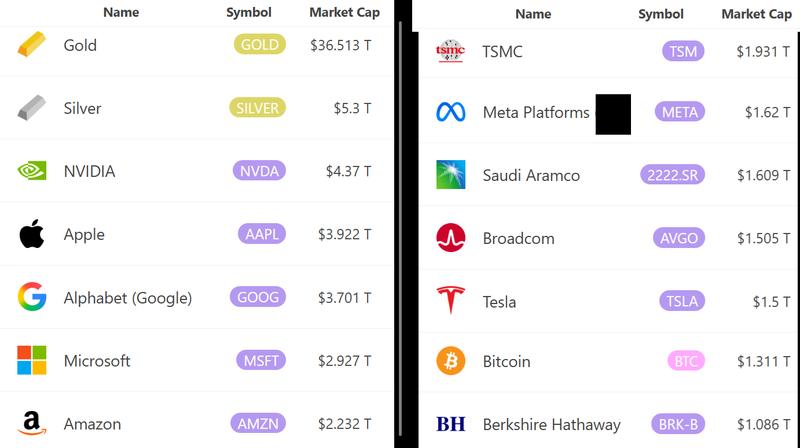
Should the S&P 500 demonstrate constrained upward potential, Bitcoin stands positioned to gain from potential capital reallocation given that gold, the preeminent store of value asset, has already climbed to a $36.5 trillion market capitalization. For context, the ten largest technology corporations possess a collective market capitalization totaling $24.2 trillion. Even assuming Bitcoin price advances by 52% to reach $100,000, its market capitalization would amount to $2 trillion. Consequently, unless bond markets or property sectors capture the prospective capital flows, Bitcoin emerges as a legitimate contender.
Market sentiment surrounding Bitcoin may turn increasingly positive once additional major corporations or national sovereign wealth funds declare strategic BTC holdings, regardless of whether such positions are established via exchange-traded fund (ETF) vehicles. While predicting the timing of such announcements remains impossible, historical precedent demonstrates how trader risk appetite can improve dramatically when a corporation like Tesla (TSLA US) disclosed a significant Bitcoin allocation. However, in the interim, the probability of an onchain separation from US equity markets continues to be minimal.