
Bank of England Enlists Private Sector Partners for Distributed Ledger Settlement Testing Program
A half-year experimental program from the UK's central banking authority unites financial infrastructure operators, traditional lenders and blockchain-focused enterprises to evaluate onchain transition potential for Britain's key financial markets.

The Bank of England has introduced a fresh experimental program for industry participants aimed at investigating the settlement of tokenized assets through synchronized, atomic settlement mechanisms denominated in British pounds sterling, representing part of broader efforts to upgrade the United Kingdom's real-time gross settlement (RTGS) infrastructure for the modern era.
Known as the Synchronisation Lab initiative, the program will enable 18 carefully chosen organizations to experiment with delivery-versus-payment alongside payment-versus-payment settlement mechanisms linking the BoE's next-generation RTGS core ledger, designated as RT2, with external distributed-ledger platforms, conducted within a testing environment that does not involve actual currency, as outlined in an official bank announcement.
Spanning six months and set to commence during spring 2026, the pilot program aims to confirm the central bank's architectural decisions regarding synchronized settlement mechanisms, evaluate compatibility between central bank-issued money and tokenized asset classes, and guide the creation of a potentially operational RTGS synchronization functionality for future deployment.
First unveiled in October, the experimental program assembles 18 participating organizations, encompassing market infrastructure operators, traditional banking institutions, financial technology firms and decentralized-technology enterprises to evaluate practical applications ranging from settlement of tokenized securities, optimization of collateral management, foreign currency exchange and the creation of digital-money instruments.
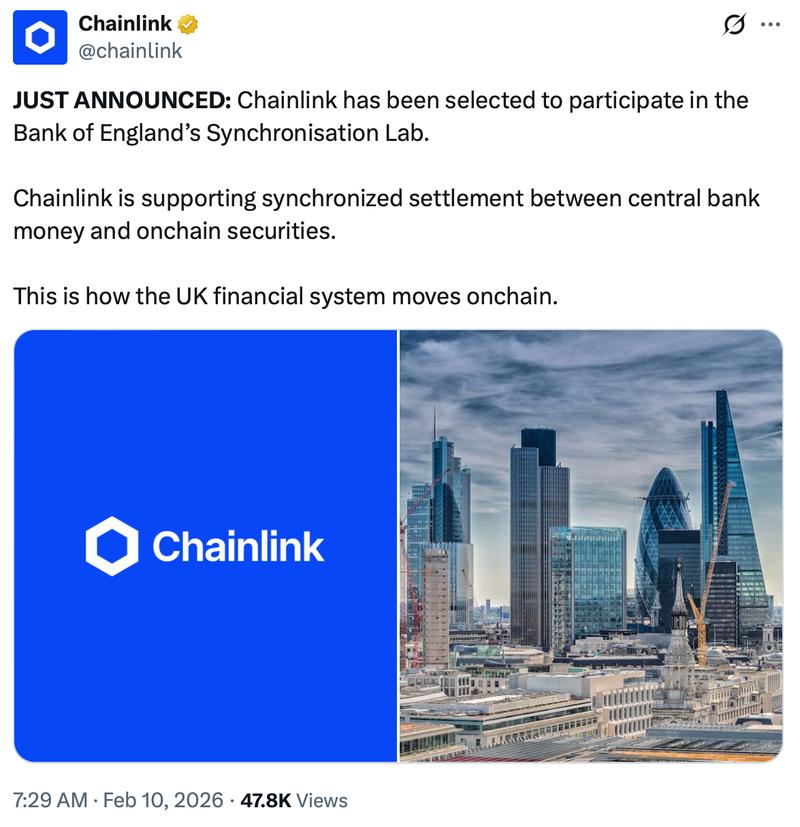
Within the Web3 participant cohort, Chainlink alongside UAC Labs will evaluate decentralized methodologies for orchestrating synchronized settlement operations between central bank-issued currency and assets created on distributed-ledger platforms. Enterprises like Ctrl Alt and Monee will concentrate on delivery-versus-payment settlement mechanisms for tokenized gilts and additional securities instruments.
Additional participants, such as Tokenovate and Atumly, will evaluate conditional margin payment processes and digital-money creation and redemption mechanisms engineered to synchronize with RTGS settlement operations. The participant list also features Swift and LSEG among its members.
According to the bank's statement, the findings from the lab initiative will serve to enhance the architectural design of its RTGS synchronization functionality and facilitate additional development activities, with participating organizations anticipated to showcase their practical applications and research outcomes after the program reaches its conclusion.
Global central banks expand pilots
The Bank of England represents merely one member of an expanding group of central banking authorities investigating how tokenization technologies, programmable settlement mechanisms and digital currency innovations might transform their fundamental monetary and payment infrastructure systems.
During May, the Federal Reserve Bank of New York in collaboration with the Bank for International Settlements released research findings from Project Pine that examined how smart contract technology could facilitate monetary policy implementation within tokenized financial ecosystems, including a prototype toolkit designed for accelerated and more adaptable central bank interventions on programmable ledger systems.
In October, the Monetary Authority of Singapore unveiled BLOOM, a strategic initiative designed to broaden settlement infrastructure capabilities to accommodate transactions conducted in tokenized bank liabilities alongside regulated stablecoin instruments.
Extending beyond tokenization experimental programs concentrated on settlement operations and market infrastructure, central banking authorities have additionally been conducting trials with central bank digital currencies (CBDCs).
Within Australia, the central banking institution initiated a wholesale digital currency experimental program in July utilizing stablecoins, tokenized bank deposit instruments and a pilot CBDC system.
This development was subsequently followed by the United Arab Emirates successfully completing its inaugural government payment transaction with a digital dirham during November, and the China-led mBridge platform reporting in January that it had facilitated $55 billion in cross-border CBDC transaction volume spanning multiple participating jurisdictions.