
Balance Sheet Turmoil Emerges as Bitcoin and Ether Face Major Downturn
The cryptocurrency market decline is creating widespread effects across corporate treasuries, exchange-traded funds and mining operations, revealing the extensive impact of digital currency price swings on financial statements and business activities.
The recent cryptocurrency market downturn extends beyond mere price movements. Its impact is manifesting across corporate financial statements, within spot exchange-traded funds (ETFs), and throughout the operational frameworks that support the industry during periods of market turbulence.
During this week's market action, the decline in Ether's (ETH) value has resulted in significant unrealized losses for companies maintaining substantial treasury positions, while exchange-traded funds focused on Bitcoin (BTC) are providing a fresh cohort of market participants with their initial experience of significant downside price movement.
Simultaneously, severe weather conditions have served as a stark reminder to mining operations that computational power output remains fundamentally dependent on electrical grid infrastructure, and a company that transitioned away from cryptocurrency mining toward artificial intelligence demonstrates how mining equipment from previous cycles has seamlessly evolved into critical infrastructure supporting today's AI operations.
BitMine's ETH paper losses widen
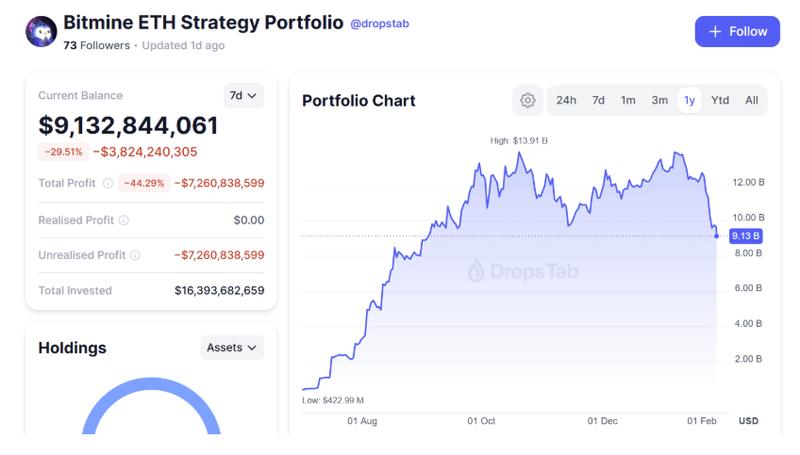
BitMine Immersion Technologies, with Tom Lee serving as chairman, is confronting escalating unrealized losses across its Ether-focused treasury holdings as ETH dropped beneath the $2,200 threshold amid the most recent cryptocurrency market selloff.
The price deterioration has driven the firm's paper losses beyond the $7 billion mark, illustrating the substantial risks associated with maintaining balance sheets concentrated in highly volatile digital currencies.
BitMine's current holdings stand at approximately $9.1 billion in Ether value, which includes a fresh acquisition of 40,302 ETH, creating significant vulnerability to additional downward price movements.
Though these losses remain unrealized pending actual asset liquidation, they underscore the precarious nature of cryptocurrency treasury approaches during bearish market conditions. Lee has responded to critics by defending the position, maintaining that paper losses are an inherent characteristic of companies holding ETH. "BitMine is designed to track the price of ETH," he explained, noting that ETH weakness should be anticipated during market downturns.
BlackRock Bitcoin ETF holders slip underwater
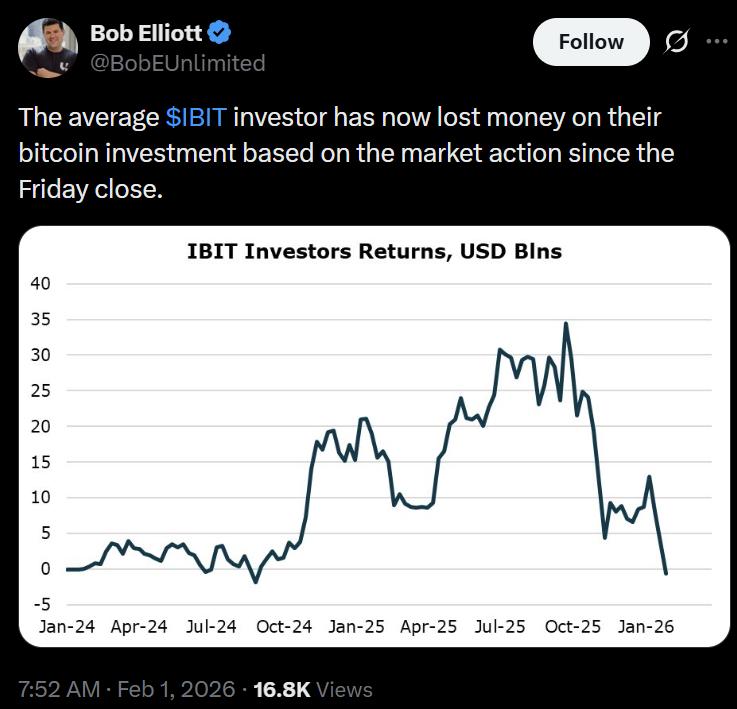
Following Bitcoin's descent beneath the $80,000 level, the collective returns experienced by participants in BlackRock's iShares Bitcoin Trust (IBIT) have moved into negative territory, demonstrating the severity of the current market decline and its consequences for investment portfolios.
Based on analysis from Unlimited Funds chief investment officer Bob Elliott, the typical dollar allocated to IBIT has now fallen below its entry point. Bitcoin's price action has subsequently extended its downward trajectory below $75,000, compounding the negative impact on investor returns.
IBIT represented one of BlackRock's most impressive ETF product introductions, achieving the distinction of being the asset management firm's quickest fund to accumulate $70 billion in managed assets. These same investors are now receiving a practical education in Bitcoin's characteristic volatility, particularly during periods when price momentum shifts decidedly toward the downside.
US winter storm slams Bitcoin production
An intense winter storm system that moved through the United States during late January compelled Bitcoin mining operations to dramatically reduce their production activities, emphasizing the degree to which mining operations remain vulnerable to electrical grid constraints during periods of severe weather.
Fresh analytics from CryptoQuant reveal that daily Bitcoin production from publicly traded mining companies averaged approximately 70 to 90 BTC prior to the storm's arrival, before collapsing to merely 30 to 40 BTC during the peak intensity of the weather disruption. The reduction occurred rapidly, illustrating extensive facility closures as mining operators decreased their electrical consumption or ceased operations entirely to prevent additional burden on regional power infrastructure.
The production decline proved short-lived in duration. Following improvements in weather patterns, mining output started rebounding, demonstrating the operational adaptability that miners maintain while simultaneously exposing the instability inherent in grid-reliant business models.
The analytics provided by CryptoQuant monitor publicly traded mining entities, encompassing CleanSpark, MARA Holdings, Bitfarms and Iris Energy, providing insight into how major United States-based mining enterprises react during periods when electrical power availability becomes constrained.

CoreWeave shows how crypto infrastructure became AI's data center backbone
CoreWeave's transformation from cryptocurrency mining operation to artificial intelligence infrastructure supplier represents a compelling illustration of how equipment originally deployed for mining is being redirected to support the AI industry expansion, demonstrating how computational infrastructure shifts between technological innovation waves.
As reported by The Miner Mag, Ethereum's transition away from proof-of-work toward proof-of-stake mechanisms dramatically diminished the market need for GPU-powered mining capabilities, prompting CoreWeave alongside comparable operators to reorient their business models toward artificial intelligence and high-performance computational services.
Although CoreWeave has exited the cryptocurrency sector entirely, its strategic transformation has established a framework that other mining companies are examining as they consider diversification strategies, with examples including HIVE Digital, Hut 8 and MARA Holdings.
CoreWeave's strategic repositioning received additional validation following Nvidia's commitment to a $2 billion equity stake in the enterprise, strengthening the notion that infrastructure originally constructed for cryptocurrency mining operations now constitutes an essential component of the data center foundation supporting artificial intelligence development.
Crypto Biz is your weekly pulse on the business behind blockchain and crypto, delivered directly to your inbox every Thursday.